Why You Cannot Cut Losses in Forex: The Psychology and How to Fix It With Rules
Are you sitting on a floating loss, unable to press the button to cut it?
In short, the cause is not only weak willpower but also psychological bias and a lack of design, and a system can reduce it.
This article covers the causes, a calculation of how losses grow, and how to place a stop-loss at the same time as your entry.
Key takeaways
- The causes split into the pain of loss, hope for a rebound, entering without a basis and lots that are too large.
- On a $10,000 balance with 0.5 lot, a −40 pip loss is 200 USD, and holding to −200 pips makes it 1,000 USD.
- Placing a stop-loss at entry and working out lots from the stop distance reduces moments of hesitation.
In short: it is a psychological bias, and a system can reduce it
- The pain of a loss tends to feel bigger than the joy of an equal gain
- The hope that "it will come back" delays the decision to cut
- The longer you delay, the more profit you need to recover
- Placing a stop-loss at entry and working out lots from it reduces moments of hesitation
5 reasons you cannot cut losses: psychology and design
Behind failing to cut losses are both quirks of human psychology and a lack of design in the trade. If you separate the causes, it is easier to pick a fix.
| Cause | What it means | What tends to happen |
|---|---|---|
| The pain of loss is bigger | The pain of a loss feels bigger than the joy of an equal gain | You do not want to lock in a floating loss |
| Not wanting to admit a loss | Cutting a loss feels like admitting your judgment was wrong | You cannot press the close button |
| Hope that it will come back | Thinking relative to your entry price (anchoring) and not wanting past losses to be wasted (sunk cost) | You keep waiting for the price to return to your entry |
| Entering without a basis | If you enter on a hunch, there is no condition for exiting | You cannot decide on an exit |
| Lots are too large | The loss is too big relative to your funds to bear | You freeze out of fear |
In an idea called prospect theory, the pain of a loss is said to feel bigger than the joy of an equal gain. It is often said to be about twice as big, but that is only a rough guide and varies by person.
Note that psychology is not the only cause. Entering without a basis or using lots that are too large cannot be fixed by mental tricks alone.
How far can losses grow if you delay cutting?
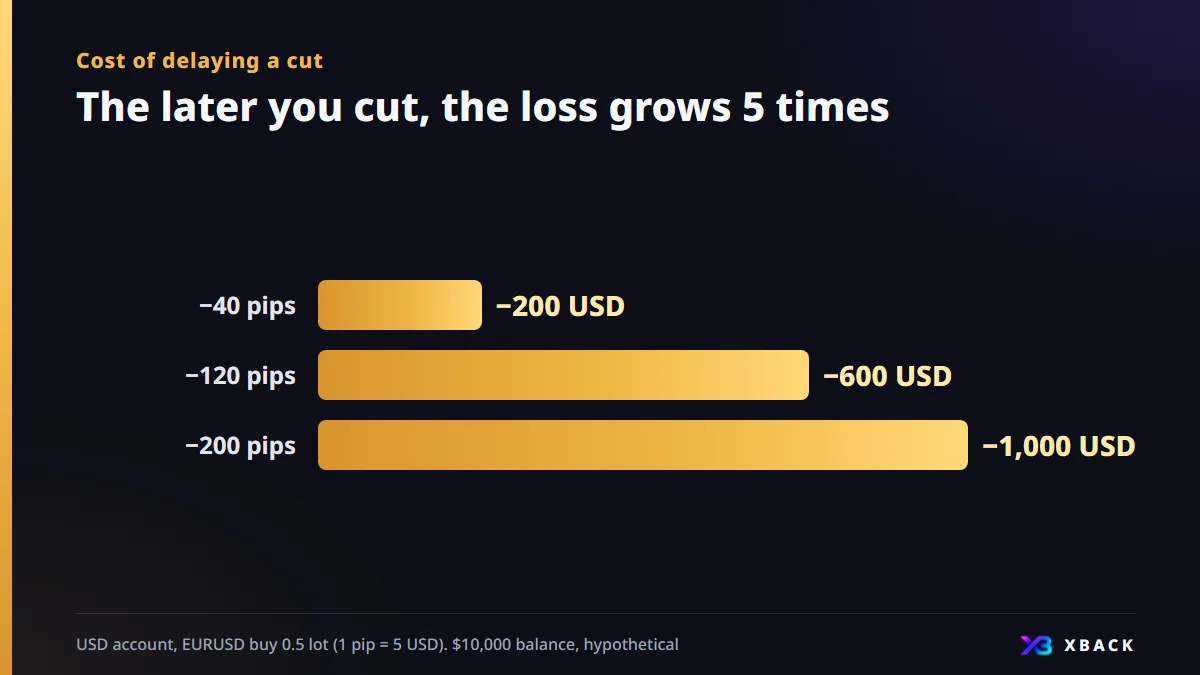
A USD account example. With a balance of $10,000, you buy 0.5 lot of EURUSD. For 0.5 lot, 1 pip = 5 USD.
| Where you cut | Calculation | Loss | Share of balance |
|---|---|---|---|
| Planned −40 pips | 40 × 5 USD | −200 USD | 2% |
| Held on to −120 pips | 120 × 5 USD | −600 USD | 6% |
| Further to −200 pips | 200 × 5 USD | −1,000 USD | 10% |
If you cut at the planned −40 pips, the loss is $200, or 2% of your balance. Hold to −200 pips and it becomes $1,000, so on the same trade the loss is 5 times larger.
As losses grow you lose your composure, and it becomes even harder to close. To avoid this cycle, fix your exit before your feelings start to swing.
The return needed to recover a loss
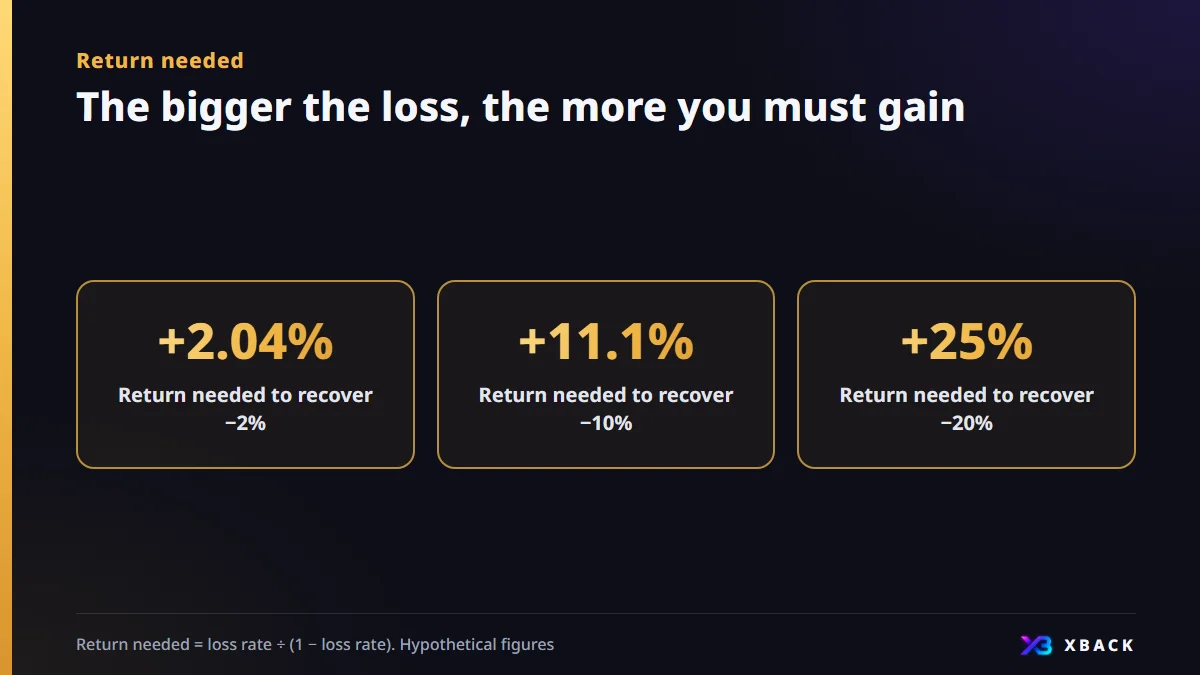
The bigger the loss, the larger the gain needed to get back to your original balance compared with the loss rate. The formula is loss rate ÷ (1 − loss rate).
| Loss rate | Return needed | Calculation |
|---|---|---|
| −2% | +2.04% | 2 ÷ 98 |
| −10% | +11.1% | 10 ÷ 90 |
| −20% | +25% | 20 ÷ 80 |
In the −200 pips example above, the loss is 10% of your balance. To bring the remaining $9,000 back to $10,000, you need a gain of about 11.1%.
More detailed tables by loss rate and the time needed to recover are in a related column. For now, just remember that delaying a cut makes the burden heavier.
5 steps to solve it with a system
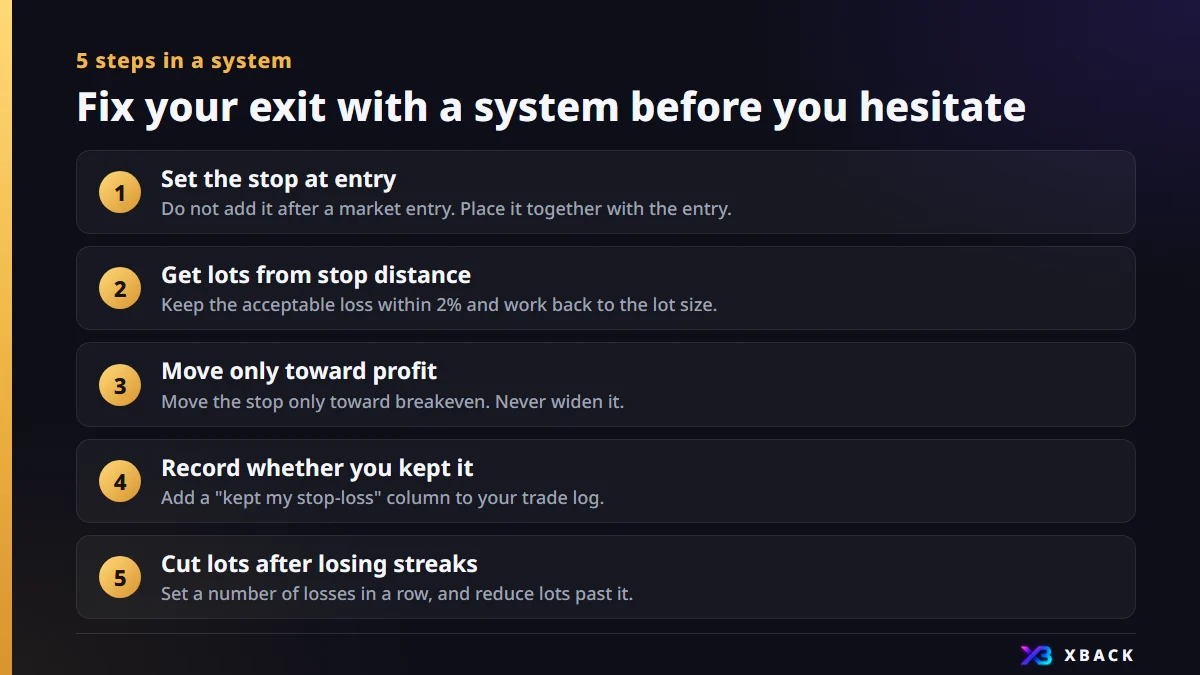
Do not leave cutting losses to your feelings. Build it into your trading rules and procedure. Follow these 5 steps on every entry.
- 1
Set the stop at entry
Do not add it after a market entry. Place it together with the entry.
- 2
Get lots from stop distance
Keep the acceptable loss within 2% and work back to the lot size.
- 3
Move only toward profit
Move the stop only toward breakeven. Never widen it. Write that down.
- 4
Record whether you kept it
Add a "kept my stop-loss" column to your trade log.
- 5
Cut lots after losing streaks
Set a number of losses in a row, and reduce lots past it.
An example of working back to lots. If the acceptable loss is 2%, or $200, and the stop distance is 40 pips, then 200 ÷ 40 = 5 USD. That is 0.5 lot, where 1 pip = 5 USD.
Write your rules as short sentences at the top of your trade log. For example, like these.
- Do not enter when the stop-loss price is not decided
- Do not move a stop-loss further away
- Keep the loss on one trade within 2% of your balance
Make the decision to close while you are calm, before any loss appears. That is the main aim of solving this with a system.
If you keep getting stopped out, review your distance and basis
When stop-losses keep happening, you may feel stopped out too often and want to stop using them. But the cause of many stop-outs is not the stop-loss itself.
- Is your stop distance too narrow compared with the market's normal swings?
- Is your basis for entry vague, so you are not picking your spots?
- Is your take-profit distance small, leaving profit and loss out of balance?
How to place a stop-loss distance is covered in more detail in a related column. Before you remove a stop-loss, first check your distance and basis.
If the fear remains, lower your lots and practice
If the fear comes from the size of the loss, lowering lots is the most direct fix. When you feel calmer, the rules are easier to keep.
- Halve your current lots so the loss amount is within what you can bear
- Practice holding to the stop-loss at the minimum lot size
- Write your stop-loss price in a note before you enter
- Take a break after a stop-out to settle your mind
Hedging with opposite positions does not replace cutting losses
Hedging by opening an opposite position while holding a floating loss only fixes the loss for a while. The decision to close has just been put off.
- Costs such as the spread are paid twice
- You need to make a new decision about which side to close first
- Some brokers restrict hedging in their terms
Cutting losses and cashback
Many cashback schemes are calculated on trading volume. It is not meant to make up for losses.
- The cashback amount is not yet confirmed and will be posted on each broker page at launch
- Do not count on it as income to cover losses
- Do not delay cutting a loss or trade more often for the sake of cashback
Enter your balance and stop distance to check the lot size that keeps you within your acceptable loss. Fix your exit in numbers before you enter.
Calculate lot sizeFAQ
Q.Why can't I cut losses in forex?
The main causes are a psychological bias that makes losses hurt more, the hope that the price will come back, entering without a basis for a stop-loss, and lots that are too large. It is not only a matter of feelings, as problems in the design of the trade also play a part.
Q.What should I do if I am afraid to cut losses?
First lower your lots and keep the loss on one trade within 2% of your balance. If you place a stop-loss at the same time as your entry, you reduce moments of hesitation later.
Q.What is the problem with delaying a stop-loss?
The loss gets bigger, and so does the return needed to recover. For example, after losing 10% of your balance, you need a gain of about 11.1% to get back to where you started.
Q.If I keep losing because of frequent stop-outs, should I stop using stop-losses?
No. Review whether your stop distance is too narrow and whether your basis for entry is vague. Trading without stop-losses raises the risk of losing a large part of your funds.

This article is for information purposes only and is not investment advice. Conditions may change, so please check each broker's official page for the latest information. Offshore FX and CFD trading carries a risk of losses exceeding your principal.