Forex Drawdown Recovery: 5 Steps After a Losing Streak and the Gain You Need
After a long losing streak or a deep drawdown, are you unsure how to get back on track?
In short, the deeper the loss, the harder the recovery, so stop trying to win it back, pause, lower your lot size and rebuild.
This article covers a table of the gain needed, a losing streak example, what not to do and the steps to rebuild.
Key takeaways
- The deeper the loss, the more sharply the gain needed to recover rises (a 50% loss needs a 100% gain).
- Even with a 50% win rate, losing streaks are not rare, and five losses of 2% each cut about 9.6%.
- Rather than trying to win it back, rebuild in this order: pause, classify the cause, halve your lot size, restart small.
In short: stop trying to win it back, pause and lower your lot size
- The deeper the loss, the more sharply the gain needed to recover rises
- Even with a 50% win rate, losing streaks are not rare, so expect them and prepare
- Avoid raising your lot size to win it back or removing your stop-loss
- Recover in this order: pause, classify the cause, halve your lot size, restart small
What is drawdown (max DD)?
Drawdown is the amount your equity has fallen from its most recent peak. Maximum drawdown is the largest such decline within a set period.
- It is measured as the drop from the highest balance (the peak)
- It is shown either as an amount or as a percentage (%) of the peak
- Example: if $10,000 falls to $8,000, the drawdown is $2,000 (20%)
- Whether it includes unrealized losses or only closed balances differs by tool
Loss rate and the gain needed to recover
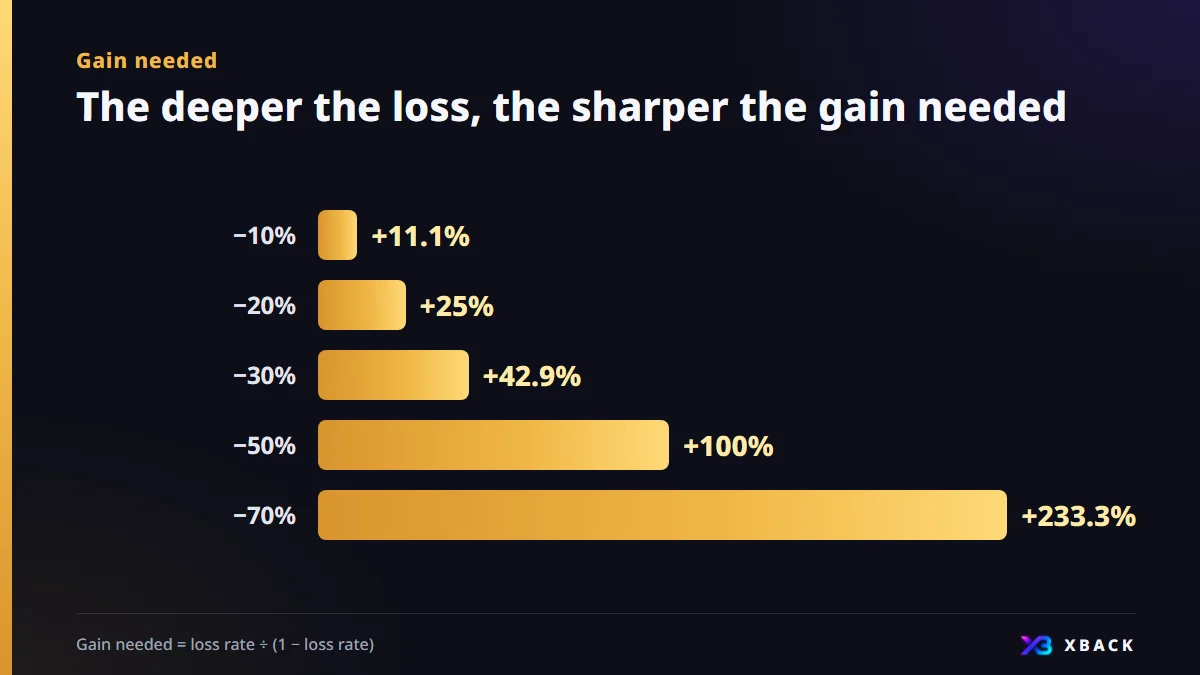
To win back what you lost, you have to earn a profit starting from the reduced balance. That is why the gain needed is larger than the loss rate.
The formula is gain needed = loss rate ÷ (1 − loss rate). For a 20% loss, for example, it is 0.2 ÷ 0.8 = 25%.
| Loss rate | Balance | Profit needed to recover | Gain needed |
|---|---|---|---|
| −10% | $9,000 | $1,000 | +11.1% |
| −20% | $8,000 | $2,000 | +25% |
| −30% | $7,000 | $3,000 | +42.9% |
| −50% | $5,000 | $5,000 | +100% |
| −70% | $3,000 | $7,000 | +233.3% |
The sooner you stop, the easier it is to recover
Once you are down 50%, you need to double your funds to get back. Stopping before the hole gets deeper is the most realistic way to recover.
Even with a 50% win rate, losing streaks are not rare
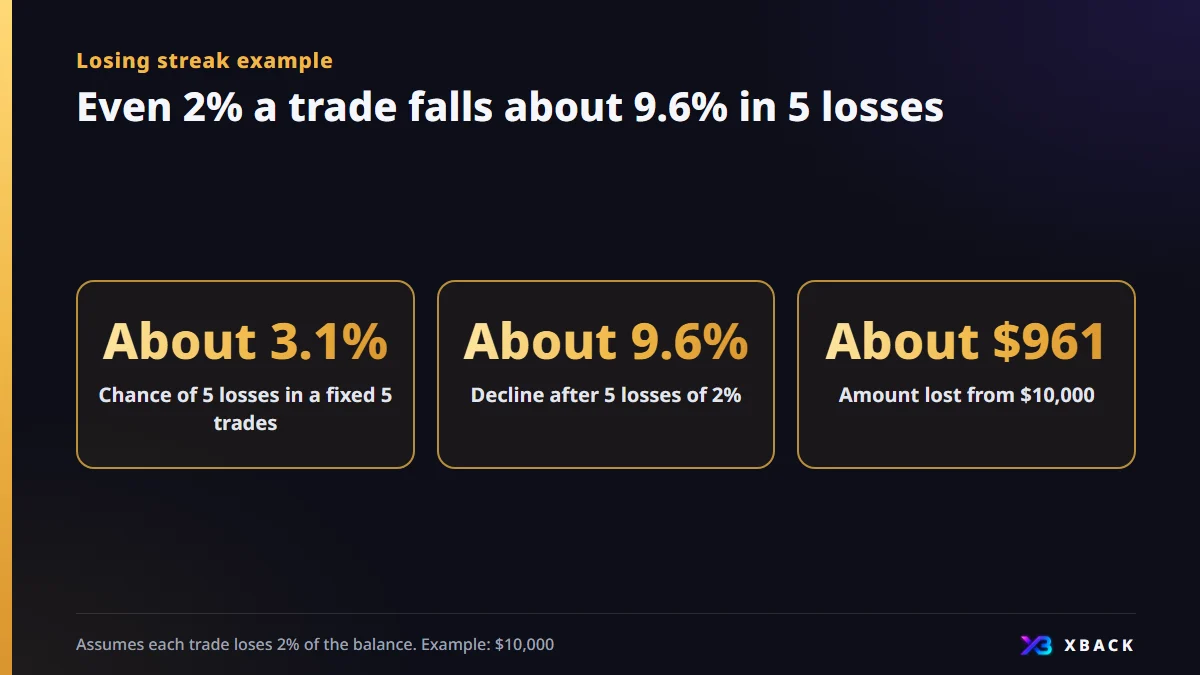
Even with a 50% win rate, losing streaks happen routinely. The probability of losing five in a row, looking at a fixed set of five trades, is about 3.1% (1/32).
However, the more you trade, the more chances there are for a five-loss streak to show up somewhere. A losing streak is not abnormal, and you should prepare for it as something that happens.
Here is a calculation example. Assume a $10,000 balance, and each trade loses 2% of the balance at that point.
| Losses in a row | Loss on that trade | Balance after the loss |
|---|---|---|
| 1 loss | About $200 | About $9,800 |
| 2 losses | About $196 | About $9,604 |
| 3 losses | About $192 | About $9,412 |
| 4 losses | About $188 | About $9,224 |
| 5 losses | About $184 | About $9,039 |
After five losses in a row, the total decline is about $961, or about 9.6%. You can also confirm it from 0.98 multiplied five times, which gives 0.9039 (about 90.4%).
3 things not to do during a drawdown
- Raising your lot size to win it back
- Removing the stop-loss on a trade whose unrealized loss is growing
- Adding to a position as it moves against you (averaging down)
Raising your lot size to win it back
Many people increase their lot size because they want to fill the loss quickly. But each loss becomes bigger, and the next losing streak cuts even deeper.
Removing or moving your stop-loss
Removing your stop-loss means you can no longer set a cap on your losses. A single loss can take most of your funds. You can read how to place one in the related column.
Averaging down to keep lowering your average price
If you add to a position when it moves against you, your average price falls. But the lot size carrying the loss also grows, and you move closer to a stop-out.
Classify the cause of a losing streak with your trading journal
Before rebuilding, sort out why you lost. The response is completely different depending on whether the problem is your method or broken rules.
| Type of cause | How to tell | Direction of the fix |
|---|---|---|
| Rule violation | Stops were moved, lot size exceeded, or trades were made outside your hours | Keep your method and build a way to follow the rules |
| Change in market conditions | You followed the rules, but losses have only piled up recently | Lower your lot size and watch |
| Method has a thin edge | Expectancy stays non-positive even over a long record | Re-test and review your method |
| Losing to costs | Even when you win, spreads and fees leave nothing | Review your trade frequency and time of day |
5 steps to rebuild
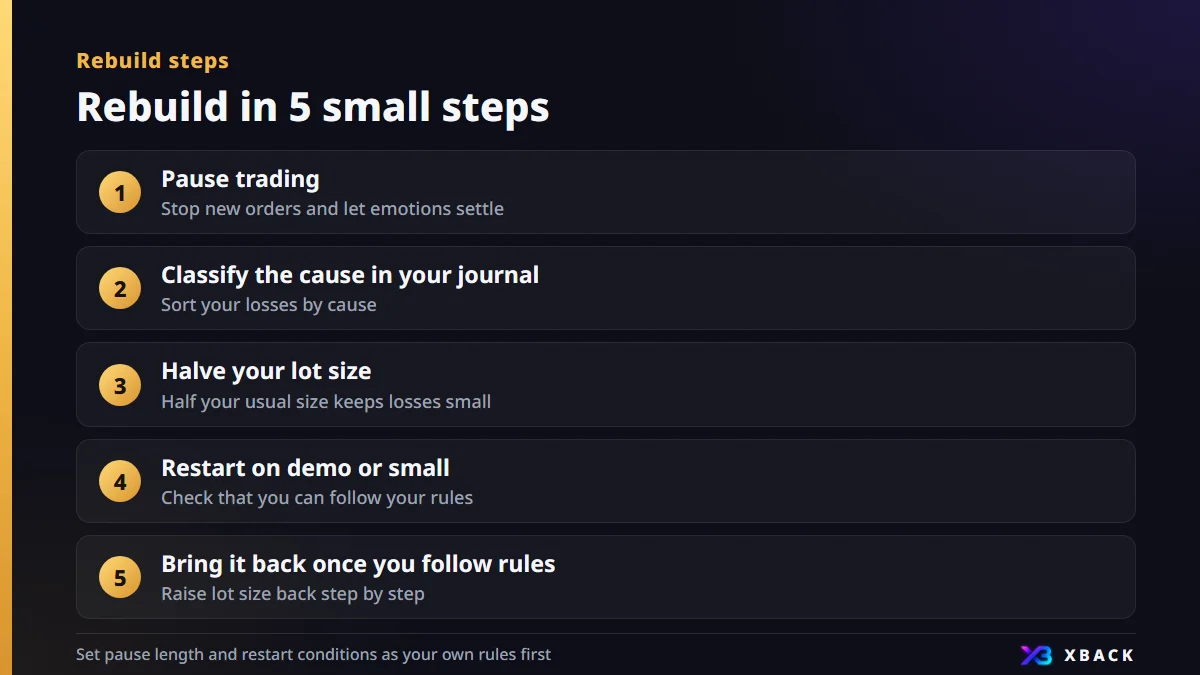
- 1
Pause trading
Stop placing new orders and let your emotions settle. One approach is to take a few days to a week off.
- 2
Classify the cause in your trading journal
Sort your losses by cause. Separate rule violations, market conditions and method problems.
- 3
Halve your lot size
When you restart, use half your usual lot size to keep each loss small.
- 4
Restart on demo or with a small amount
On a demo account or with a small amount, check that you can follow your rules.
- 5
Bring it back once you follow the rules
After a stretch of following them, raise your lot size back step by step.
Examples of stop rules that keep a losing streak from getting deeper
| Rule | Example setting | Purpose |
|---|---|---|
| Daily maximum loss | Once you lose 3% of funds in one day, you are done for the day | Prevent a collapse in a single day |
| Weekly maximum loss | Once you lose 5% of funds in one week, rest until next week | Prevent a losing streak from digging deeper |
| Number of losses in a row | After three losses in a row, no more trading that day | Prevent emotional trading |
| Drawdown limit | When you are down 10% from the peak, halve your lot size | Keep the gain needed to recover low |
How drawdown relates to cashback
Many cashback systems calculate returns from your trading volume. Losing trades may also be eligible, but the conditions differ by broker.
- Return amounts are not yet confirmed, and we will post them on each broker's page at launch
- Do not count on it as income to cover your losses
- Do not raise your lot size or number of trades because of returns
Enter your win rate and average profit and loss to check your method's expectancy. Use it as material for planning how to prepare for losing streaks.
Calculate expectancyFAQ
Q.Where should I start to recover from a forex drawdown?
First pause trading and classify the causes of your losses in your trading journal. The usual flow is then to restart with half your usual lot size and raise it back step by step once you follow your rules.
Q.Should I stop trading after a losing streak?
You do not need to quit, but it helps to set stop rules such as a daily or weekly maximum loss and a limit on losses in a row. Build a way to stop before you keep trading on emotional decisions.
Q.Can I raise my lot size to win back my losses?
We do not recommend it. A larger lot size makes each loss bigger, and the next losing streak cuts deeper. The deeper the loss, the more sharply the gain needed rises, so the basic approach is to lower your lot size and rebuild.
Q.How much drawdown is acceptable?
There is no fixed right answer. For example, recovering from −50% needs +100%, so dealing with it while it is still shallow is a well-known approach. Decide your limit in advance to suit your funds and method.

This article is for information purposes only and is not investment advice. Conditions may change, so please check each broker's official page for the latest information. Offshore FX and CFD trading carries a risk of losses exceeding your principal.