How to Spot an Overseas Forex Scam: Common Tactics and a 6-Point Check
Are you unsure how to tell whether an overseas forex broker is safe?
In short, check regulator registration yourself and know warning signs such as pushy solicitation and stalled withdrawals.
This article covers common tactics, what to check and the steps to take if you suspect harm, in general terms.
Key takeaways
- Treat pitches that promise profit or principal, and demands to prepay withdrawal fees, as warning signs.
- Verify a regulator's registration number on the regulator's public site yourself, and check the domain spelling too.
- If you suspect harm, stop depositing, keep records and contact an official consultation service.
In short: check registration, withdrawals and solicitation yourself
- Be suspicious first of any pitch that promises profit or guarantees your principal
- Verify a regulator's registration number yourself on the regulator's public site
- See whether withdrawal rules are written clearly in the terms
- Test a small deposit and withdrawal before you deposit in earnest
Common tactics of overseas forex scams and risky brokers
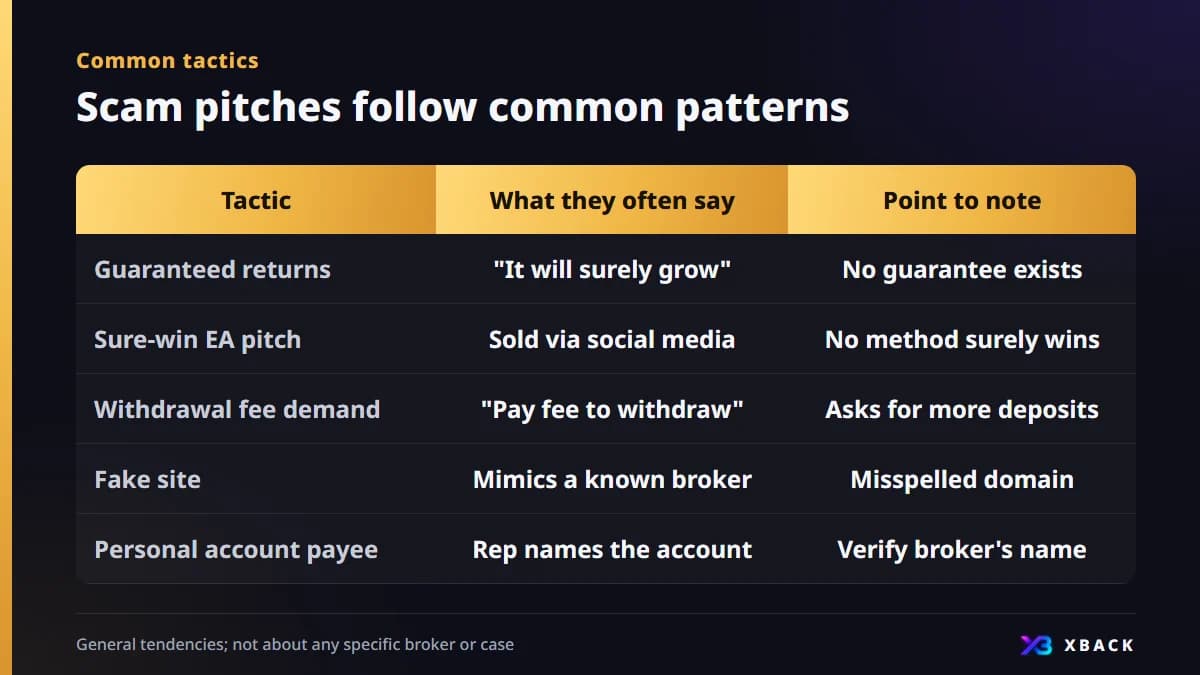
Fraudulent solicitation follows a few common patterns. The following sorts tactics for which such cases are generally reported.
| Tactic | What they often say | Point to note |
|---|---|---|
| Guaranteed principal or monthly return | Says "it will definitely grow" | Markets offer no guarantees |
| Pitching a "sure-win" EA | Sells it over social media or DMs | No method is certain to win |
| Demanding a withdrawal fee | "Pay a fee and you can withdraw" | You are asked for more deposits |
| Fake sites | A screen that imitates a well-known broker | The domain spelling differs |
| Transfers to a personal account | A representative names the account to pay into | Check it is in the broker's name |
Cases are also reported where deposits are credited at once but only withdrawals are stalled with excuses. Repeating extra identity checks or "under review" without giving a date is typical.
Be careful also with a broker that shows no financial license. Even where one is shown, there are cases where the number cannot be confirmed on the regulator's site.
"Sure-win EA" pitches that arrive on social media or DMs
Be suspicious first of investment offers from strangers on social media or DMs. Cases are reported of people being rushed to deposit with talk of an "EA that surely wins" or high returns.
An EA's results are only past results and do not promise future profit. You can read how to approach testing in the related column on backtesting.
If you are told "a fee is required to withdraw"
There are cases where you are asked to send more money because "a fee is required to withdraw". Legitimate brokers can also charge withdrawal fees, but the conditions are normally written in the terms. Check the terms and the official page before you pay.
Being asked to transfer to a personal account
If a representative asks you to transfer to an account in an individual's name, treat it as a warning sign. Use only the deposit destinations shown on the broker's official page or in your client area.
6 checkpoints for telling them apart
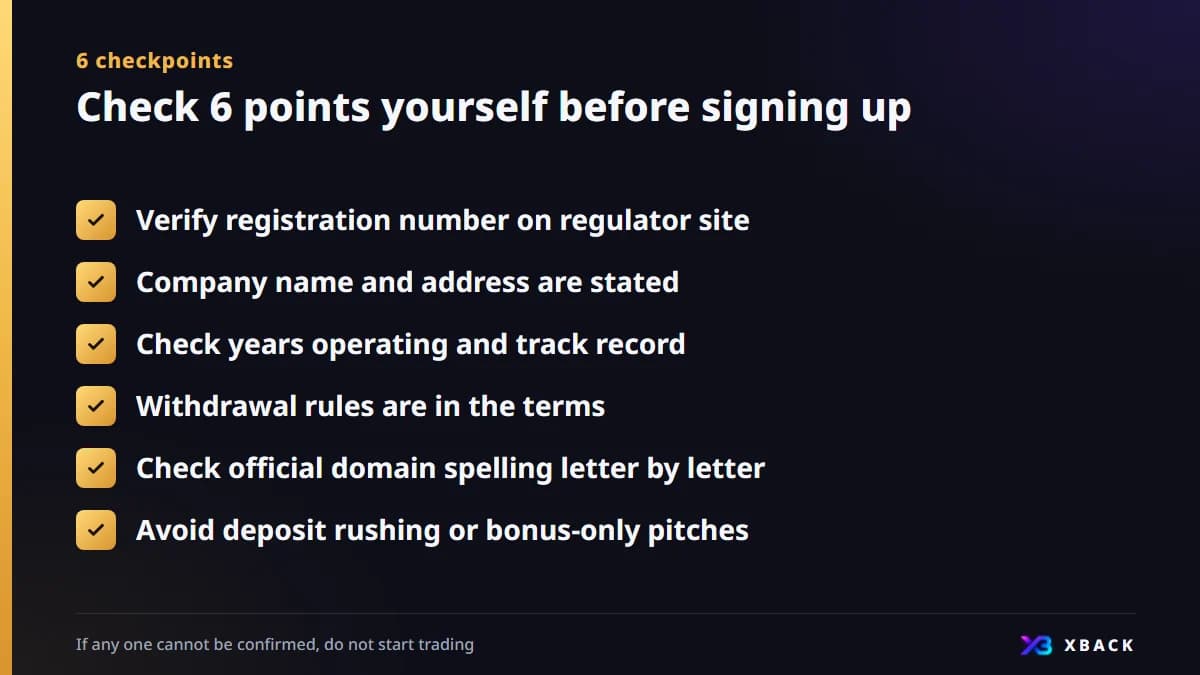
- Verify the regulator's registration number on the regulator's site
- The company name and address are clearly stated
- Check how long it has operated and its track record
- Withdrawal rules are written clearly in the terms
- Check the spelling of the official domain letter by letter
- Avoid brokers that rush your deposit or stress only the bonus
Verify the license number on the regulator's site
A license notice does not mean it is genuine. Search the number shown on the broker's site on the public site of the regulator said to have issued it, and check it.
See whether the company name, address and type of registration match. If they do not match or cannot be found, it is safer not to start trading.
Difference between an official domain and a fake one
Fake sites are sometimes built on domains spelled to resemble the official one. Cases are reported where one letter differs or the ending is different.
A padlock icon or https only shows the connection is encrypted and is not proof that the operator is safe. Get into the habit of opening official sites from a bookmark or official guidance.
Difference between "suspicious" and "a limit under the rules"
Not every withdrawal limit is a scam. Bonus withdrawal conditions and requests for identity verification are ordinary rules at many brokers.
| Situation | Limit under the rules | Warning sign |
|---|---|---|
| Bonus | Withdrawal conditions are in the terms | Conditions are added later |
| Identity check | Reviewed after you submit documents | Asks for the same documents again and again |
| Withdrawal fee | Amount and conditions are in the terms | Demands an extra transfer for no reason |
| Withdrawal period | A guide to the number of days is given | Stalls without giving a reason |
If unsure, look for what the terms spell out
If the limit is written in the terms and applied the same way to everyone, it is more likely a limit under the rules. If conditions change only by voice or chat, be careful.
Actions to avoid becoming a victim
- Do a small deposit and withdrawal test first
- Open an account only from the URL on the official site
- Do not give your account details or password to anyone
- Do not deposit based on solicitation via social media or DMs
- Keep records of deposit amounts and withdrawal dates
A withdrawal test means depositing a small amount and checking that you can actually withdraw it. Trying it once before trading in earnest also shows you how withdrawals work.
You can read about account protection settings in the related column on account security. For the withdrawal flow, see the column on withdrawal basics.
Steps to take if you suspect harm
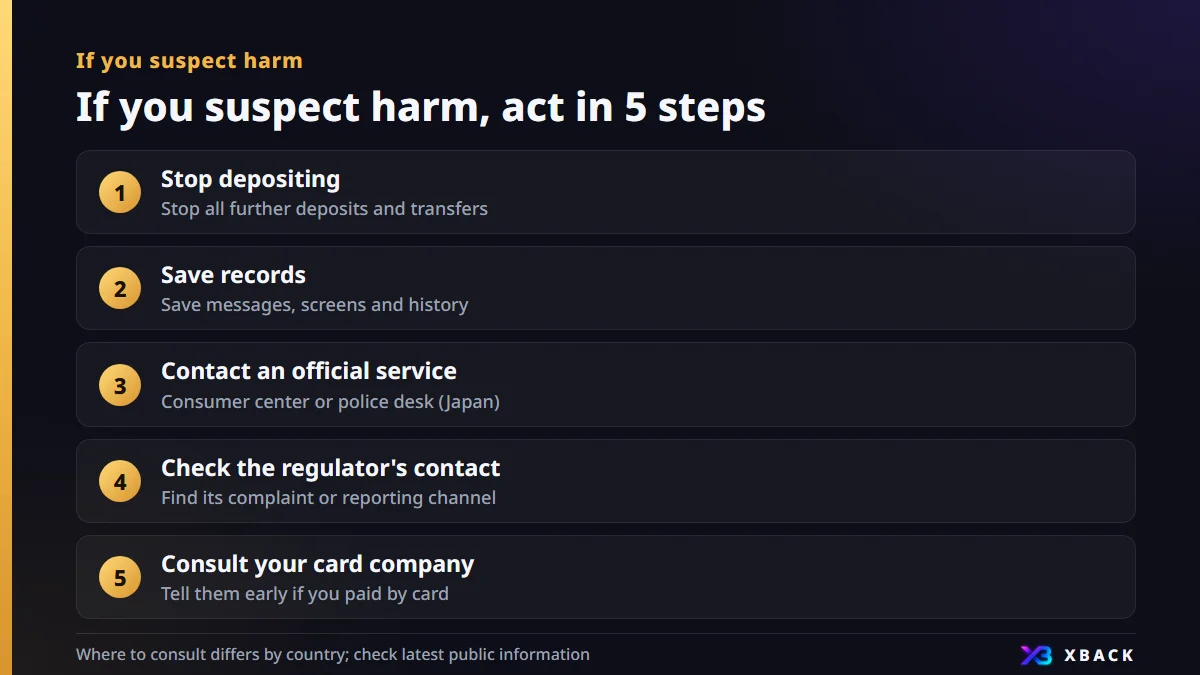
- 1
Stop depositing
Stop all further deposits and transfers. Avoid sending more money "to get it back" as well.
- 2
Save records
Save the messages, the site screens and your trading history. Keep them before they are deleted.
- 3
Contact an official consultation service
For residents of Japan, consult a consumer affairs center or a police consultation desk.
- 4
Check the regulator's contact point
Find the complaint or reporting channel of the regulator the broker claims to be registered with.
- 5
Consult your card company
If you deposited by credit card, tell your card company the situation early and ask for advice.
How XB's broker checks relate to cashback
XB's policy is to list brokers only after checking each one against its official regulatory information. Brokers we do not cover offer no cashback returns.
- Return amounts are not yet confirmed, and we will post them on each broker's page at launch
- Being listed is not a guarantee of safety
- Make the final check yourself using official information
Use it to compare trading costs in numbers. Together with your safety checks, use it to help choose a broker.
Compare broker costsFAQ
Q.What is the main point for spotting an overseas forex scam?
Solicitation that promises profit, and verifying the license. Check the registration number yourself on the regulator's public site, and see whether withdrawal rules are written clearly in the terms. If even one thing cannot be confirmed, it is safer not to start trading.
Q.Does a bonus withdrawal limit mean it is likely a scam?
Not necessarily. Bonus withdrawal conditions are ordinary rules written in the terms at many brokers. Be careful if conditions change later, or if you are asked for extra transfers for no reason.
Q.Can I assume a site is safe if it uses https?
No. https only shows the connection is encrypted and does not prove the operator is safe. Check the domain spelling, and get into the habit of reaching the site from official guidance or a bookmark.
Q.What should I do first if I suspect harm?
First stop all further deposits and transfers. Save the messages, screens and trading history, and contact an official consultation service. For residents of Japan, that means a consumer affairs center or a police consultation desk. If you deposited by card, also consult your card company.

This article is for information purposes only and is not investment advice. Conditions may change, so please check each broker's official page for the latest information. Offshore FX and CFD trading carries a risk of losses exceeding your principal.