Averaging Down (Nanpin) in Forex: Risks and Average Entry Price Examples
When a trade shows a floating loss, are you unsure whether to add to it and lower your average price?
In short, averaging down increases the lots carrying a loss, and it is dangerous unless you set a limit and a stop-loss first.
This article covers an average entry price calculation, how floating losses grow, how it differs from planned scaling in, and alternatives.
Key takeaways
- Averaging down adds to the side of a floating loss, and more lots mean bigger swings in profit and loss.
- In the example the average entry price falls to 1.0675, but the floating loss at 1.0550 grows from −250 USD to −500 USD.
- Place the stop-loss first, and keep the total acceptable loss for one trade within 2% of funds even if you split entries.
In short: averaging down is dangerous unless you set a limit and a stop-loss first
- Averaging down means adding lots on the side of a floating loss
- Your average entry price falls, but the profit and loss from the same move also gets bigger
- More lots mean more required margin, which brings a stop-out closer
- If you add, set a maximum lot size and a stop-loss position first
What is averaging down? How to calculate the average entry price
Averaging down (nanpin in Japanese) is a method where you add to a position in the same direction as a floating loss, to improve your average entry price. For buys it is called buying the dip, and for sells it is called selling into strength.
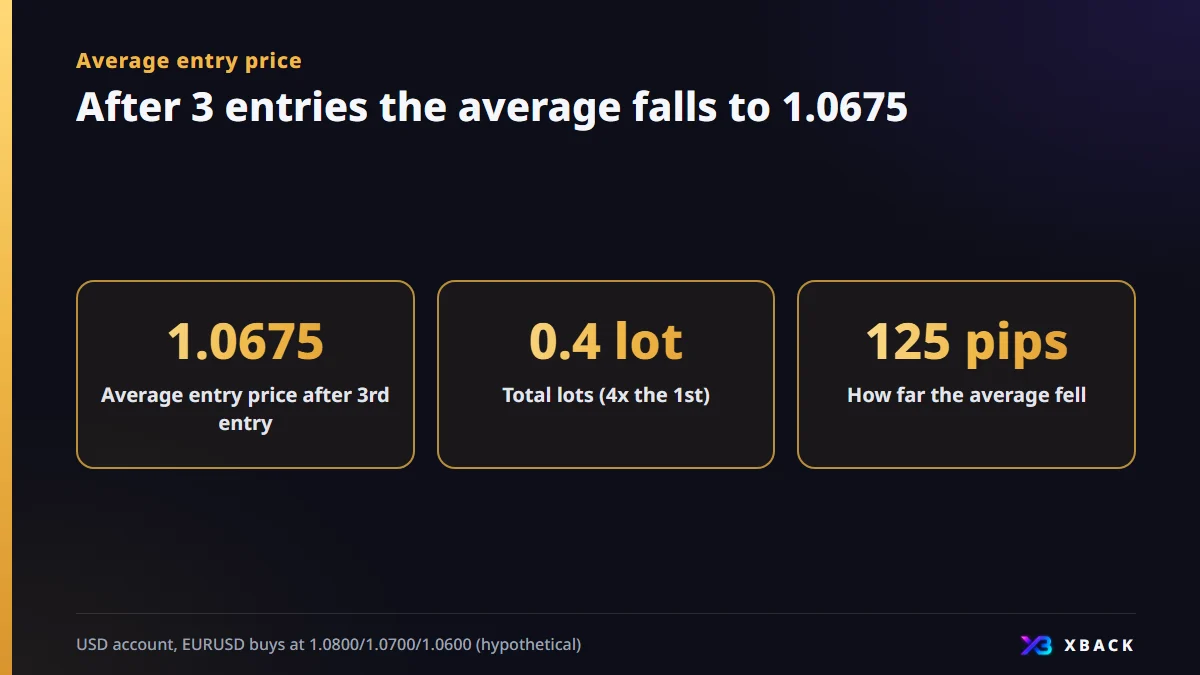
Take buying EURUSD in a USD account. You buy 0.1 lot at 1.0800, 0.1 lot at 1.0700 and 0.2 lot at 1.0600, in that order.
| Entry | Fill price | Added lots | Total lots | Average entry price |
|---|---|---|---|---|
| 1st | 1.0800 | 0.1 | 0.1 | 1.0800 |
| 2nd | 1.0700 | 0.1 | 0.2 | 1.0750 |
| 3rd | 1.0600 | 0.2 | 0.4 | 1.0675 |
The formula is (1.0800 × 0.1 + 1.0700 × 0.1 + 1.0600 × 0.2) ÷ 0.4. The numerator is 0.108 + 0.107 + 0.212 = 0.427, and 0.427 ÷ 0.4 = 1.0675. The average fell 125 pips from 1.0800.
How do floating losses grow? Compare at 1.0550
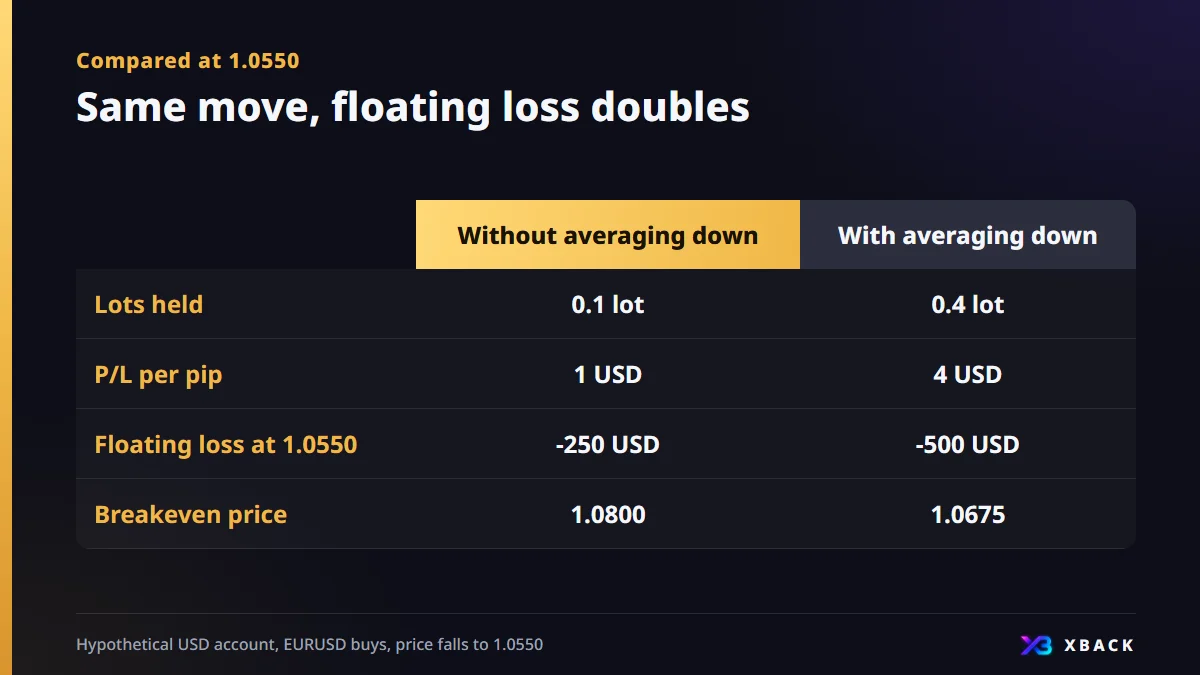
Suppose the price falls to 1.0550. For 0.1 lot, 1 pip = 1 USD, and for 0.4 lot, 1 pip = 4 USD.
- Without averaging down (0.1 lot): a 250-pip fall from 1.0800 gives 250 × 1 USD = −250 USD
- With averaging down (0.4 lot): a 125-pip fall from the 1.0675 average gives 125 × 4 USD = −500 USD
Because the average fell, the breakeven price moved closer, from 1.0800 to 1.0675. But the profit and loss from the same move is also 4 times larger. If the move against you continues, the floating loss grows twice as fast.
Effect on margin level and stop-out
More lots mean more required margin. Your equity falls from the floating loss while required margin swells, so your margin level drops twice over.
- Floating loss grows: equity falls
- Lots increase: required margin rises
- Together they lower your margin level and bring a stop-out closer
The margin level at which a stop-out occurs differs by broker. Read how to interpret the figures in the related column, and check the level on each broker's official page.
How averaging down differs from planned scaling in
Both add as the price falls, but they are different things. The difference is whether you act on rules decided in advance.
| Aspect | Averaging down | Planned scaling in |
|---|---|---|
| Maximum lots | Not set, keeps growing | A total limit is set in advance |
| Stop-loss position | Removed or moved | Placed first and kept for the whole position |
| Reason to add | It has fallen, so it feels cheap | Price zones or conditions set in advance |
| Purpose of adding | To erase a floating loss | To prepare for an expected move |
4 forms of averaging down you should not do
- Adding after removing or moving your stop-loss
- Adding lots without setting a limit on funds
- Adding around economic releases or major events
- Adding on the strength of a balance inflated by a bonus
Prices tend to move sharply around releases, and if it goes against you right after you add, losses grow at once. The related column on reading economic indicators may help.
Bonuses often come with withdrawal conditions, so the balance is not always funds you can use as freely as it looks. Conditions differ by broker, so check the official page.
Danger of martingale EAs: a system that doubles up
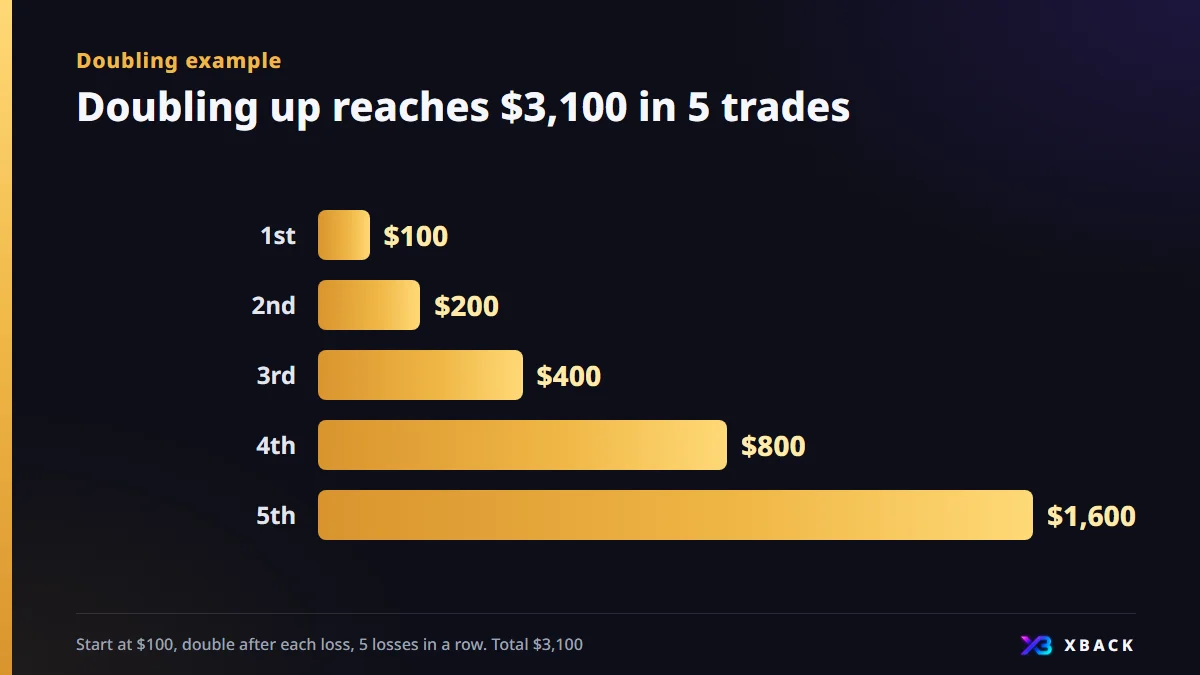
The martingale method doubles the next trade size after each loss, hoping one win recovers all the losses. Like averaging down, it adds to positions on the losing side.
Here is a calculation example. Start with $100 and double after each loss, losing five times in a row. From the 1st trade the sizes are $100, $200, $400, $800 and $1,600.
The total is 100 + 200 + 400 + 800 + 1,600 = $3,100. The 5th trade alone, $1,600, exceeds the $1,500 accumulated before it.
- Whether a cap on the multiplier and a maximum lot size are set
- Whether a stop-loss is included, and whether it can be turned off
- Whether you checked the maximum drawdown after a run of losses on demo or in a backtest
Alternatives to averaging down and how to set an acceptable loss
The basic approach is to place your stop-loss first and work back from it to decide your lot size. A well-known idea is to keep the acceptable loss per trade within 2% of your funds.
- 1
Decide your stop-loss position first
Before you enter, decide the price at which you will exit.
- 2
Keep the acceptable loss within 2%
With a $10,000 balance, the acceptable loss per trade is $200.
- 3
Work out the lots from the distance to your stop-loss
Divide the acceptable loss by the profit or loss across the stop-loss distance.
- 4
If you split, keep the total within 2%
Even when split over several entries, the total loss must not exceed the acceptable amount.
- 5
Exit when the stop-loss is reached
Do not put it off by adding; finish at the position you decided.
For example, with 0.2 lot in total, 1 pip = 2 USD, so a move 100 pips against your average entry price is the guide for a $200 loss. You can also check the calculation steps in a related column.
Averaging down and cashback
Many cashback systems calculate returns from your trading volume. Even if averaging down raises your volume, it does not necessarily make up for losses.
- Return amounts are not yet confirmed, and we will post them on each broker's page at launch
- Do not count on it as income to cover your losses
- Do not raise your lot size or number of trades because of returns
Enter your balance and lots to check how much room you have before a stop-out. See that room in numbers before you add to a position.
Calculate the stop-out levelFAQ
Q.What is averaging down in forex?
It is a method of adding to a position in the same direction as a floating loss, to improve your average entry price. For buys it is called buying the dip, and for sells it is called selling into strength. The more lots you add, the bigger the swings in your losses.
Q.How do you calculate the average entry price when averaging down?
Divide the sum of price × lots for each position by the total lots. For example, 0.1 lot at 1.0800, 0.1 lot at 1.0700 and 0.2 lot at 1.0600 give 0.427 ÷ 0.4, so the average is 1.0675.
Q.Does averaging down always fail?
It cannot be said to always fail. However, adding with no maximum lot size and no stop-loss makes losses grow suddenly if the move against you continues. It is usually treated separately from scaling in with a total acceptable loss set in advance.
Q.What should I do if I have already averaged down?
First write down your current total lots, floating loss and stop-loss position. If you are over your acceptable loss, one option is to stop adding and reduce your lots. If it is hard to judge, review your trading records and sort out the cause.

This article is for information purposes only and is not investment advice. Conditions may change, so please check each broker's official page for the latest information. Offshore FX and CFD trading carries a risk of losses exceeding your principal.