Pyramiding in Forex: How to Add to Winning Trades, With Examples

When a trade is in profit, are you unsure whether adding to it with pyramiding really lets you grow the gain?
In short, adding to a winner increases profit if the move continues, but it pulls your breakeven close to the current price, so a small pullback can wipe out the gain.
This article covers how it differs from averaging down, a USD account calculation, the rules for adding correctly and the markets that suit it.
Key takeaways
- Pyramiding adds to the side of a floating profit, the opposite of averaging down on a floating loss.
- In the example, adding lifts the floating profit at 1.1000 by 100 USD, but a pullback to 1.0875 brings it to 0.
- The basics are to keep additions small and raise the stop-loss for the whole position to breakeven or better.
In short: add small amounts, and raise your stop-loss to breakeven or better
- Pyramiding means adding to a position on the side of a floating profit
- Each addition raises your average entry price, so a small pullback can erase the profit
- Make each addition smaller than the first entry, and raise the stop-loss for the whole position to breakeven or better
- Use it only in trending markets, and set a maximum number of additions beforehand
What is pyramiding? How it differs from averaging down
Pyramiding is a method where you add to a position in the same direction while it is in profit. It is also called adding to winners or scaling in. For buys you add as the price rises, and for sells you add as the price falls.
It is the opposite of averaging down (nanpin), which adds on the side of a floating loss. The risks of averaging down are covered in a related column.
| Point | Pyramiding | Averaging down |
|---|---|---|
| When you add | While in floating profit | While in floating loss |
| Direction of the addition | With the move in your favor | Against the move |
| Purpose | Ride the trend and extend profit | Improve the average entry price |
| Main danger | A reversal erases the profit | Lots and losses grow as the market moves against you |
Calculation example: adding raises profit but weakens you against pullbacks
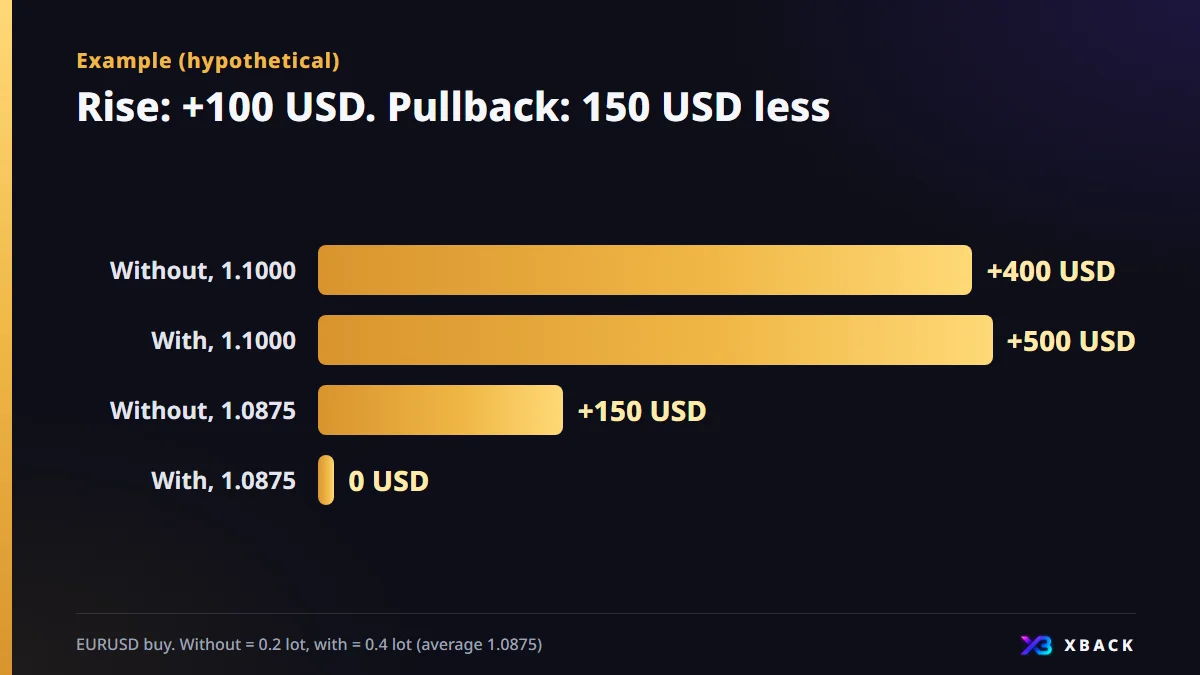
Take buying EURUSD in a USD account. You buy 0.2 lot at 1.0800, 0.1 lot at 1.0900 and 0.1 lot at 1.1000, for a total of 0.4 lot.
| Entry | Fill price | Added lots | Total lots |
|---|---|---|---|
| 1st | 1.0800 | 0.2 | 0.2 |
| 2nd | 1.0900 | 0.1 | 0.3 |
| 3rd | 1.1000 | 0.1 | 0.4 |
The average entry price is (1.0800 × 0.2 + 1.0900 × 0.1 + 1.1000 × 0.1) ÷ 0.4. The numerator is 0.216 + 0.109 + 0.110 = 0.435, and 0.435 ÷ 0.4 = 1.0875.
For 0.2 lot, 1 pip = 2 USD, and for 0.4 lot, 1 pip = 4 USD. Compare the result when the price is at 1.1000 with when it falls back to 1.0875.
| Scenario | Without adding (0.2 lot) | With adding (0.4 lot) |
|---|---|---|
| At 1.1000 | 200 pips × 2 USD = +400 USD | 125 pips × 4 USD = +500 USD |
| Pulled back to 1.0875 | 75 pips × 2 USD = +150 USD | 0 USD at the average price |
If the rise continues, adding increases your floating profit by 100 USD. But if the price pulls back to 1.0875, the +150 USD you would have had without adding becomes 0 USD, which is 150 USD less.
How your breakeven moves closer to the current price
Each time you add, your average entry price moves closer to the current price. That means the price at which your profit and loss is zero rises up toward the current price.
- 1
0.2 lot at 1.0800
The average entry price is 1.0800.
- 2
Add 0.1 lot at 1.0900
The average rises to about 1.0833.
- 3
Add 0.1 lot at 1.1000
The average rises to 1.0875.
The gap between the average entry price and the current price is your room to protect profit. In this example the room is 125 pips, but the lots are twice the first entry.
5 rules for adding correctly
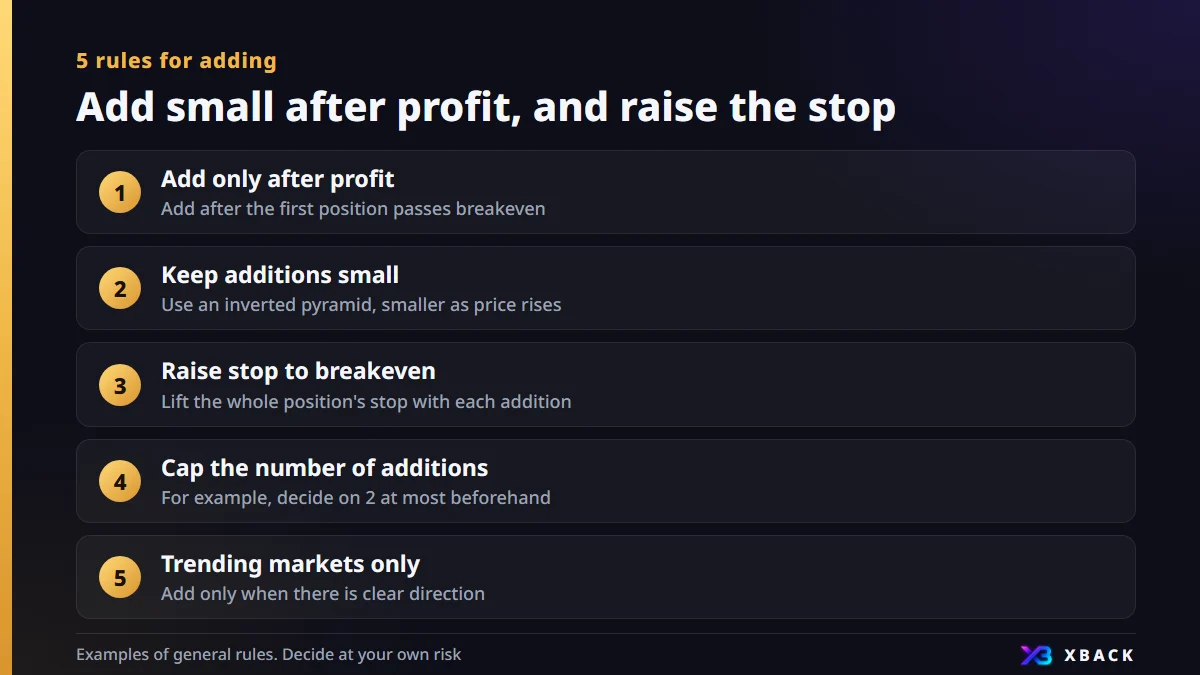
Adding only makes sense if you follow rules. Decide these 5 points before your first entry.
- 1
Add only after profit
Add after the first position passes breakeven
- 2
Keep additions small
Use an inverted pyramid, smaller as price rises
- 3
Raise stop to breakeven
Lift the whole position's stop with each addition
- 4
Cap the number of additions
For example, decide on 2 at most beforehand
- 5
Trending markets only
Add only when there is clear direction
If you place the stop-loss for the whole position at or above the average entry price of 1.0875, closing out should not produce a loss (excluding slippage). However, around data releases or weekend gaps, orders can fill at a worse price than expected.
Markets that suit adding, and markets that do not
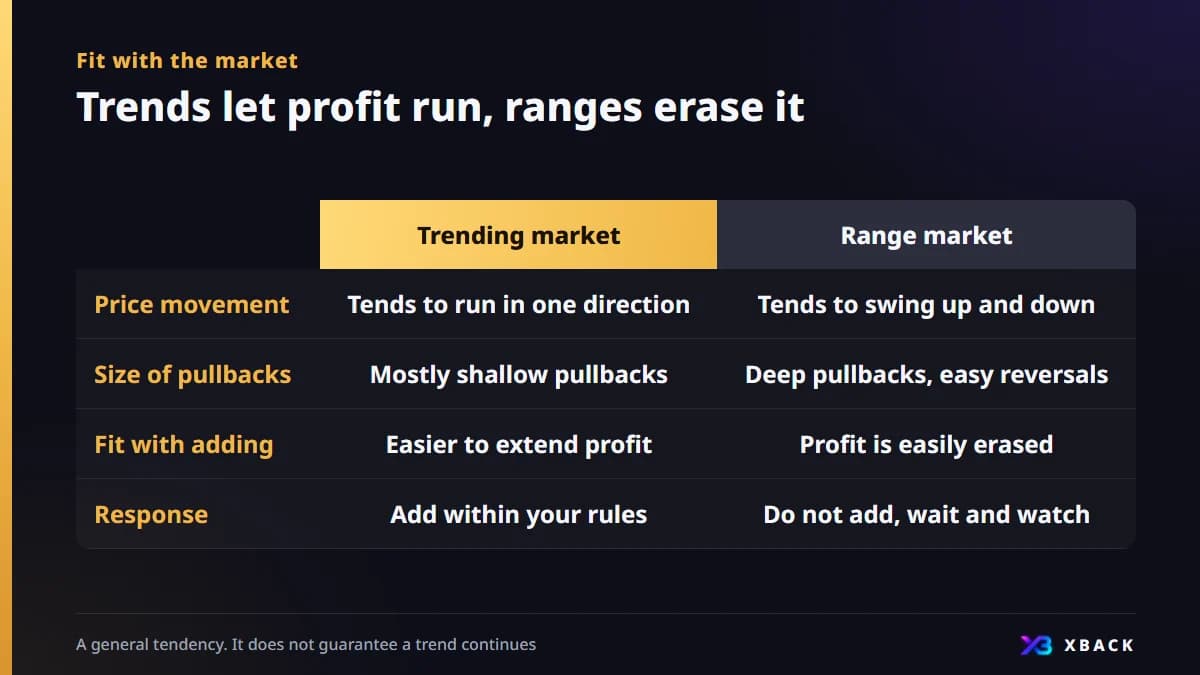
Adding works best in trending markets that extend in one direction. When it is hard to tell whether the market is trending, the basic approach is not to add.
| Point | Trending market | Range market |
|---|---|---|
| Price movement | Tends to run in one direction | Tends to swing up and down |
| Size of pullbacks | Mostly shallow pullbacks | Deep pullbacks that reverse easily |
| Fit with adding | Easier to extend profit | Profit is easily erased |
| Response | Add within your rules | Do not add, wait and watch |
Examples of what to check are the direction of a higher timeframe, and whether recent highs and lows keep rising. If in doubt, skip the addition.
4 forms of adding you should avoid
- Making an addition larger than the first entry
- Adding without moving the stop-loss for the whole position
- Adding just before data releases or major events
- Adding repeatedly in a range market
A larger addition pulls your average entry price close to the current price at once, so even a slight pullback erases the profit.
Around data releases, sudden reversals and wider spreads are common. Before adding, check that you can place a stop-loss where the total loss on the position stays within what you can accept.
Combining adding with a trailing stop
Raising the stop-loss yourself every time you add takes effort. A trailing stop is an order that moves the stop-loss automatically as the price moves, so it combines easily with adding.
- Activate it once you are in profit, so the stop moves at breakeven or better
- If the distance is too tight, normal pullbacks will close the trade
- If the distance is too wide, the profit you protect becomes small
How a trailing stop works and how to choose the distance are covered in a related column. Test the distance on a demo account before you decide.
Adding to positions and cashback
Many cashback schemes are calculated on trading volume. Even if adding increases your volume, it does not guarantee a profit.
- The cashback amount is not yet confirmed and will be posted on each broker page at launch
- Do not add to positions or raise lots for the sake of cashback
- Calculation methods differ by broker, so check the official page
Enter the currency pair, lots and price difference to check profit and loss before and after adding. See the numbers before you add.
Calculate profit and lossFAQ
Q.What is pyramiding in forex?
It is a method where you add to a position in the same direction while it is in profit. It is the opposite of averaging down, which adds on the side of a floating loss, and each addition moves your average entry price closer to the current price.
Q.Which is safer, pyramiding or averaging down?
Neither can be called safe. With pyramiding you can design it to limit losses by raising your stop-loss to breakeven or better. But a reversal can still erase the profit, so it is dangerous without rules.
Q.How do I decide the lot size for an addition?
In general, make it smaller than the first position. In this article's example, 0.1 lot was added each time after an initial 0.2 lot. After adding, check that you can still place a stop-loss so the total loss stays within what you can accept.
Q.Does adding to positions increase cashback?
With volume-based schemes, your eligible trading volume may increase. However, the cashback amount is not yet confirmed and will be posted on each broker page at launch. Do not add to positions for the sake of cashback.

This article is for information purposes only and is not investment advice. Conditions may change, so please check each broker's official page for the latest information. Offshore FX and CFD trading carries a risk of losses exceeding your principal.