Overseas Forex Pros and Cons: How It Differs From Domestic FX in Japan
Are you unsure whether to open an account because you do not know the pros and cons of overseas forex?
In short, behind the appeal of high leverage and bonuses sit points to watch on tax, withdrawals and choosing a broker.
This article covers the differences from domestic FX, a margin calculation example, who it suits, and what to check before you start.
Key takeaways
- Overseas forex offers high leverage and zero-cut, but spreads and withdrawals need attention.
- For 1 lot of EURUSD, the required margin is 4,320 USD at 25x and 216 USD at 500x.
- Residents of Japan are generally taxed under comprehensive taxation, and you check a broker's FSA registration yourself.
In short: overseas forex has pros and cons together, so choose after knowing the differences
- Pros include high leverage, zero-cut, bonuses and standard MT4/MT5 support
- Cons include wider spreads, tax rules that differ from domestic FX, withdrawal effort and a broker's registration status
- High leverage magnifies losses as well as profits, so how you use it matters
- Residents of Japan should check a broker's registration with the Financial Services Agency and the tax treatment themselves before starting
Main differences between overseas forex and domestic FX
Overseas and domestic FX are both currency trading, but regulations and systems differ greatly. The table below gives the overall picture.
| Item | Overseas forex (general tendency) | Domestic FX |
|---|---|---|
| Leverage | Several hundred times or more, depending on the broker | Up to 25x for individuals by regulation |
| Margin calls for extra funds | Many brokers offer zero-cut | Additional deposits can be required (varies by broker) |
| Bonuses | Some brokers offer account-opening and deposit bonuses | Rarely seen |
| Tax | For residents of Japan, generally comprehensive taxation (miscellaneous income) | Separate self-assessment taxation |
| Spreads | Tend to be wider (varies by account type) | Tend to be narrower |
| Fund management | Segregated accounts are common | Trust preservation is mandatory |
| Registration with Japan's FSA | Many brokers are not registered | Registered brokers only |
Here, overseas forex means overseas brokers not registered with Japan's Financial Services Agency. Conditions differ by broker, so read the table as a guide.
5 main pros of overseas forex
The appeal of overseas forex lies in trading conditions that are hard to find domestically. Here are five typical ones.
- High leverage: depending on the broker, you may be able to choose leverage of several hundred times or more, so you can trade with less margin
- Zero-cut: even if a sudden market move pushes your balance negative, you are not asked for additional deposits (margin calls)
- Bonuses and cashback: some brokers offer account-opening or deposit bonuses and rebates based on trading volume
- MT4/MT5 as standard: widely used charting software that makes EAs (automated trading) and indicators easy to use
- Many instruments: besides currency pairs, some brokers offer gold, stock indices and crypto assets
Even with zero-cut, the risk of losing the margin you deposited does not change. You can check how it works in the related column.
Bonuses generally come with withdrawal conditions. The details differ by broker, so read the terms before you accept one.
Margin example: how much 25x and 500x differ
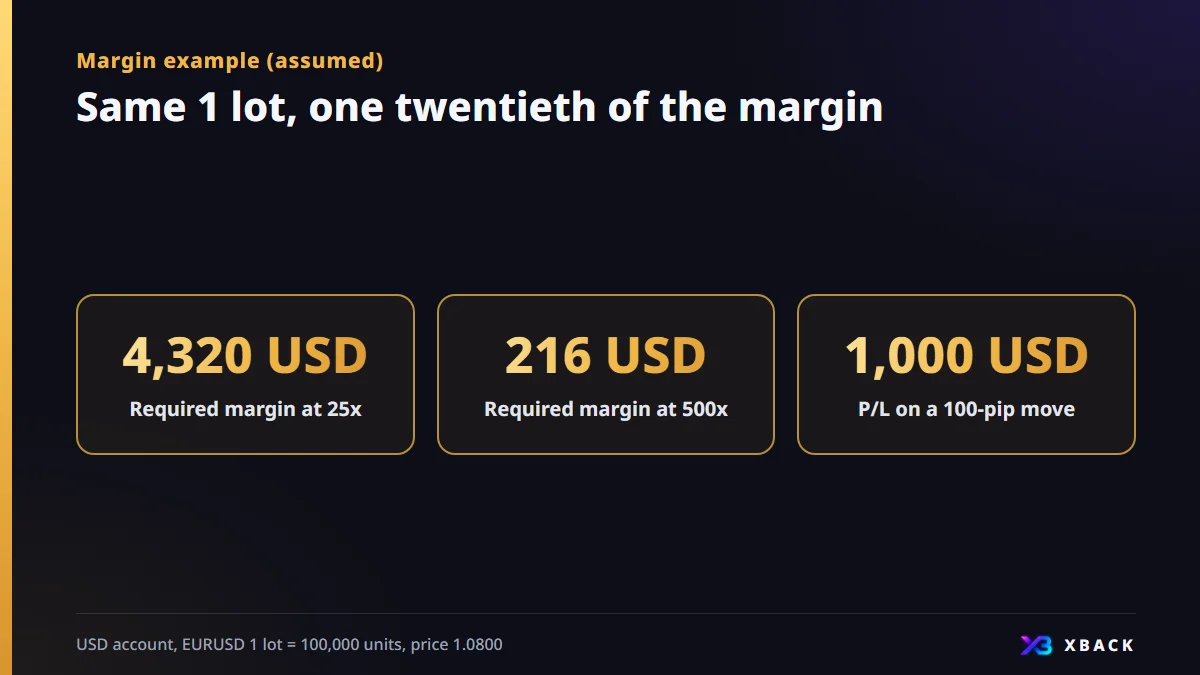
Required margin is the trade value divided by leverage. Take buying 1 lot (100,000 units) of EURUSD at 1.0800 in a USD account.
The trade value is 100,000 × 1.0800 = 108,000 USD. Divided by 25 it is 4,320 USD, and divided by 500 it is 216 USD.
| Leverage | Trade value (1 lot) | Required margin |
|---|---|---|
| 25x | 108,000 USD | 4,320 USD |
| 500x | 108,000 USD | 216 USD |
At 500x, the required margin is one twentieth of that at 25x (4,320 ÷ 216 = 20). Meanwhile, if the price moves 100 pips (0.0100), the profit or loss is 1,000 USD, the same amount whatever the leverage.
Even with 216 USD of margin, a 1,000 USD loss can happen. High leverage also speeds up stop-outs and the drop in your balance, so size your lots with room to spare.
6 main cons of overseas forex and how to handle them
Behind the pros are points that residents of Japan tend to overlook. Here are six, together with what to do about each.
| Con | Detail | What to do |
|---|---|---|
| Wider spreads | They vary by account type and weigh more on cost the more you trade | Compare account types and costs |
| Tax differs from domestic FX | For residents of Japan it is generally comprehensive taxation (miscellaneous income), unlike separate self-assessment taxation | Check the latest information from the National Tax Agency of Japan and experts |
| Withdrawals take days and fees | Days and fees change by method | Read the withdrawal rules and test with a small amount |
| Japanese support varies | Hours and quality differ by broker | Check how to contact support in advance |
| Many brokers are unregistered | Many have no registration with Japan's Financial Services Agency | Check registration status yourself |
| Not trust-preserved | Segregation is common, and the strength of protection is not the same | Check how funds are managed |
Comprehensive taxation adds your trading income to other income such as salary to calculate tax. Generally the more you earn, the higher the rate, so the burden can differ from the separate self-assessment taxation of domestic FX.
Tax treatment changes with your personal situation. Check the latest information from public bodies such as the National Tax Agency of Japan, or ask a tax accountant or other expert.
Trust preservation protects customer funds even if a broker fails. Overseas brokers often use segregated management, keeping funds apart from company money, and the strength of protection is not the same.
Do not judge a broker by its name or advertising alone. Checking registration and regulation yourself is essential.
Who overseas forex suits and who it does not
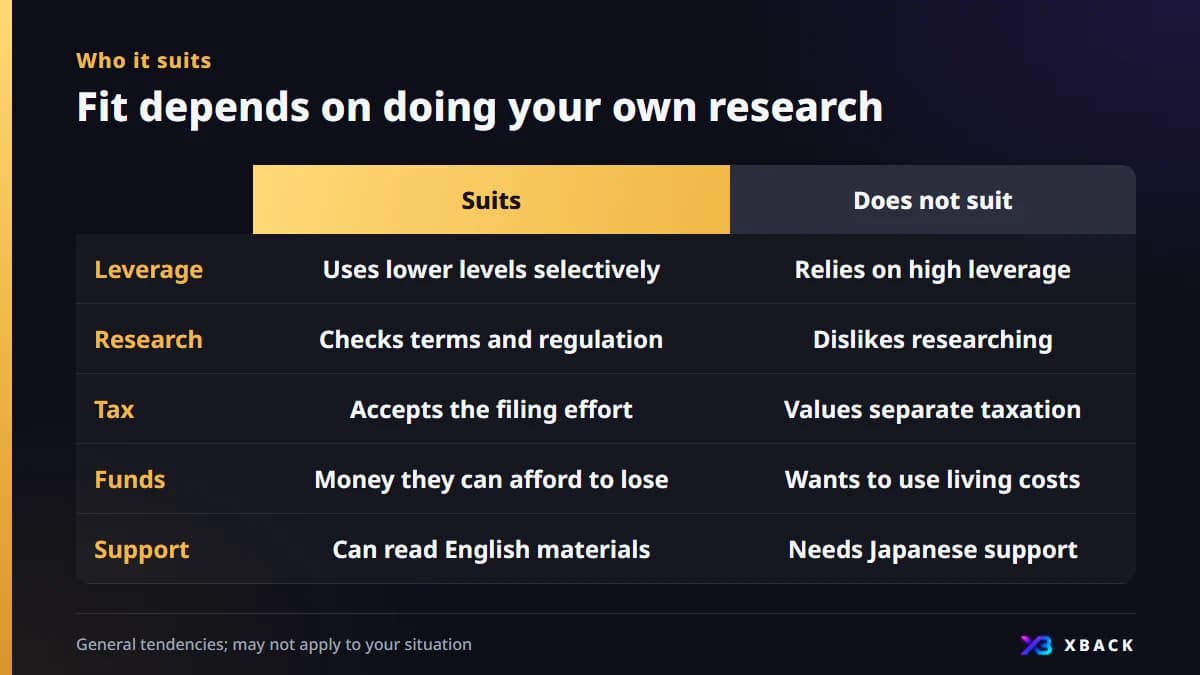
Overseas forex tends to be easier to use well for people who research and decide for themselves. The table summarizes who it suits.
| Item | Suits | Does not suit |
|---|---|---|
| Leverage | Can use a lower level selectively | Tends to rely on high leverage |
| Research | Checks terms and regulation themselves | Dislikes researching |
| Tax | Can accept the filing effort | Values separate self-assessment taxation |
| Funds | Trades with money they can afford to lose | Wants to use living expenses |
| Support | Can also read English materials | Needs Japanese support |
If many items fall under Does not suit, there is no need to force yourself to start. You can also try the platform on a demo account before you decide.
Checklist before you start
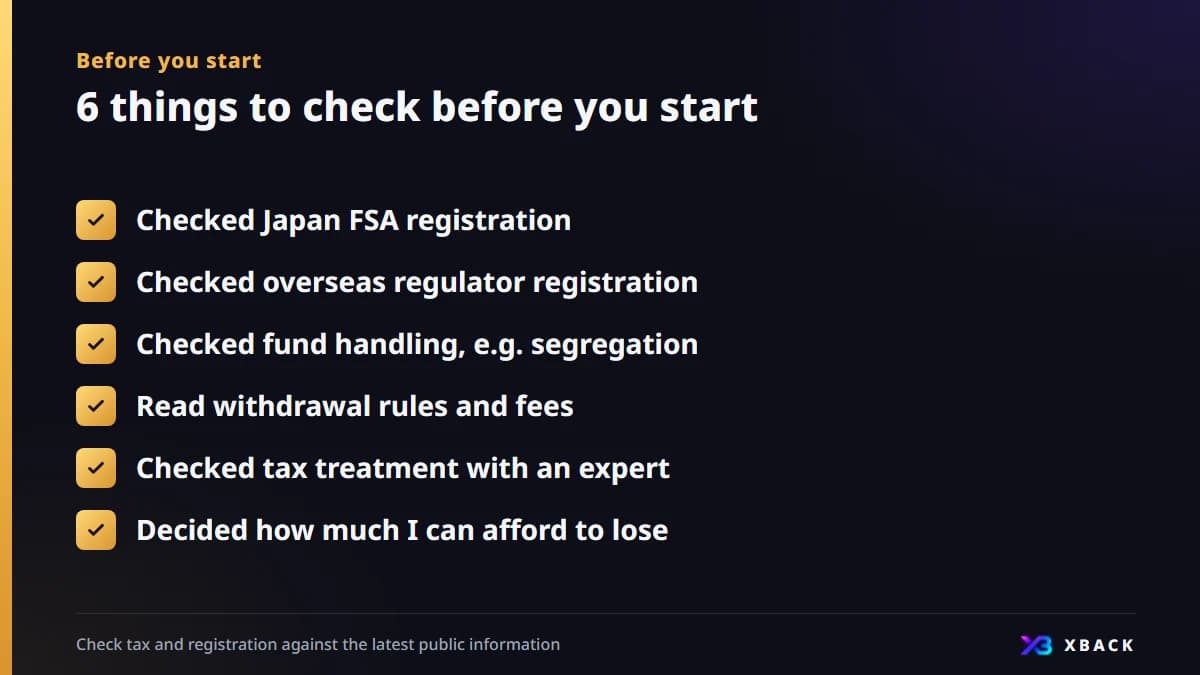
Checking the following six points before opening an account can reduce mistakes.
- I checked whether the broker is registered with Japan's Financial Services Agency
- I checked registration with overseas regulators
- I checked how funds are handled, such as segregation
- I read the withdrawal rules and fees
- I checked the tax treatment with an expert or similar
- I decided how much I can afford to lose
Get used to the platform on a demo account first and start with a small deposit. Trying one deposit and withdrawal before trading in earnest gives extra peace of mind.
Cashback is one way to lower costs
The weakness of wider spreads can sometimes be eased by managing trading costs. Cashback is one such way.
- Return amounts are not yet confirmed, and we will post them on each broker's page at launch
- Do not increase trades or lot size just to earn returns
- Put checking a broker's regulation and withdrawal rules ahead of whether it offers returns
Enter a currency pair and leverage to check your required margin. Use it as material for deciding your lot size.
Calculate required marginFAQ
Q.What are the pros and cons of overseas forex?
The pros are high leverage, zero-cut, bonuses, standard MT4/MT5 support and a wide range of instruments. The cons are wider spreads, tax rules that differ from domestic FX, withdrawal effort and the fact that many brokers are unregistered. Conditions differ by broker.
Q.How does overseas forex differ from domestic FX?
The leverage cap, how margin calls are handled, the availability of bonuses, tax and fund management all differ. For residents of Japan, tax is generally comprehensive taxation for overseas forex and separate self-assessment taxation for domestic FX. Check the latest information with public bodies.
Q.Is overseas forex illegal?
No rule that directly punishes residents of Japan for trading with an overseas broker is generally known. However, this cannot be stated definitively, and Japan's Financial Services Agency has a system for issuing warnings to unregistered brokers. Check a broker's registration and the latest public information yourself, and consult an expert if unsure.
Q.Can beginners start overseas forex?
Starting itself is possible, but high leverage also magnifies losses. The basics are to get used to the platform on a demo account, start with a small amount and decide your stop-loss placement first. Finish checking tax and registration before you trade.

This article is for information purposes only and is not investment advice. Conditions may change, so please check each broker's official page for the latest information. Offshore FX and CFD trading carries a risk of losses exceeding your principal.