Forex Floating Loss: Hold or Cut? 5 Criteria and Margin Examples
Are you sitting on a floating loss and can't decide whether to hold it or cut it?
In short, judge it calmly against five criteria: whether your reason for entry still stands, whether you set a stop-loss level before entering, and whether your margin level has room.
This article calculates how the margin level moves under hypothetical conditions. It also covers when holding can make sense, when to cut, and the rules to follow if you hold.
Key takeaways
- Judge holding a floating loss by 5 criteria: reason for entry, stop-loss level, margin level, weekends and releases, and swap.
- In the hypothetical example, a 400-pip adverse move leaves the margin level at 454.5%, but equity falls from 1,000 USD to 200 USD.
- After an 80% drop in balance you need a 400.0% gain to recover, so always place a stop-loss order even if you hold.
In short: judge holding a floating loss by 5 criteria
- Is the reason (scenario) for your entry still intact today?
- Did you decide your stop-loss level before opening the position?
- Do you understand that capital is shrinking even when the margin level has room?
- If you hold over a weekend or a major economic release, can you withstand a gap or a sudden move?
- On a pair with negative swap, are your costs growing the longer you hold?
What happens when you hold a floating loss: results by adverse move
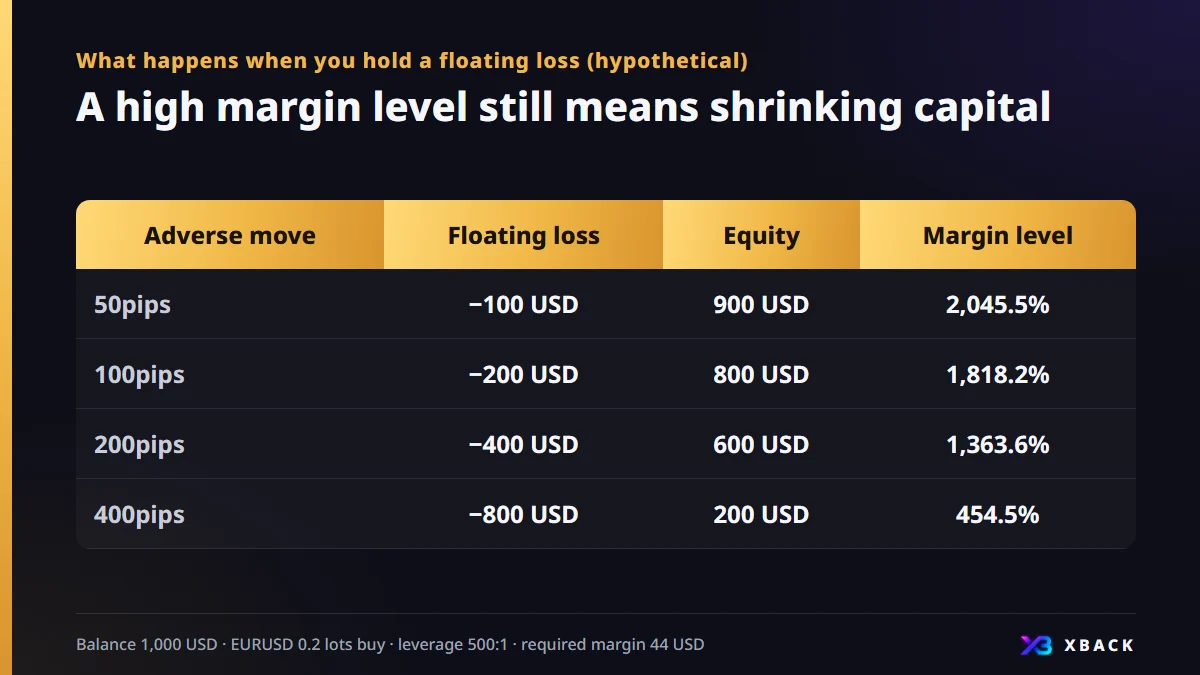
Take hypothetical conditions. Your balance is 1,000 USD and you buy 0.2 lots (20,000 units) of EURUSD at 1.1000. Leverage is 500:1 and 1 pip = 2 USD. Required margin is 20,000 × 1.1000 ÷ 500 = 44 USD.
| Adverse move | Floating loss | Equity | Margin level |
|---|---|---|---|
| 50 pips | −100 USD | 900 USD | 2,045.5% |
| 100 pips | −200 USD | 800 USD | 1,818.2% |
| 200 pips | −400 USD | 600 USD | 1,363.6% |
| 400 pips | −800 USD | 200 USD | 454.5% |
Even after a 400-pip adverse move, the margin level is still 454.5%, which looks safe if you only read that number. But equity has fallen from 1,000 USD to 200 USD, so you have lost 80% of your capital.
The bigger the loss, the harder the recovery: the gain you need
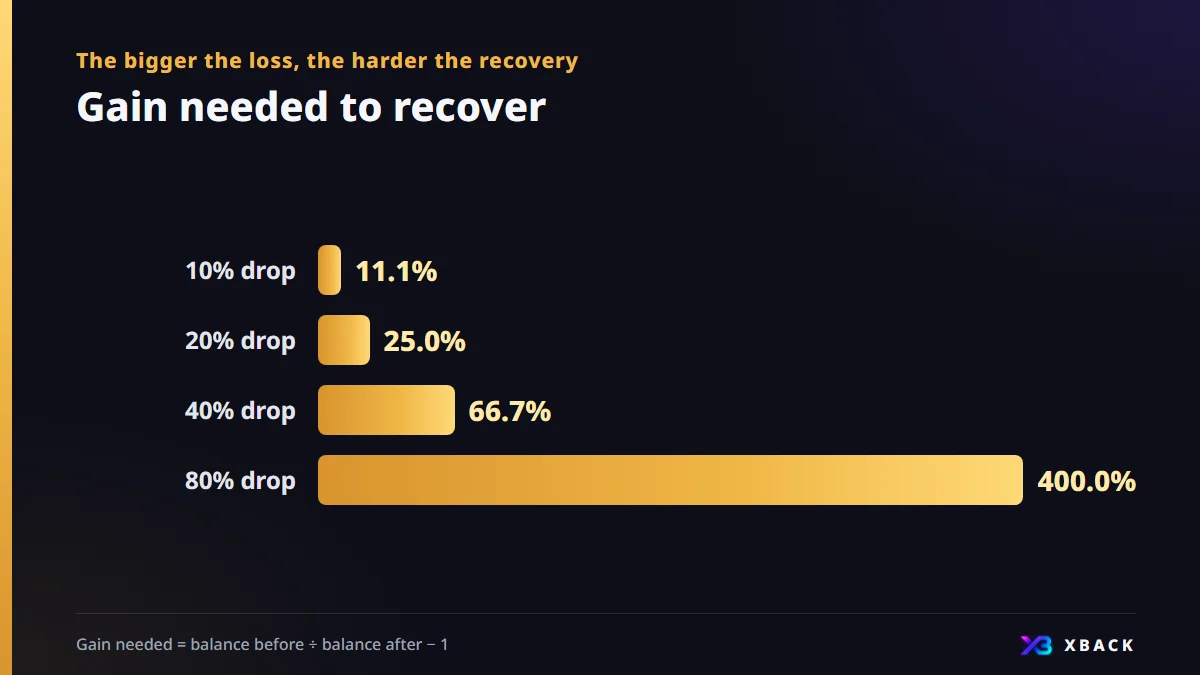
Once your capital shrinks, getting back to the original balance takes a gain larger in percentage terms than the loss. Using the example above, here is the gain needed for each drop in balance.
| Balance drop | Example balance | Gain needed to recover |
|---|---|---|
| 10% drop | 1,000→900 USD | 11.1% |
| 20% drop | 1,000→800 USD | 25.0% |
| 40% drop | 1,000→600 USD | 66.7% |
| 80% drop | 1,000→200 USD | 400.0% |
The 400-pip move in the earlier table is the 80% row. Ride it out that far before cutting, and you need a 400.0% gain to get back. Cut at 50 pips and it is a 10% drop, recovered with 11.1%. Drawdown recovery covers the math in more depth.
When holding can make sense and when to cut
Which is right depends on the situation, so no one answer applies. Use the table below as a rough guide for checking your own position.
| What to check | Holding can be considered | Consider cutting |
|---|---|---|
| Reason | Your reason for entry is still valid | The reason has collapsed, or you can't remember it |
| Time frame | You trade a longer time frame such as the daily chart | You entered short term but it turned into a long hold |
| Advance plan | You set the stop-loss level before entering | No stop-loss level is set, or you moved it |
| Size of loss | Within the amount you can afford | Beyond the amount you can afford |
The most dangerous case is entering a short-term trade and, once it turns into a floating loss, changing the reason to "I'm holding long term." Moving your stop-loss level further away carries the same danger.
Rules when you decide to hold
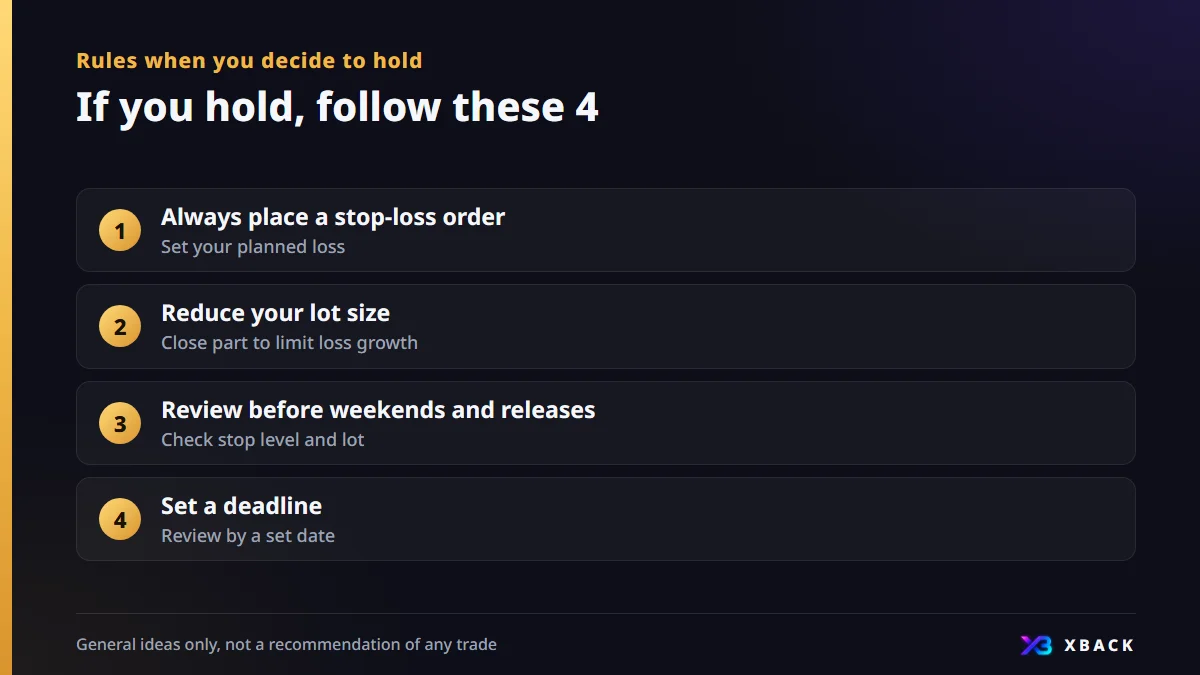
- 1
Always place a stop-loss order
Even if you hold, place a stop order and set your planned loss. On a gap, the stop can fill at a worse price, so the actual loss may exceed the plan.
- 2
Reduce your lot size
Close part of the position so the same price move is less likely to inflate your loss.
- 3
Review before weekends and releases
Before the Friday close or a major release, check that your stop-loss level and lot size are still appropriate.
- 4
Set a deadline
Decide by date how long you will hold, and review the trade when the deadline arrives, whatever the result.
Halving your lot size also halves how fast the floating loss grows. See how to partially close a trade for the steps.
If you hold over a weekend, allow for a gap between your planned loss and the actual one. Weekend gap risk explains how gaps work.
Why averaging down to hold on is dangerous
- Adding to the position raises both the required margin and how fast the floating loss grows
- Your average entry price recovers more easily, but losses accelerate if the adverse move continues
- When the assumption "I'll hold until it comes back" fails, the stop-loss suddenly becomes much larger
- In the example above, if 0.2 lots becomes 0.4 lots, the floating loss at the same adverse move also doubles
Unless averaging down is built into your plan with a lot cap, it tends to become a way of widening losses. The risks of averaging down walks through the numbers.
Enter your balance, lot size and leverage to see in USD how many pips you can withstand before stop-out. Check your margin of safety in numbers before you hold a floating loss.
Calculate the distance to stop-outFAQ
Q.Is it OK to hold a forex floating loss?
There is no single answer. Check whether your reason for entry still stands, whether you set a stop-loss level in advance, and whether the loss is within what you can afford; if not, consider cutting. If you do hold, always place a stop-loss order.
Q.If I hold with a stop-loss order, is my loss capped at that amount?
Not always. If the market gaps at the weekly open, the stop fills at a worse price. A stop-loss order sets your planned loss; the actual loss can be larger.
Q.Is a floating loss fine if my margin level is high?
Capital is still shrinking even at a high margin level. In the 0.2-lot example, a 400-pip adverse move leaves the margin level at 454.5%, but equity falls from 1,000 USD to 200 USD, an 80% loss of capital.
Q.Does swap affect a floating loss I hold?
On a pair with negative swap, costs build up each day the longer you hold. It depends on the trade direction and the broker, so check the swap in the instrument specifications before trading.
Q.Can averaging down reduce a floating loss?
Your average entry price recovers more easily, but a larger lot size also means a bigger loss if the move goes against you. Repeating it with no cap can make the margin level drop suddenly.

This article is for information purposes only and is not investment advice. Conditions may change, so please check each broker's official page for the latest information. Offshore FX and CFD trading carries a risk of losses exceeding your principal.