Forex Lot Size: When to Increase It, 4 Criteria and Steps
After a few good days, do you want to size up but wonder when it is actually safe?
In short, check your results and maximum drawdown on a record traded under the same rules, then raise size only as far as your per-trade risk cap allows. The cap also tells you how big each step can be.
This article separates two cases: size that grows with your balance, and raising the risk per trade itself. It also covers when to cut back and when not to size up at all.
Key takeaways
- Raise your lot size only after checking results and maximum drawdown from records made under the same rules.
- Work back from your maximum loss rate to set each step, and going from 1% to 2% in two steps means raising it about 1.4 times each time.
- Do not raise it right after a winning streak or a deposit or when chasing losses, and decide when to lower it in advance.
In short: raise your lot size only when four conditions are met
- You have a record of the number of trades you set in advance, all under the same rules
- Results over that period are positive and not just built on a lucky winning streak
- Maximum drawdown (the largest drop from your equity peak) is within your own tolerance
- Even at the higher lot size, a single loss stays within the cap you set (for example, 2% of capital)
There is no magic number of trades. Over a short sample, winning and losing streaks happen by pure chance. You can work out how long a losing run is plausible with losing streak probability.
Trades taken after you changed your rules are safer left out of the count.
Raising lots automatically with your balance (fixed-fraction method)
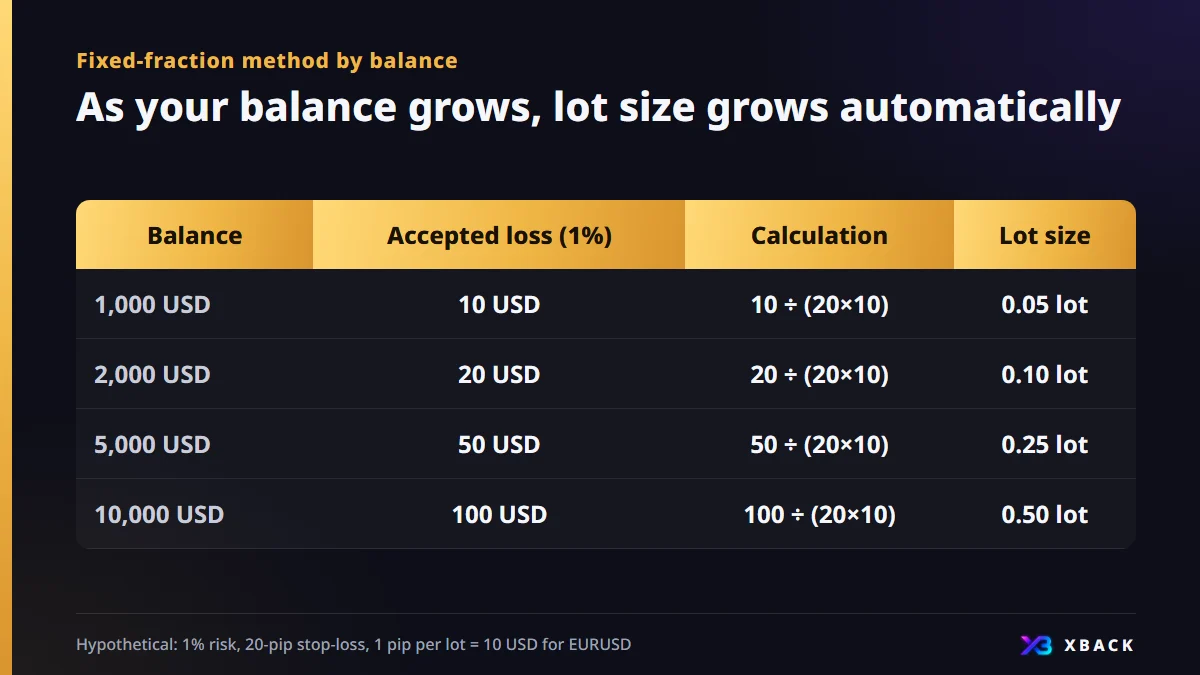
Here the risk stays fixed at 1%, and lot size rises only because the balance rises. Fixed-fraction sizing keeps mood out of the decision.
The formula is lot size = balance × risk rate ÷ (stop-loss pips × value of 1 pip per lot). For EURUSD, 1 pip per lot is 10 USD, so a 20-pip stop-loss means a loss of 200 USD per lot.
| Balance | Accepted loss (1%) | Calculation | Lot size |
|---|---|---|---|
| 1,000 USD | 10 USD | 10 ÷ (20×10) | 0.05 lot |
| 2,000 USD | 20 USD | 20 ÷ (20×10) | 0.10 lot |
| 5,000 USD | 50 USD | 50 ÷ (20×10) | 0.25 lot |
| 10,000 USD | 100 USD | 100 ÷ (20×10) | 0.50 lot |
With this method the risk per trade stays at 1%, so you are not taking on more risk. How to pick the risk rate is covered in the 2% risk-per-trade rule.
How to raise your lot size in steps
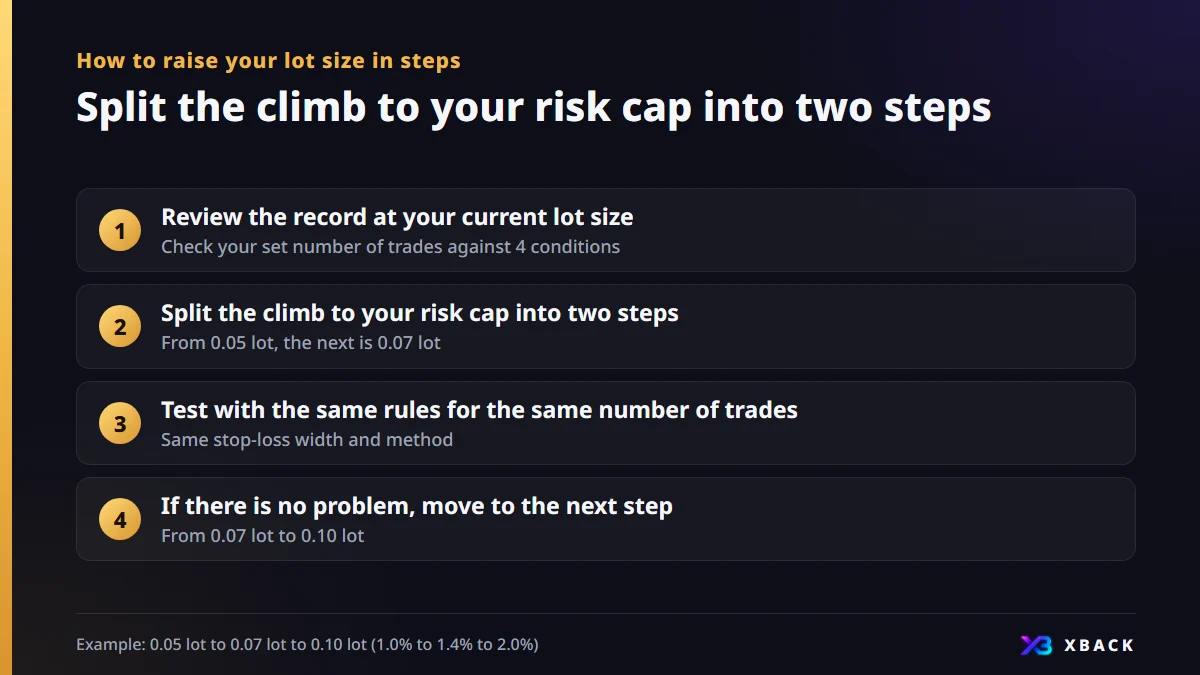
This case keeps the balance at 1,000 USD and raises the risk per trade itself, from 1% to 2%. It is a separate decision from fixed-fraction sizing above.
If your cap is 2% and you risk 1% now, your size can at most double. Splitting that into two steps gives about 1.4 times per step (1.4 × 1.4 ≈ 2).
- 1
Review the record at your current lot size
Check results, maximum drawdown and loss per trade over your set number of trades against the four conditions.
- 2
Split the climb to your risk cap into two steps
From 0.05 lot, the next step is 0.07 lot. 0.07 ÷ 0.05 = 1.4 times.
- 3
Test with the same rules for the same number of trades
Keep the stop-loss width and method unchanged, trade the same number of times as in the previous step and compare the records.
- 4
If there is no problem, move to the next step
From 0.07 lot to 0.10 lot. 0.10 ÷ 0.07 is about 1.43 times, and this is the cap.
With a 20-pip stop-loss, the loss is 10 USD at 0.05 lot, 14 USD at 0.07 lot and 20 USD at 0.10 lot. On a 1,000 USD balance, that is 1.0%, 1.4% and 2.0%.
Decide when to lower your lot size in advance
If you only set rules for sizing up and none for cutting back, you end up holding a large size through a losing streak. Write down your cut-back rules at the same time as your step-up rules.
- Example: if your balance falls 10% from its peak, go back one step (from 0.10 lot to 0.07 lot)
- Example: once you have made the same number of trades at the lower step, start considering raising again
- If trades that break your rules increase, cut your size once, regardless of results
- If a losing streak goes beyond what you expected, stop trading and look for the cause in your records
The gain needed to recover from a drawdown grows sharply as the loss gets bigger. See the numbers in drawdown recovery.
When you should not raise your lot size
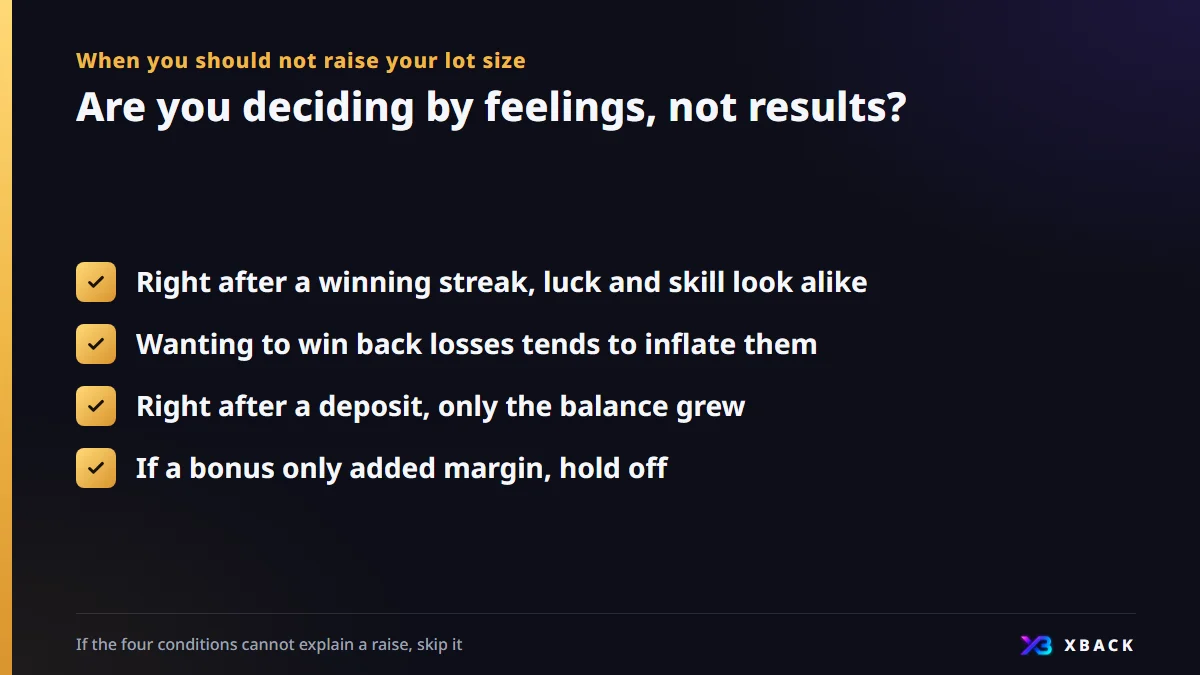
- Right after a winning streak: you cannot yet tell luck from skill. Wait until you have enough recorded trades
- When you want to win back losses: sizing up out of emotion tends to make losses bigger
- Right after a deposit: your balance grew, but your trading record has not changed
- When a bonus only increased your margin: it is not your own money, and under some conditions it can be removed
In every case, size is being set by feelings or by money that only looks like yours, not by results. If the four conditions cannot justify a raise, skip it.
What changes when you raise your lot size
| Item | When you raise your lot size | Example (0.05 to 0.10 lot) |
|---|---|---|
| Profit or loss per pip | Grows in proportion to lot size | 0.5 USD to 1.0 USD |
| Loss at a 20-pip stop | Grows in proportion to lot size | 10 USD to 20 USD |
| Required margin | Grows in proportion to lot size | About 2 times (the amount depends on the broker's leverage) |
| Cashback | Grows in proportion to trading volume (lots) | 0.9 USD to 1.8 USD (DecodeFX STD) |
Doubling your size adds 0.9 USD of cashback per trade. A stopped-out trade, meanwhile, costs 10 USD more. Sizing up to earn more cashback simply does not add up.
Enter your balance, risk rate and stop-loss width to see an appropriate lot size in USD. Before you size up, check how much a single loss would cost.
Work backward from your accepted loss with the lot size calculatorFAQ
Q.When should I increase my lot size in forex?
When you have the number of trades you set in advance under the same rules, results are positive, maximum drawdown is within your tolerance, and a single loss stays within your cap even at the higher size. Hold off right after a winning streak or a deposit.
Q.How much should I raise my lot size each time?
Work backward from your risk cap. If you risk 1% now and your cap is 2%, your size can at most double. Split into two steps, that is about 1.4 times per step: 0.05 to 0.07 to 0.10 lot.
Q.What if 0.01-lot increments don't give exactly 1.4 times?
Round down. For example, 1.4 times 0.03 lot is 0.042, so trade 0.04 lot. Rounding up can push your loss per trade over the cap you set.
Q.Is it okay to raise my lot size to earn more cashback?
It is not recommended. On DecodeFX STD with EURUSD, going from 0.05 to 0.10 lot raises cashback from 0.9 USD to 1.8 USD per round trip. At the same time, the loss at a 20-pip stop rises from 10 USD to 20 USD.

This article is for information purposes only and is not investment advice. Conditions may change, so please check each broker's official page for the latest information. Offshore FX and CFD trading carries a risk of losses exceeding your principal.