Forex Losing Streak Probability: How Many Losses in a Row by Win Rate, and Money Management
When losses pile up, do you wonder whether your method is broken or it is just chance?
In short, even with a 50% win rate, a 5-loss streak happens with about 81% probability over 100 trades, so it is nothing unusual.
This article shows streak probabilities by win rate in a table, how streaks affect your capital and how to set money management that assumes them.
Key takeaways
- At a 50% win rate, a 5-loss streak occurs with about 81% and a 7-loss streak with about 32% probability over 100 trades.
- With 10,000 USD and 2% per trade, you still have 8,000 USD after 10 losses and need a 25% gain to recover.
- Do not raise your lot during a streak; set the planned streak and the loss rate per trade from your win rate and write them down.
In short: even at a 50% win rate, a 5-loss streak occurs about 81% of the time over 100 trades
- Losing streaks happen as a matter of probability, whether the method is good or not
- At a 50% win rate over 100 trades, a 5-loss streak occurs with about 81% and a 7-loss streak with about 32% probability
- If you risk a fixed 2% of starting capital per trade (200 USD), even 5 losses in a row cost only 10% of capital
- Raising your lot during a streak makes you lose more capital than probability alone explains
Losing streak probability formula: a single run vs. within 100 trades
There are two ways to look at streak probability: "the next 5 trades all lose" and "a 5-loss streak occurs somewhere within 100 trades."
- Single run: multiply the loss rate k times. At a 50% win rate, 5 losses in a row is 0.5 to the 5th power = about 3.1%
- Within 100 trades: the probability of at least one streak occurring somewhere, which is much higher than a single run
- The calculation assumes a constant win rate and independent trades
- The real win rate varies, so use the table figures as a guide
The single-run 3.1% makes a 5-loss streak look rare. But over 100 trades there are many places it can start, so the probability rises to about 81%.
When judging a method, think in terms of the probability within 100 trades. If you drop a method after an expected streak, no method will last.
Losing streak probability by win rate (100 trades)
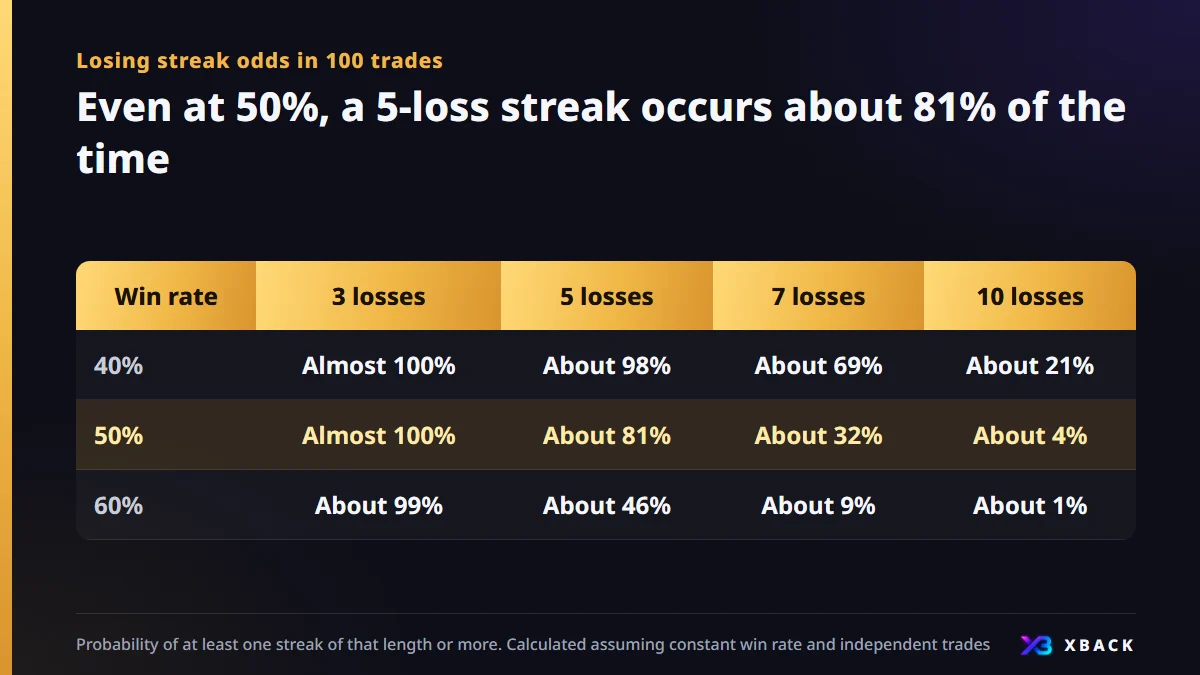
This is the probability that a streak of k losses or more occurs at least once in 100 trades, for win rates of 40%, 50% and 60%. These are calculated values.
| Win rate | 3 losses | 5 losses | 7 losses | 10 losses |
|---|---|---|---|---|
| 40% | Almost 100% | About 98% | About 69% | About 21% |
| 50% | Almost 100% | About 81% | About 32% | About 4% |
| 60% | About 99% | About 46% | About 9% | About 1% |
With a 40% win rate, a 7-loss streak occurs with about 69% probability. Methods with a high risk-reward ratio tend to have low win rates, so they must be designed for long streaks.
Even at a 60% win rate, a 5-loss streak occurs about 46% of the time. A high win rate does not mean you will not lose in a row.
How streaks affect your capital: a 2% rule example
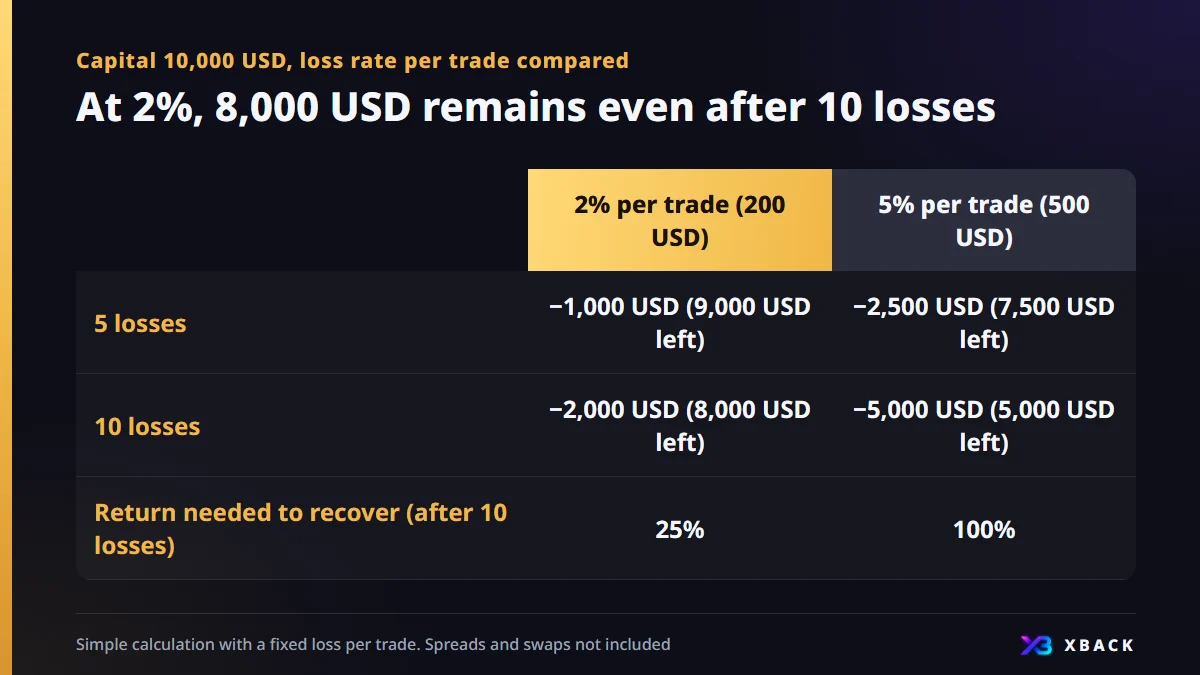
The percentage of capital you risk per trade changes how much the same streak costs. Here is a comparison of 2% and 5% per trade with 10,000 USD of capital.
| Losing streak | 2% per trade (200 USD) | 5% per trade (500 USD) |
|---|---|---|
| 5 losses | −1,000 USD (9,000 USD left) | −2,500 USD (7,500 USD left) |
| 10 losses | −2,000 USD (8,000 USD left) | −5,000 USD (5,000 USD left) |
| Return needed to recover (after 10 losses) | 25% | 100% |
Check the math. 200 USD × 10 = 2,000 USD, leaving 8,000 USD. To get from 8,000 USD back to 10,000 USD you need 2,000 ÷ 8,000 = 25%.
At 5%, 500 USD × 10 = 5,000 USD, leaving 5,000 USD. To recover you need 100%, that is, to double your capital.
At a 50% win rate, a 10-loss streak occurs with about 4% probability. At 5% per trade, a streak that can realistically happen cuts your capital in half.
The table above keeps the loss amount fixed. If you recalculate the loss as 2% of whatever your balance is after each loss, capital falls a little more slowly.
| Losses in a row | 2% of current balance | 5% of current balance |
|---|---|---|
| 5 losses | About 9,039 USD left | About 7,738 USD left |
| 10 losses | About 8,171 USD left | About 5,987 USD left |
| Gain needed to recover (after 10 losses) | About 22.4% | About 67.0% |
This is the same method as the losing-streak table in the 2% rule article. Because your lot shrinks with your balance, each loss gets smaller.
3 things not to do during a losing streak
- Raise your lot to win it back: the streak probability does not change, only the loss per trade grows
- Take more trades outside your rules: the win-rate assumption breaks and the table no longer applies
- Widen your stop loss: a single loss exceeds 2%, and the drawdown in a streak is larger than calculated
For example, after 5 losses you raise a 200 USD loss to 1,000 USD and then lose twice more. The total is 3,000 USD, more than double the 1,400 USD you would lose in a 7-loss streak at 2%.
Check the math. 200 USD × 5 = 1,000 USD and 1,000 USD × 2 = 2,000 USD, a total of 3,000 USD. Keeping to 2%, 200 USD × 7 = 1,400 USD.
How to set money management that assumes losing streaks
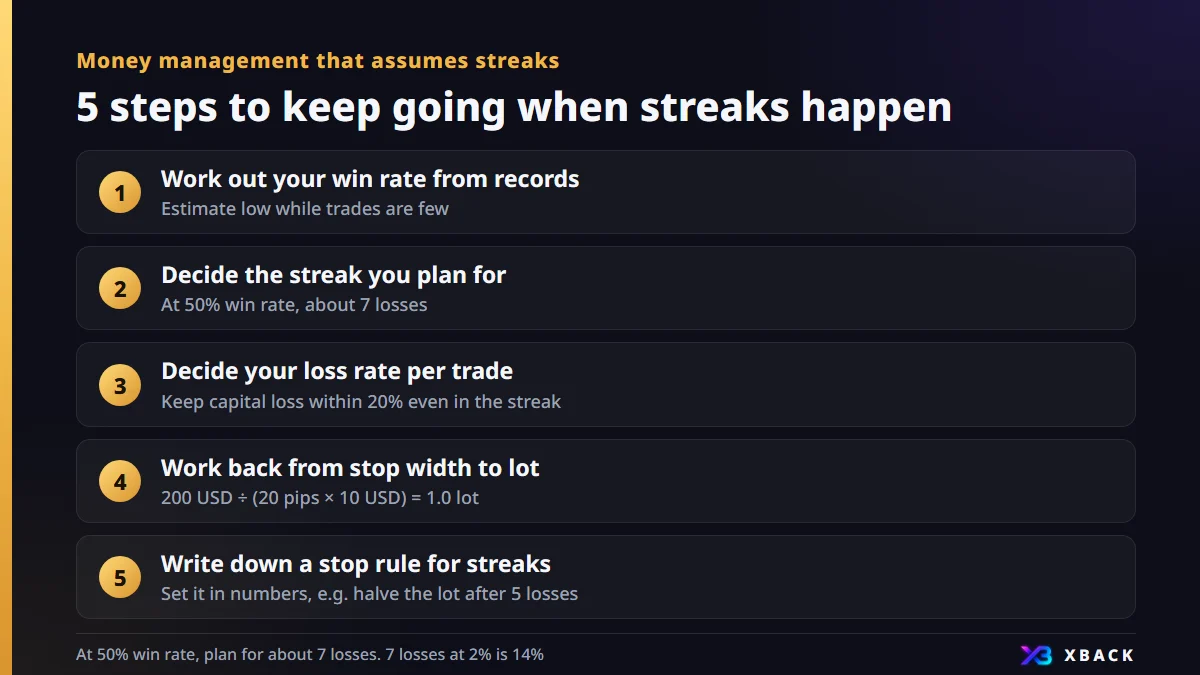
You cannot avoid losing streaks, so design your plan to keep going when they happen. There are 5 steps.
- 1
Work out your win rate from your records
Calculate your win rate from recent trading records. While trades are few, estimate it on the low side.
- 2
Decide the streak you plan for
From the table, pick the streak that can occur in 100 trades for your win rate. At a 50% win rate, about 7 losses is a guide.
- 3
Decide your loss rate per trade
Choose a rate that keeps capital loss within 20% even in the planned streak. If 7 losses is 14%, 2% per trade is a guide.
- 4
Work back from the stop-loss width to the lot
Lot = loss amount ÷ (stop-loss pips × value per pip). 200 USD ÷ (20 pips × 10 USD) = 1.0 lot.
- 5
Write down your stop rule for streaks
Set it in numbers and write it down, such as "halve the lot after 5 losses" or "stop if the day's loss reaches 4%."
Five worked lot-sizing examples are in lot size calculation examples. The wider your stop loss, the smaller your lot.
Losing streaks and cashback
- Cashback is paid on trading volume, so it builds up whether you win or lose
- Example: 10 straight losses on EURUSD at 1.0 lot cost 2,000 USD (200 USD each)
- On a DecodeFX STD account, cashback is 18 USD per round-turn lot x 10 trades = 180 USD
- On a Monaxa Standard account, FX pays 5 USD per round-turn lot, so 50 USD
- Neither covers even a tenth of the loss. Raising lots or trade count to earn more cashback just makes the losses grow first
Cashback amounts by broker are listed on the cashback rates page. Treat cashback as a way to lower trading costs, not a way to cover losing streaks.
Enter your win rate and risk-reward ratio to see the expected value per trade. Check that your method is sustainable even with losing streaks.
Calculate expectancyFAQ
Q.How many losses in a row can happen at a 50% win rate?
Over 100 trades, a 5-loss streak occurs with about 81%, 7 losses with about 32% and 10 losses with about 4% probability. These are calculated values assuming a constant win rate and independent trades. Treat 5 or 7 losses as expected and design your money management around them.
Q.Should I change my method after a losing streak?
A streak within the table's range is explained by probability, so it is not a reason to change your method. At a 50% win rate, a 5-loss streak occurs about 81% of the time. If streaks far beyond the table continue, first check in your records whether you followed your rules.
Q.What percentage of capital should I risk per trade?
Around 2% is generally considered a guide. In the example, with 10,000 USD and 2% (200 USD) per trade, you still have 8,000 USD after 10 losses and need a 25% gain to recover. At 5%, you have 5,000 USD left after 10 losses and need a 100% gain.
Q.Can I receive cashback during a losing streak?
Yes. It is paid on trading volume, so winning or losing does not matter. But 10 straight losses at 1.0 lot (a 2,000 USD loss) earn only 180 USD on a DecodeFX STD account and 50 USD on a Monaxa Standard account. That will not cover the loss.

This article is for information purposes only and is not investment advice. Conditions may change, so please check each broker's official page for the latest information. Offshore FX and CFD trading carries a risk of losses exceeding your principal.