Holding Positions Through News Releases: Close, Partial Close or Move to Breakeven
With an economic release coming up, are you unsure whether to hold your open positions through it or close them?
In short, compare your options before the release and decide how to treat each position beforehand.
This article covers the 4 choices, why stop-losses work less well, a USD account calculation and the steps for deciding.
Key takeaways
- Decide beforehand how to handle positions at a release: close all, close part, move to breakeven or hold.
- A 30-pip stop on 0.5 lot is −150 USD, but a 20-pip slip makes it −250 USD.
- Closing 0.25 lot at +40 pips locks in +100 USD, and you can move the stop on the rest to breakeven.
In short: decide how to handle positions at a release before it happens
- You have 4 choices for an open position: close all, close part, move the stop to breakeven, or hold as is
- At a release, a stop-loss order can fill at a worse price than expected because of slippage
- Combining a partial close with a move to breakeven makes it easier to cap your loss
- If you are unsure, closing before the release and sitting it out is also a valid choice
Comparing the 4 choices at a release
There are 4 broad ways to handle open positions at a release. There is no single right answer. The point is to choose what fits your funds and your approach.
| Choice | Advantage | Drawback | Suits |
|---|---|---|---|
| Close everything before the release | Unaffected by sudden moves | You also miss any follow-through | Beginners, and those who want to limit losses |
| Close part and hold the rest | Locks in part of the profit | The rest is exposed to sudden moves | Those with floating profit |
| Hold with the stop at breakeven | Nearly caps the loss if the move is as expected | May not fill at breakeven in a sudden move | Those riding a trend |
| Hold as is | No effort, and you capture any extension | Losses can grow suddenly | Experienced traders with a clear loss limit |
A guide when you are unsure is whether a sudden move would push your loss past what you can accept. One well-known approach is to keep the acceptable loss per trade within 2% of your funds.
For general cautions around releases, see the related column on economic indicators. Another related column explains how to read the calendar.
Why stop-loss orders work less well at releases
A stop-loss (stop order) turns into a market order once the set price is reached. At releases the price tends to jump, so you are not always filled at the set price.
- Slippage: you are filled at a worse price than set
- Wider spreads: the wider spread can touch your stop-loss price sooner
- Fill delays: orders pile up and processing can take time
How slippage works and when spreads tend to widen are covered in separate related columns. How much spreads widen differs by broker.
Calculation example: when slippage increases your loss
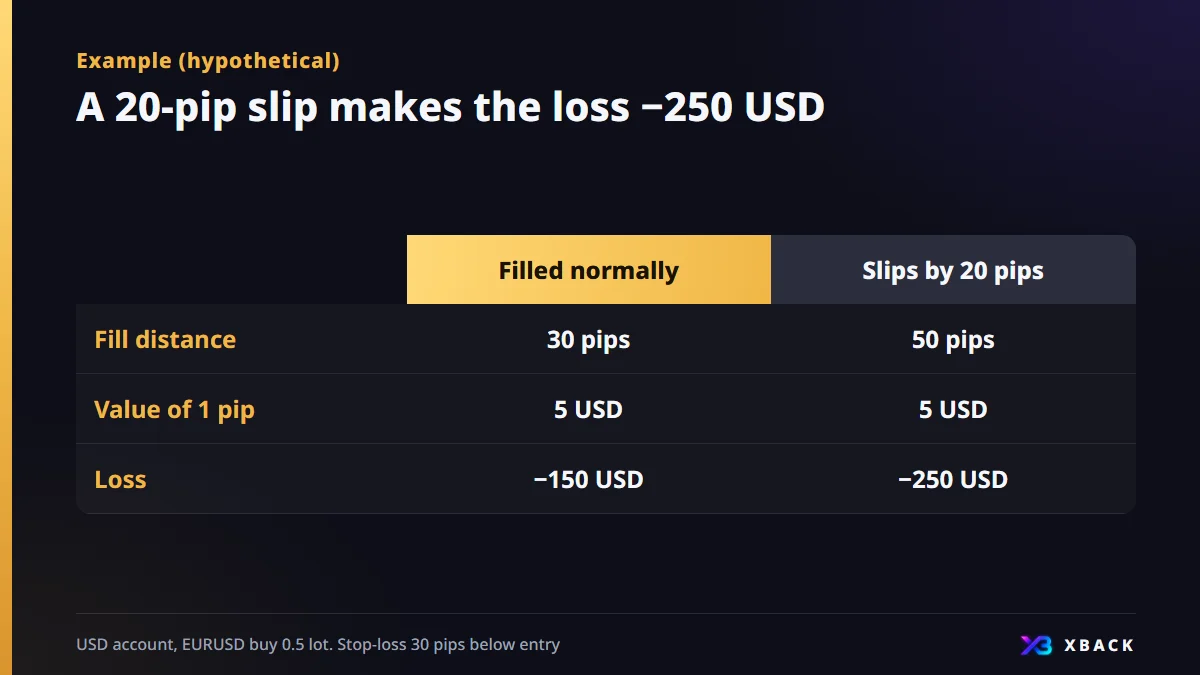
In a USD account you buy 0.5 lot of EURUSD and place the stop-loss 30 pips below your entry price. For 0.5 lot, 1 pip = 5 USD.
| Scenario | Fill distance | Value of 1 pip | Loss |
|---|---|---|---|
| Filled normally | 30 pips | 5 USD | −150 USD |
| Slips by 20 pips | 50 pips | 5 USD | −250 USD |
The calculations are 30 × 5 = 150 and 50 × 5 = 250. You lose 100 USD more than planned.
If the spread also widens to several times its usual size, the point where your stop-loss is touched comes sooner. How much it widens differs by broker and time of day, so these figures are only examples.
Calculation for closing half and moving the stop to breakeven
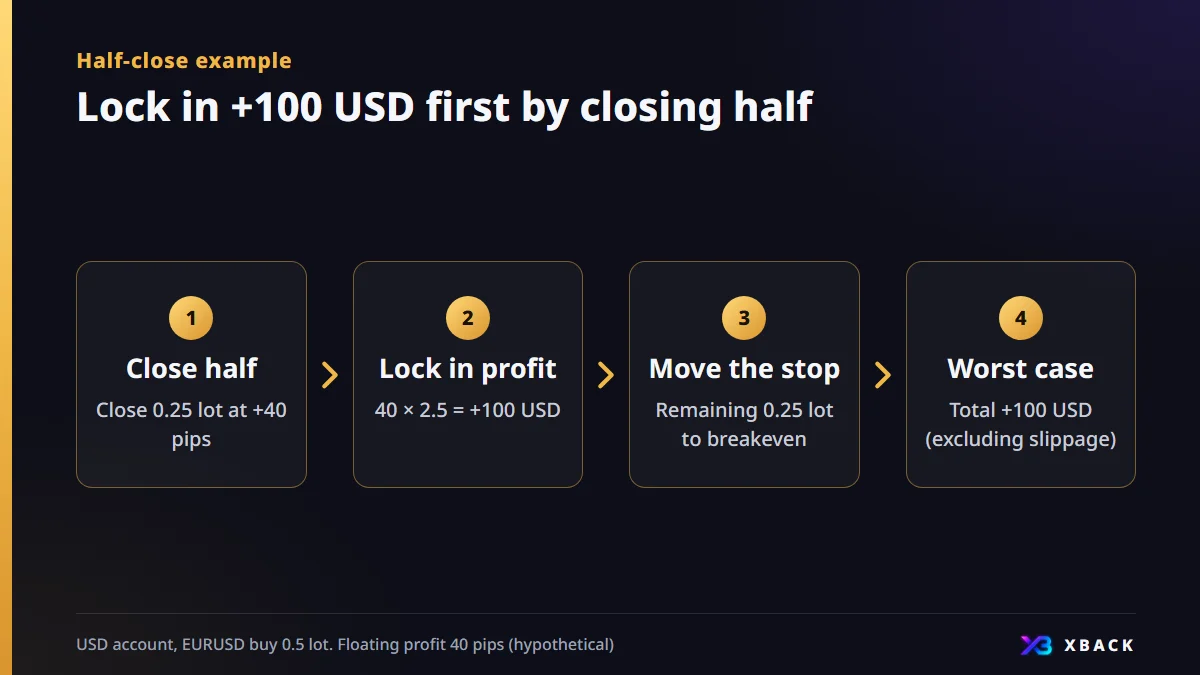
Take the same 0.5-lot buy when the floating profit reaches 40 pips. For 0.25 lot, 1 pip = 2.5 USD.
- Close 0.25 lot at +40 pips: 40 × 2.5 = +100 USD locked in
- Move the stop-loss for the remaining 0.25 lot to breakeven
- Even if stopped at breakeven, the remainder's profit and loss is 0, so the total is +100 USD
The +100 USD you locked in stays even if the price reverses after the release. However, if slippage occurs, an order may fill at a worse price than breakeven.
If the remaining 0.25 lot extends another +40 pips and you close it, that adds 40 × 2.5 = +100 USD. The total becomes +200 USD.
5 steps for deciding how to respond at a release
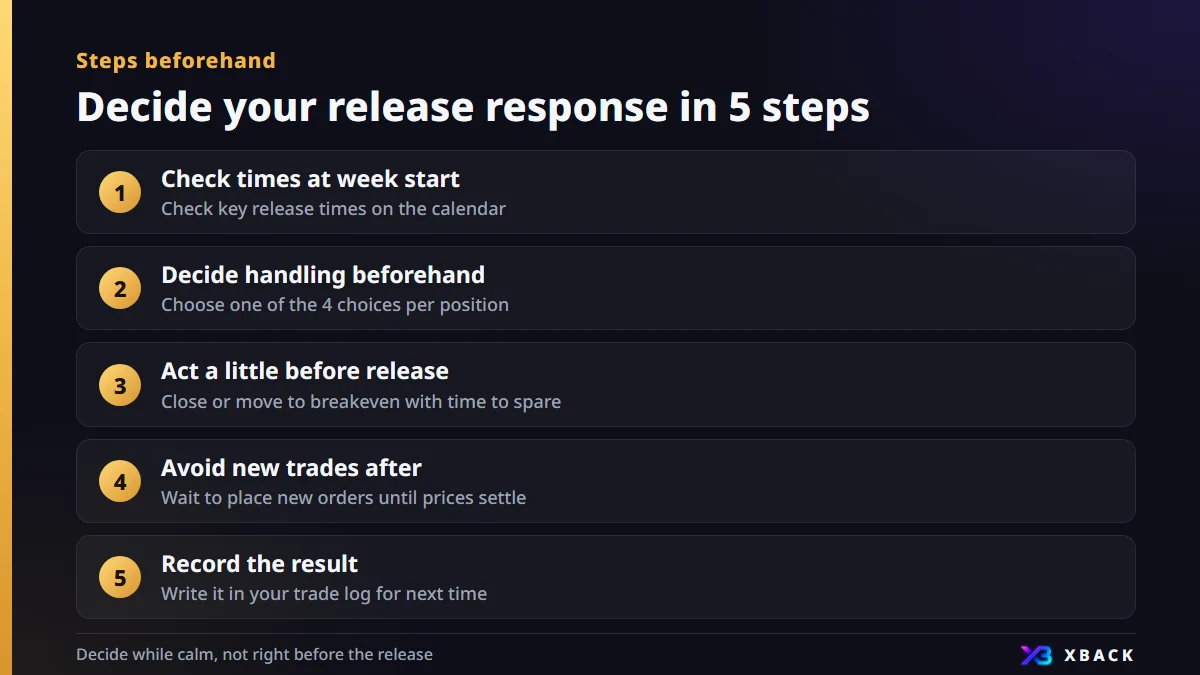
Make the decision while you are calm, not right before the release. Decide for each position using the flow below.
- 1
Check times at week start
Check release times of key indicators on the calendar.
- 2
Decide handling beforehand
Choose one of the 4 choices for each position.
- 3
Act a little before release
Close or move to breakeven with time to spare.
- 4
Avoid new trades after
Wait to place new orders until prices settle.
- 5
Record the result
Write it in your trade log for next time.
Orders get crowded right before a release. The common approach is to act several minutes to tens of minutes ahead, not at the last moment.
4 forms to avoid
- Adding new lots right before the release
- Removing your stop-loss and holding on
- Hedging with opposite positions and feeling covered
- Raising lots because of a balance inflated by a bonus
Hedging with opposite positions can fix a loss, but costs such as the spread are paid twice. How it works is covered in a related column.
Bonuses often come with withdrawal conditions, so your balance may not be as freely usable as it looks. Conditions differ by broker, so check the official page.
If you run an EA
An EA keeps placing orders without human judgment. It is important to know in advance how it behaves at releases.
- Check whether the EA has a setting to stop during releases
- Some EAs have a news filter, but this differs by EA
- If you stop it, also decide how to handle open positions
- Check behavior at releases on demo or in a backtest
Cashback and trading rules around releases
- The cashback amount is not yet confirmed and will be posted on each broker page at launch
- Many cashback schemes are calculated on trading volume and do not make up for losses
- Some brokers restrict trading during releases, so check the terms
- Do not trade more around releases for the sake of cashback
Enter the currency pair and lots to check the profit and loss per pip. See the loss at your stop-loss distance in numbers before the release.
Calculate pip valueFAQ
Q.Should I close positions before an economic release?
Closing is not required. You choose based on your funds and approach. If a sudden move would push your loss past what you can accept, you can close all or part to reduce exposure. If you are unsure, closing before the release and sitting it out is also an option.
Q.Does a stop-loss fill at the set price at a release?
Not always. A stop-loss turns into a market order, so slippage can occur. With 0.5 lot, a planned loss of −150 USD at 30 pips becomes −250 USD if it fills at 50 pips.
Q.If I move my stop-loss to breakeven, will I have no loss?
If the move is as expected, your profit and loss approaches 0, but in a sudden move an order can fill at a worse price than breakeven. The spread also has an effect. Do not assume the loss disappears. Treat it as one way to cap the loss.
Q.Do any brokers restrict trading during releases?
Some brokers set restrictions or cautions in their terms. The details differ by broker, so check the official page and terms. The cashback amount is not yet confirmed and will be posted on each broker page at launch.

This article is for information purposes only and is not investment advice. Conditions may change, so please check each broker's official page for the latest information. Offshore FX and CFD trading carries a risk of losses exceeding your principal.