When Spreads Widen: Early Morning and Market Open Tactics, with Cost Examples
Have you ever opened the chart in the morning or at the start of the week and been surprised to find the spread suddenly wide?
In short, the times when spreads tend to widen are fairly set, so you can avoid them in advance.
This article covers the timing, why they widen, a cost example, how to handle it and how to check in MT5.
Key takeaways
- Spreads tend to widen around the early morning rollover, at the start of the week, around indicator releases and on thin-volume days.
- They widen mainly because fewer participants trade and brokers allow for more risk.
- Avoid new orders when spreads are wide, and check the spread in the MT5 Market Watch before you trade.
In short: spreads tend to widen in early morning, at the market open and around releases
- They tend to widen around the early morning rollover, at the start of the week, around indicator releases and on thin-volume days
- The main reason is that fewer participants trade and brokers allow for more risk
- The extra width is added directly to the trading cost of every trade
- Avoid new orders in those periods and check the spread before you trade
5 main times when spreads widen
The spread is not always constant and changes with the time of day and market conditions. The following five are typical times when it tends to widen.
| Timing | Guide in Japan time | Why it tends to widen |
|---|---|---|
| Around the early morning rollover | Around 6 to 7 a.m. | The US market has closed and few participants are active |
| Right after the Monday market open | Early Monday morning to morning | Price tends to gap because of events over the weekend |
| Around economic indicator releases | Differs by indicator | The result is hard to read and price moves suddenly |
| Holidays and the New Year period | US and European holidays, etc. | Few people trade and the market gets thin |
| Statements by key officials and breaking news | Irregular | Brokers allow for risk because of sudden moves |
Around the early morning rollover
Rollover is the time when the date changes at the end of the trading day. It falls in the early morning in Japan time and is known as a period when spreads tend to widen.
In this period, few participants from Europe and the US are around, and the Tokyo market has not yet started to move. It also overlaps with swap crediting, so many people avoid it.
The start of the week, holidays and the New Year period
Right after the market opens at the start of the week, events that happened over the weekend can be reflected in price all at once.
On holidays and over the New Year, participants in major countries are off, so trading volume gets thin. Spreads wider than usual may last for a while.
Economic indicators and breaking news
For key indicators such as employment reports and policy rate decisions, spreads tend to widen from just before the release to just after. You can read the details of what to watch in the related column on indicators.
Why spreads widen: liquidity and risk avoidance
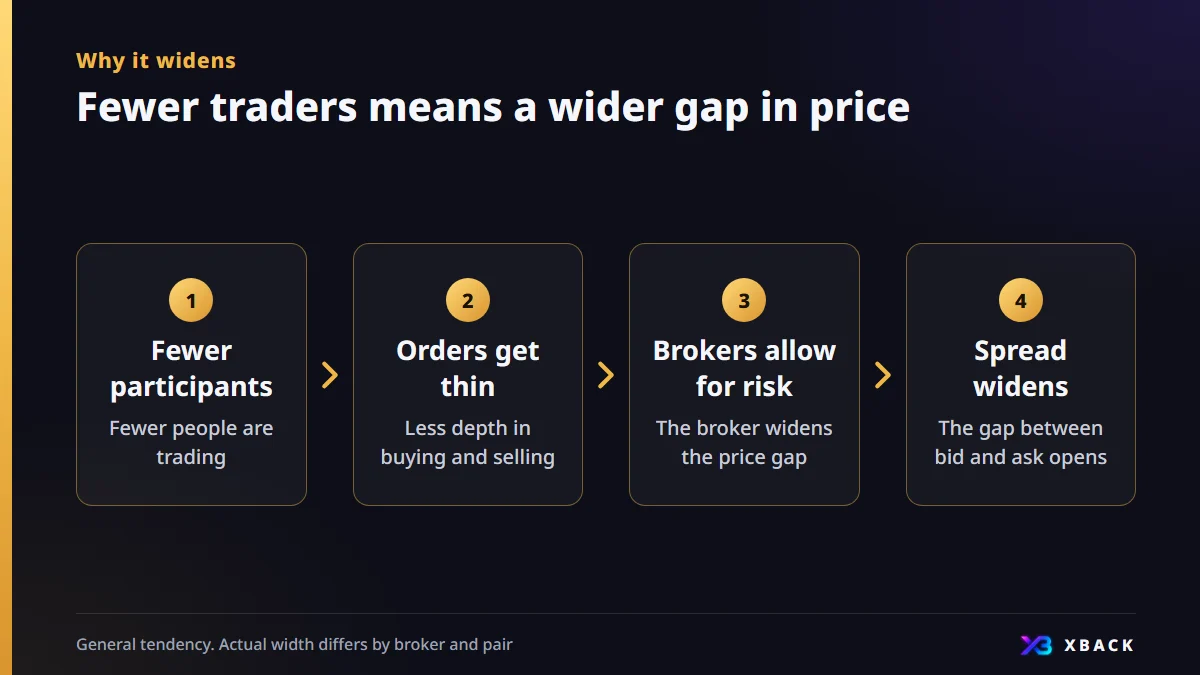
The spread is the difference between the buy price and the sell price. A broker quotes this width taking into account the certainty of execution and its own risk.
- Fewer participants trade and buy and sell orders get thin (lower liquidity)
- The chance of price jumping suddenly rises, and brokers allow for the risk
- As a result, the gap between the buy price and sell price opens and the spread widens
When many people trade, competition tends to narrow the width. When few people trade, the width moves toward opening up.
Watch the gap between server time and Japan time
The times shown on MT5 charts are the broker's server time, not Japan time. Even if you memorize the widening periods in Japan time, they will not match the time on your screen.
- The difference between server time and Japan time is set for each broker
- Many brokers shift the difference by one hour when the US and others switch between summer and winter time
- The widening period in Japan time moves by about an hour with the season
How much does a wider spread add to your cost?
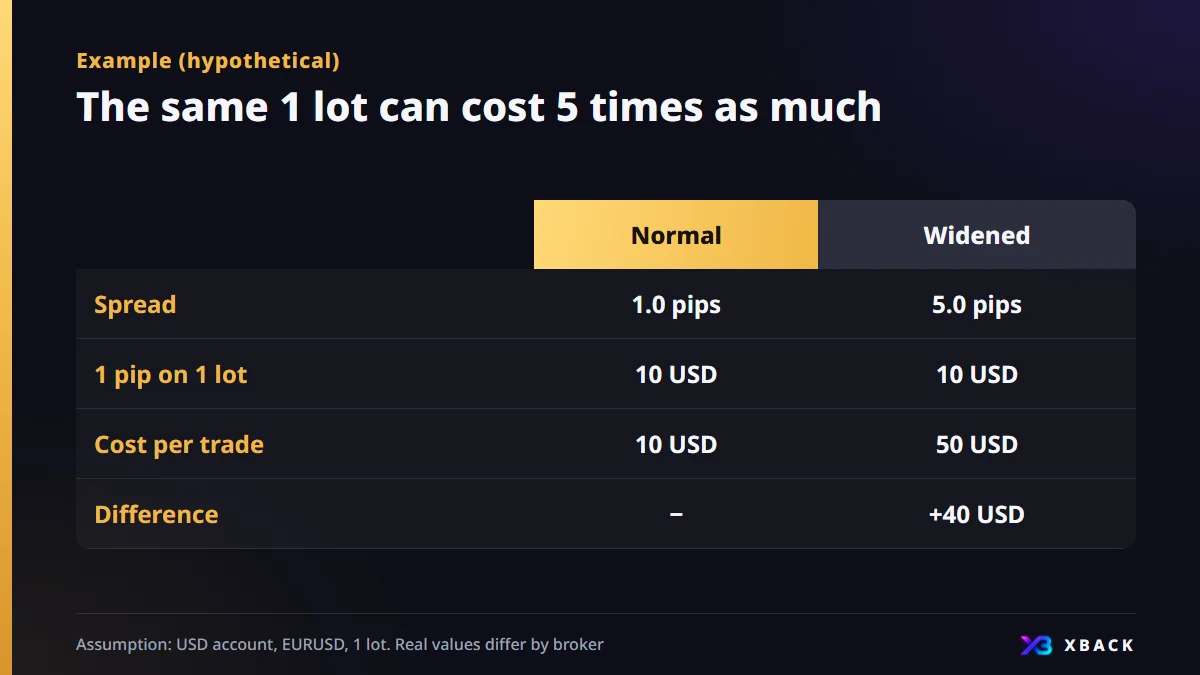
This example calculates the cost difference for trading 1 lot of EURUSD. At 1 lot, 1 pip is 10 USD, and you start the trade at a disadvantage equal to the spread.
| Item | Normal | Widened |
|---|---|---|
| Spread | 1.0 pips | 5.0 pips |
| 1 pip on 1 lot | 10 USD | 10 USD |
| Cost per trade | 10 USD | 50 USD |
| Difference | − | +40 USD |
1.0 pips × 10 USD is 10 USD, and 5.0 pips × 10 USD is 50 USD. For the same trade, entering in a widened period makes the difference 40 USD.
With a smaller lot size, the amount falls in proportion. At 0.1 lots, 1 pip is 1 USD, so it is one tenth: 1 USD and 5 USD.
5 ways to handle spread widening
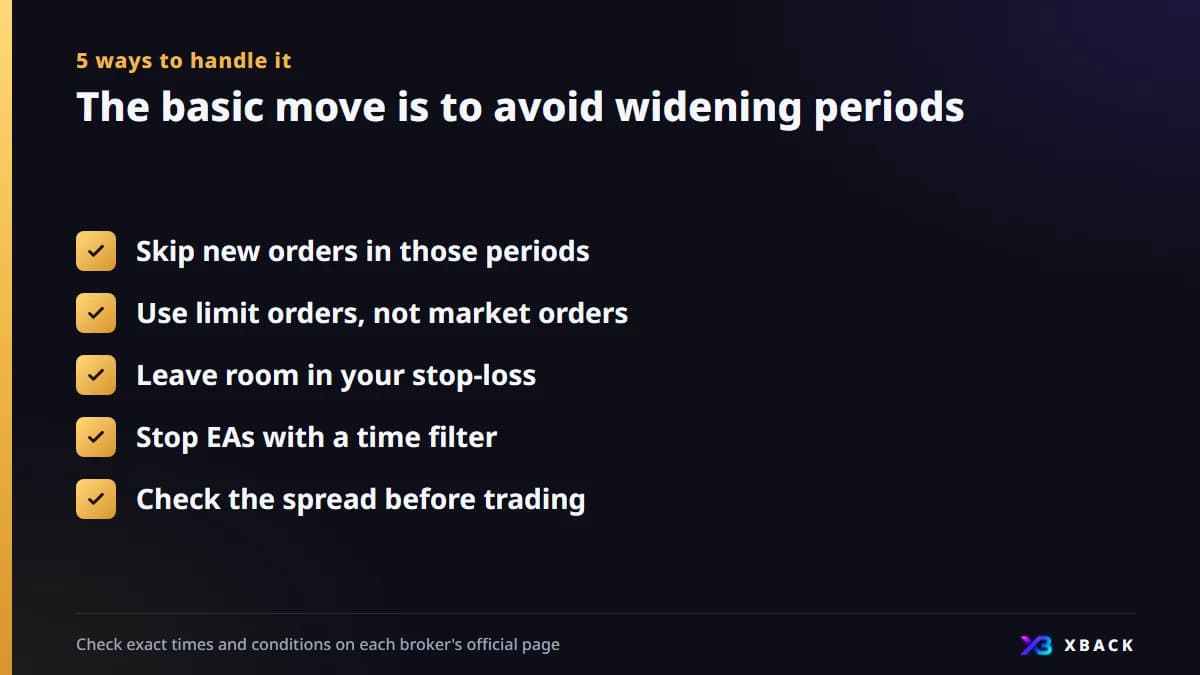
- 1
Skip new orders in those periods
Avoid new entries in the early morning, right after the market opens for the week and around indicator releases.
- 2
Use limit orders rather than market orders
One option is to enter with a limit order so that you do not get a worse price than the one you specify.
- 3
Leave room in your stop-loss
A widening can touch your stop-loss, so review the distance and lot size.
- 4
Stop EAs with a time filter
For automated trading, add a setting that stops it during widening periods.
- 5
Check the spread before trading
Make it a habit to always look at the current spread just before you place an order.
Pay particular attention to your stop-loss. A sell position is closed at the ask-side price, so when the spread widens it is easier for your stop-loss to be touched.
Holding overnight can cross a widening period
If you hold a position overnight, it may cross the early morning widening period. One approach is to close before then or use a lot size with room to spare.
How to check the spread in MT5
- 1
Open the Market Watch
This is the window listing the bid and ask price of each symbol. Check the current price here.
- 2
Show the Spread column
If you show the Spread column in the Market Watch, you can see the difference for each symbol at a glance.
- 3
Compare at different times of day
Compare the figures in normal conditions with those in the early morning or around releases to learn your own broker's tendencies.
How spreads relate to cashback
The spread is a real cost that applies to every trade. Cashback can be seen as one way to ease part of that cost.
Return amounts are not yet confirmed, and we will post them on each broker's page at launch. Even with returns, it is not a reason to trade in widened periods.
Enter the spread and lot size to see the trading cost per trade. Compare normal and widened conditions.
Calculate your spread costFAQ
Q.At what time in Japan time do spreads widen?
Generally, the period around the early morning rollover (around 6 to 7 a.m. Japan time) is well known. It shifts by an hour between summer and winter time and also differs by broker, so checking on your own broker is the surest way.
Q.Why do spreads widen?
Fewer participants trade, buy and sell orders get thin, and brokers allow for more price-movement risk. It is more likely in thin trading in the early morning or on holidays, around indicator releases and during breaking news.
Q.How do I handle the periods when spreads widen?
The basics are to skip new orders, use limit orders, leave room in your stop-loss, stop EAs with a time filter and check before you trade. If you hold overnight, also watch for crossing a widening period.
Q.Can a wider spread trigger my stop-loss?
It can. A sell position is closed at the ask-side price, so when the spread widens it is easier to touch your stop-loss price. In widening periods, review your stop distance and lot size.

This article is for information purposes only and is not investment advice. Conditions may change, so please check each broker's official page for the latest information. Offshore FX and CFD trading carries a risk of losses exceeding your principal.