FX Trading Sessions: Tokyo, London and New York Hours and When the Market Moves

FX trades almost 24 hours on weekdays, so are you unsure which time of day to trade?
The short answer: markets open in the order Tokyo, London, New York. In the evening (Japan time) when London and New York overlap, the business hours of the US and UK hubs, where trading volume is large, line up.
This article covers converting to Japan time (summer time and winter time), cautions for each session, and which sessions suit which trading style.
Key takeaways
- Markets open in the order Tokyo, London, New York, and Japan time shifts by 1 hour between summer time and winter time.
- London and New York overlap from 22:00 to 2:00 (next day) Japan time in winter time and from 21:00 to 1:00 (next day) in summer time.
- In the weeks when the US and European daylight saving switch dates differ, the overlap becomes 5 hours: March 8 to 28 and October 25 to 31 in 2026.
Short answer: FX session characteristics are set by the order markets open and where they overlap
- Markets move in the order Tokyo, London, New York, starting from the morning in Japan time
- London and New York hours shift by 1 hour in Japan time between summer time and winter time
- In the evening when two markets overlap, the business hours of the US and UK hubs, where trading volume is large, line up
- Early morning, around the end of the New York session, tends to see wider spreads
- Which session suits you depends on your trading style, so choose to match your daily schedule
What are Tokyo, London and New York hours in Japan time?
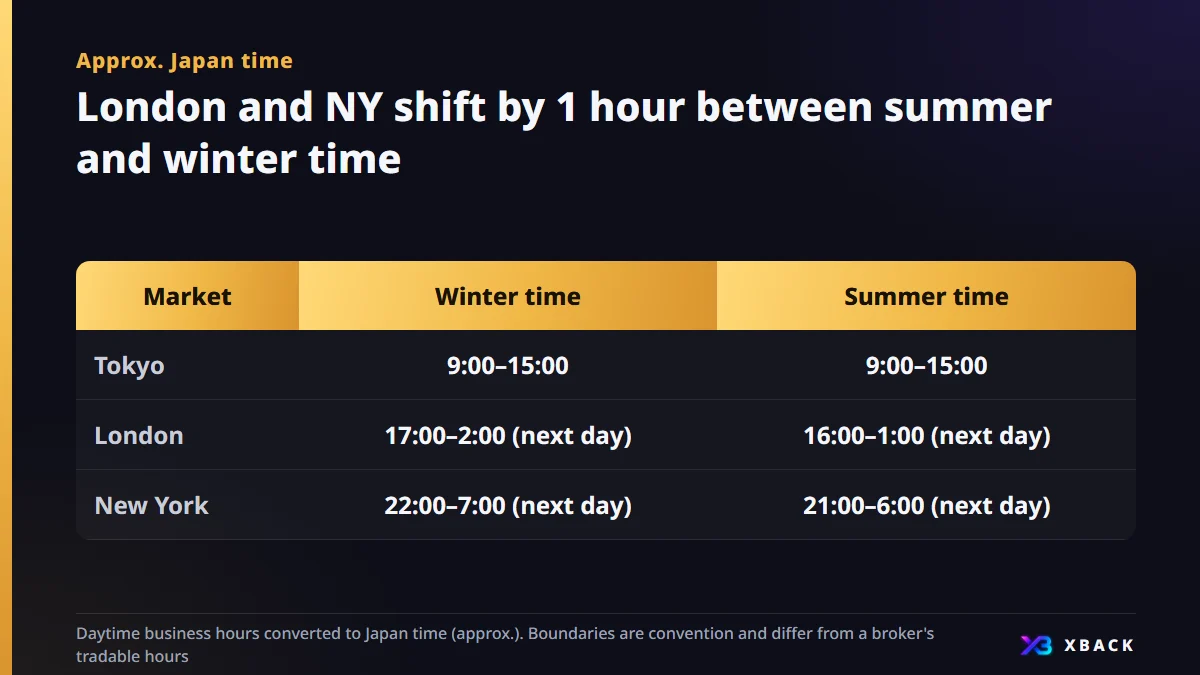
Forex has no exchange opening hours like stocks, and there is no official definition of where a session starts or ends. This article uses approximate daytime business hours of each region converted to Japan time.
| Market | Japan time (winter time) | Japan time (summer time) | Local time (approx.) |
|---|---|---|---|
| Tokyo | approx. 9:00–15:00 | approx. 9:00–15:00 | approx. 9:00–15:00 |
| London | approx. 17:00–2:00 (next day) | approx. 16:00–1:00 (next day) | approx. 8:00–17:00 |
| New York | approx. 22:00–7:00 (next day) | approx. 21:00–6:00 (next day) | approx. 8:00–17:00 |
Japan Standard Time is 9 hours ahead of Coordinated Universal Time (UTC). The conversion assumes Japan time does not change with the seasons, and converts the London and New York side.
When do summer time and winter time switch?
The switch dates differ between the US and Europe. When they switch, the market times in Japan time move by 1 hour.
| Region | Summer time starts | Summer time ends | Dates in 2026 |
|---|---|---|---|
| US | 2nd Sunday of March, 2:00 a.m. | 1st Sunday of November, 2:00 a.m. | March 8 – November 1 |
| Europe (EU) | Last Sunday of March, 1:00 (GMT) | Last Sunday of October, 1:00 (GMT) | March 29 – October 25 |
| UK | Last Sunday of March, 1:00 a.m. | Last Sunday of October, 2:00 a.m. | March 29 – October 25 |
London is converted using UK time and New York using US Eastern time business hours. The UK switch dates are the same as the European switch dates.
What time in Japan time do the London and New York sessions overlap?
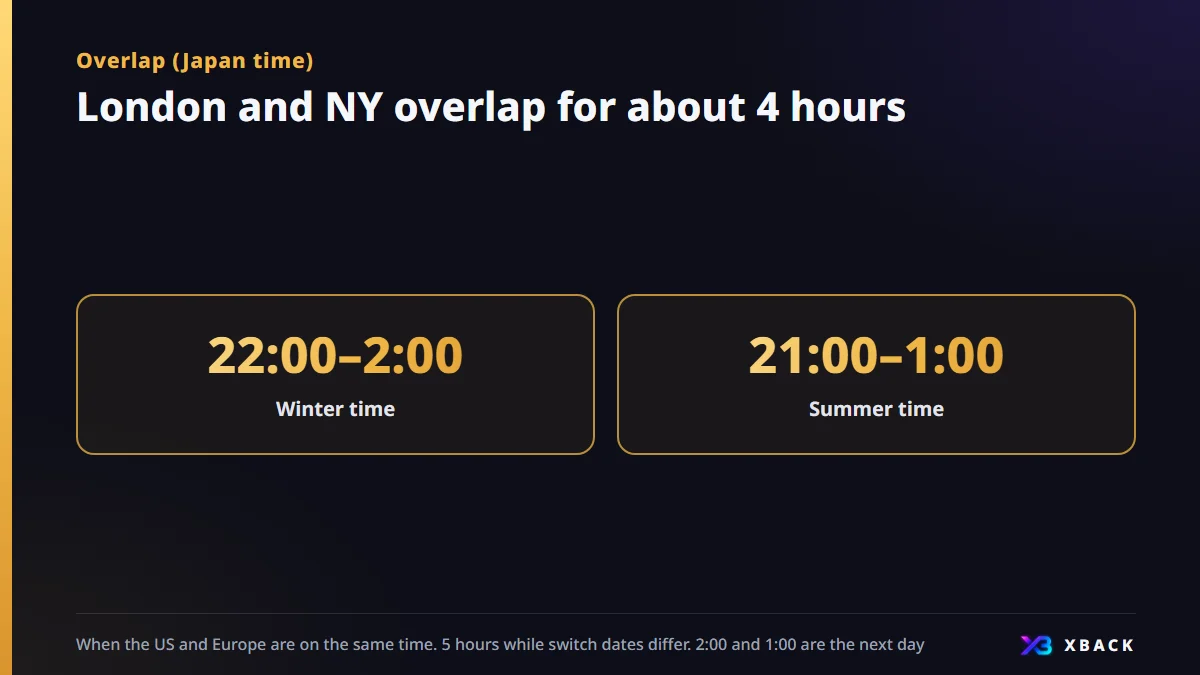
London and New York business hours overlap from 22:00 to 2:00 (next day) Japan time in winter time. In summer time it is 21:00 to 1:00 (next day), and both are about 4 hours.
| Period | London | New York | Overlap (Japan time) |
|---|---|---|---|
| US and Europe both on winter time | 17:00–2:00 (next day) | 22:00–7:00 (next day) | 22:00–2:00 (next day) |
| US and Europe both on summer time | 16:00–1:00 (next day) | 21:00–6:00 (next day) | 21:00–1:00 (next day) |
| Only the US on summer time | 17:00–2:00 (next day) | 21:00–6:00 (next day) | 21:00–2:00 (next day) |
While the US and Europe are on different switch dates, the overlap stretches to 5 hours. In 2026 this applies from March 8 to March 28, and from October 25 to October 31.
The overlap is close to economic data releases
The US employment report and similar data are often released at 8:30 US Eastern time, and the time should be checked against the release schedule. In Japan time that is 21:30 in summer time and 22:30 in winter time, which falls at the start of the overlap.
Explains converting release times and reading importance. You can check it before trading in the evening.
Read how to use an economic calendarWhen does FX move? Cautions for each session
In the Bank for International Settlements (BIS) 2025 survey (preliminary figures), the UK handled about 38% of FX trading and the US about 19%. The evening overlap is when these two biggest hubs are open at the same time.
| Session | Main market | Cautions |
|---|---|---|
| Tokyo session | Tokyo | Prices can suddenly move on data releases or remarks by officials |
| London session | London | Prices may jump right after the open |
| New York session | New York | Spreads tend to widen around US data releases as well |
| London and NY overlap | US and UK hubs | Reversals and sharp moves also happen, so check your stop-loss width |
| End of NY to early morning | Late in business hours | Spreads tend to widen |
The end of the New York session is 7:00 in winter time and 6:00 in summer time, Japan time. At many brokers this is when the daily candle closes and it also coincides with rollover.
Do spreads change by time of day?
Spreads can widen at certain times. Early morning in Japan time is a typical example.
- For the London and New York overlap, actually look at and compare brokers' spreads
- From the end of New York until before Tokyo opens, spreads tend to widen
- Around data releases, spreads can widen regardless of the time of day
- Actual values differ by broker and account type, so check them on the MT5 quote display
Why spreads widen and how to calculate the cost per lot are explained in the related column on when spreads widen.
Explains why spreads widen in early morning and at the start of the week, with an EURUSD calculation example.
Check when spreads widenWhich sessions suit which trading style?
The suitable time depends on how long you hold and when you can watch the screen. This is a general way of thinking, adapted to daily life in Japan.
| Trading style | Easier-fit session | Reason | Caution |
|---|---|---|---|
| Scalping | London and NY overlap | US and UK business hours line up and many people trade | Many people avoid trading around data releases because spreads widen |
| Day trading | Tokyo afternoon to London | You can read the day's direction and close by the evening | Holding overnight exposes you to the effect of data releases |
| Swing trading | No fixed time | Positions are held for several days or more, so the entry time matters little | Watch spreads and gaps when crossing early morning or a weekend |
If you cannot watch during the day because of work, you could trade in the evening overlap, or set a stop-loss and hold. Note, however, that the evening coincides with data releases.
The differences between trading styles are explained in another column. The times when a pair is active also vary by currency pair.
Explains the traits by holding period and who each suits.
Read the differences between trading stylesCautions when choosing a session
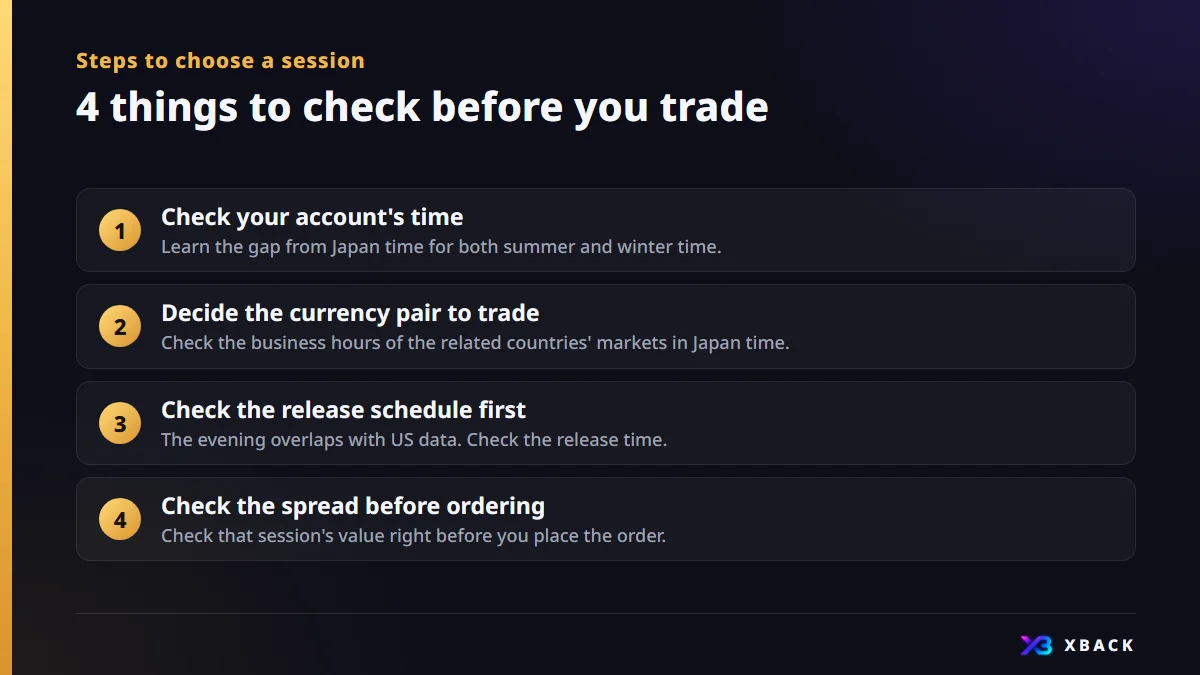
- 1
Check your account's time
Chart time is server time. Learn the gap from Japan time for both summer time and winter time.
- 2
Decide the currency pair to trade
For each pair, check the business hours of the related countries' markets in Japan time.
- 3
Check the release schedule first
The evening overlaps with US data. Check the release time and decide whether to cut your trading volume around it.
- 4
Check the spread before ordering
Check that session's value right before you place the order. Skipping a wide-spread session is also an option.
See how to choose a currency pair for picking what to trade.
Explains how to convert MT4/MT5 server time to Japan time and when the daily candle closes.
Check trading hours and server timeFAQ
Q.What time does FX move?
There is no fixed time. The overlap of US and UK business hours, where trading volume is large, is 22:00 to 2:00 (next day) Japan time in winter time and 21:00 to 1:00 (next day) in summer time. The market does not always move.
Q.What are Tokyo, London and New York hours in Japan time?
As a guide, Tokyo is about 9:00 to 15:00. London is 17:00 to 2:00 (next day) in winter time and 16:00 to 1:00 (next day) in summer time. New York is 22:00 to 7:00 (next day) in winter time and 21:00 to 6:00 (next day) in summer time. The boundaries are convention.
Q.When do the London and New York sessions overlap?
With both on winter time, it is 22:00 to 2:00 (next day) Japan time, and in summer time 21:00 to 1:00 (next day), about 4 hours. While the switch dates differ, the overlap is 5 hours.
Q.When does FX summer time start and end?
In the US it runs from the 2nd Sunday of March to the 1st Sunday of November, and in Europe from the last Sunday of March to the last Sunday of October. In 2026 the US is March 8 to November 1, and Europe and the UK are March 29 to October 25. Japan time does not change.
Q.Which session is best if I can only trade in the evening because of work?
The evening in Japan time falls in the London and New York overlap. US and UK business hours line up, but it also coincides with US data releases. Check the release time and the position of your stop-loss before trading.
Sources
- BIS Triennial Central Bank Survey 2025 (share of FX trading by location) (checked 2026-11-19)
- European Union Directive 2000/84/EC (start and end of summer time) (checked 2026-11-19)
- NIST Daylight Saving Time (US) (checked 2026-11-19)
- GOV.UK When do the clocks change (UK) (checked 2026-11-19)
- NICT Japan Standard Time (9 hours ahead of UTC) (checked 2026-11-19)

This article is for information purposes only and is not investment advice. Conditions may change, so please check each broker's official page for the latest information. Offshore FX and CFD trading carries a risk of losses exceeding your principal.