Scalping vs Day Trading vs Swing Trading: Differences by Holding Time and Who Each Suits
Are you unsure whether scalping, day trading or swing trading suits you?
In short, the three styles split by holding time, and spreads, swaps and the time you need hit each one differently.
This article compares the three in a table, with a USD account cost example and the criteria for choosing.
Key takeaways
- Trading styles split by holding time: scalping is minutes, day trading is hours and swing trading is days to weeks.
- A 1.0 pips (10 USD) spread is 10% of a 10-pip target but about 0.3% of a 300-pip target.
- Choose a style by available time, temperament and capital, and check each broker's terms for trading restrictions.
In short: three styles split by holding time, each with different costs and time needs
- Scalping holds for seconds to minutes, day trading for hours, swing trading for days to weeks
- The shorter the holding time, the more trades, and the heavier the spread is relative to profit
- The longer the holding time, the more swaps and weekend gaps matter
- The style that suits you depends on available time, temperament and capital
Differences between the three styles: holding time and trade count
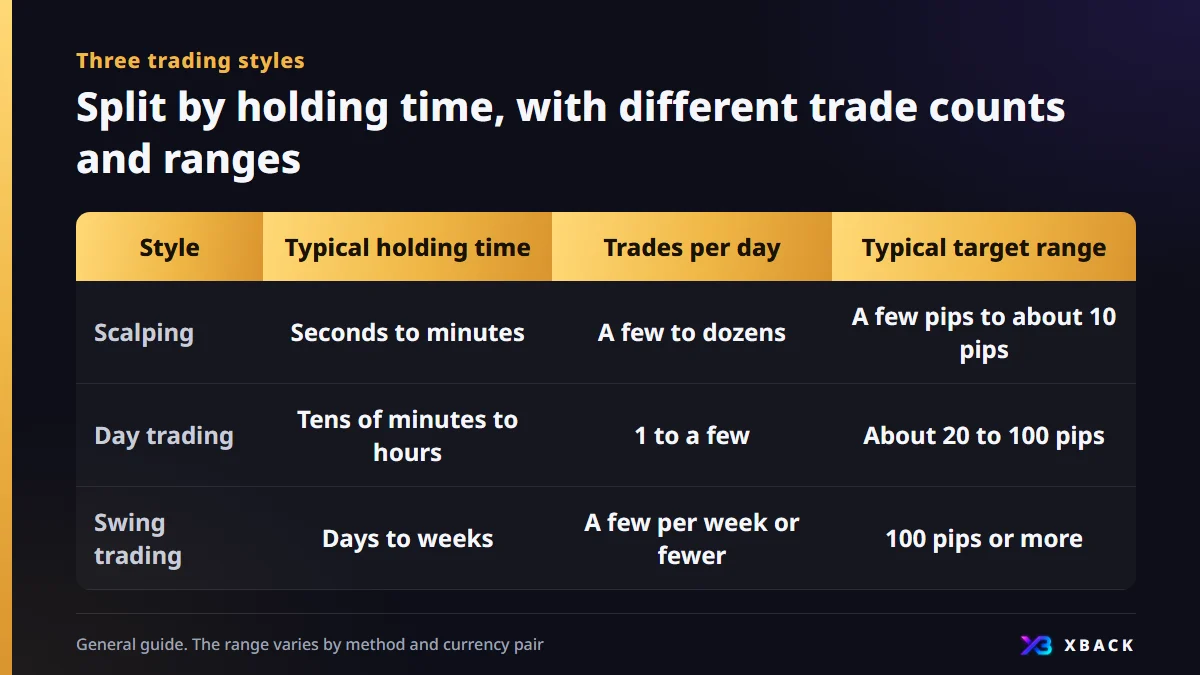
Styles are usually split by how long you hold a position. The boundaries are not strict and are only rough guides.
| Style | Typical holding time | Trades per day | Typical target range |
|---|---|---|---|
| Scalping | Seconds to minutes | A few to dozens | A few pips to about 10 pips |
| Day trading | Tens of minutes to hours (not held overnight) | 1 to a few | About 20 to 100 pips |
| Swing trading | Days to weeks | A few per week or fewer | 100 pips or more |
Scalping aims for small ranges many times. It requires long screen time and quick decisions.
Day trading means closing everything within the same day. You do not need to worry about price moves while you sleep.
Swing trading aims for a large range over days to weeks. You check the chart less often, so it is easier to continue even if you lack daytime hours.
Cost by style: how spreads and swaps hit you
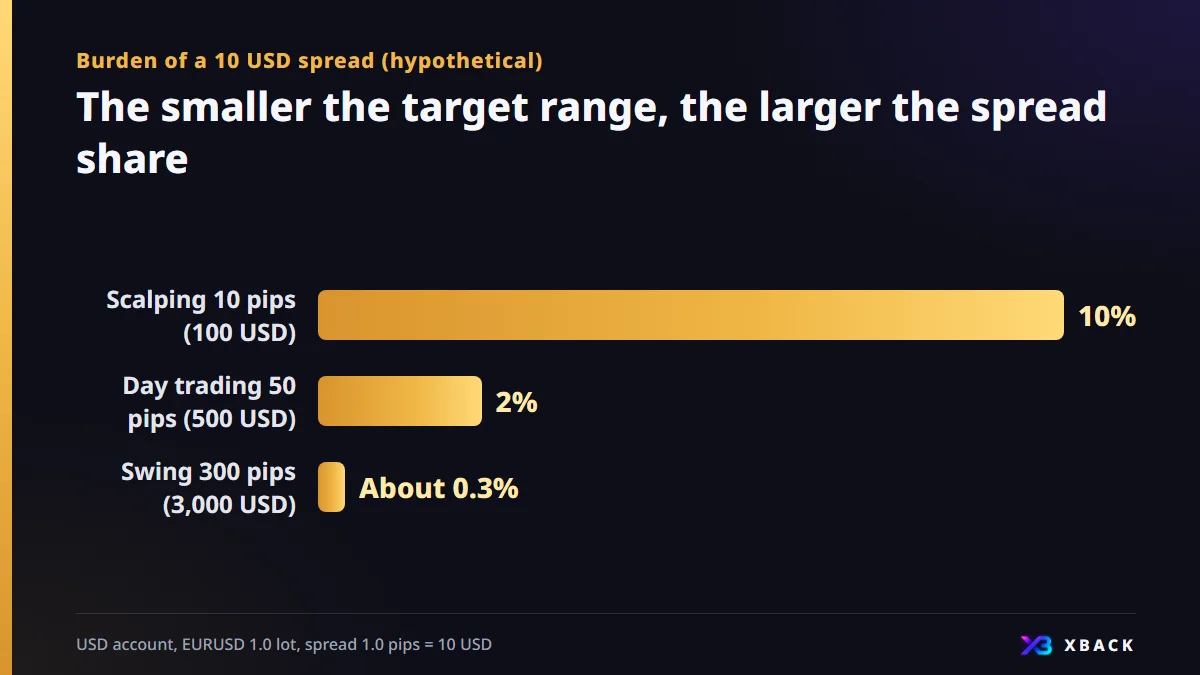
Even with the same spread, the smaller the range you aim for, the heavier the burden on profit. Compare using a USD account, EURUSD 1.0 lot and a 1.0 pips spread (10 USD).
| Style | Target range (hypothetical) | Range in money | Share of the 10 USD spread |
|---|---|---|---|
| Scalping | 10 pips | 100 USD | 10% |
| Day trading | 50 pips | 500 USD | 2% |
| Swing trading | 300 pips | 3,000 USD | About 0.3% |
Check: 10 USD ÷ 100 USD = 10%, 10 USD ÷ 500 USD = 2%, 10 USD ÷ 3,000 USD = about 0.33%.
In scalping, the spread takes one tenth of the profit. If you trade 10 times a day, you pay 100 USD in spreads alone.
Cashback returns part of that cost. On an Exness Standard account, you get back 18% of the spread you pay.
| Style | Spread share | Share after 18% back | Example trade count and cashback |
|---|---|---|---|
| Scalping | 10% | 8.2% | 10 trades: 18 USD a day |
| Day trading | 2% | 1.64% | 2 trades: 3.6 USD a day |
| Swing trading | About 0.33% | About 0.27% | 1 trade a week: 1.8 USD a week |
Scalping earns the most cashback. Even so, the spread still eats more than 8% of the profit, and the order of cost burden does not change.
In swing trading, the swap for holding overnight matters more than the spread. If you hold a currency pair with a negative swap for a long time, it is deducted for each day held.
How to choose a style that suits you: time, temperament and capital
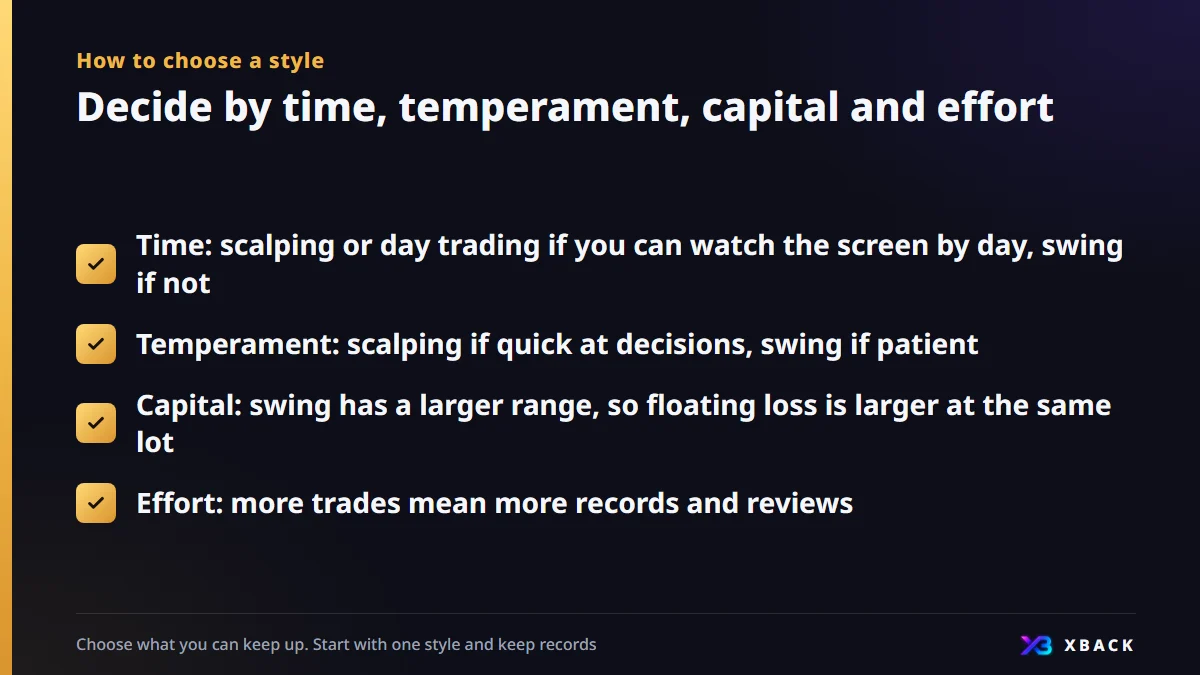
Choose by whether it fits your life, not by which style is better. A method you cannot keep up produces no results, however good it is.
- Available time: scalping or day trading if you can watch the screen during the day, swing trading if you cannot
- Temperament: scalping if you are good at quick decisions, swing trading if you can wait patiently
- Capital: swing trading has a larger range, so the floating loss is larger even at the same lot size
- Effort: the more trades you make, the more records and reviews you need
If you aim for a 300-pip range in swing trading, the stop loss also becomes wide at around 100 pips. At 1.0 lot, you need capital that can bear a 1,000 USD loss.
At first, focus on one style, keep a trading record and test it. If it does not feel right, reduce the lot size and try another style.
Cautions by style and broker rules
Some brokers restrict certain trading methods. Before opening an account, check the terms of use and trading conditions on the official page.
| Broker | Official guidance or terms | Style most affected |
|---|---|---|
| Monaxa | Says EAs are allowed. Partner terms clause 7.2 leave trades held 3 minutes or less out of the calculation | Scalping |
| INFINOX | Says there are no restrictions on EAs, scalping or hedging (XB cashback is in preparation) | Scalping |
- Scalping: some brokers limit extremely short trades or server load. Check the terms to see whether it is prohibited
- Day trading: avoid the times around economic indicators when spreads widen, or lower the lot size
- Swing trading: decide your lot size and stop loss expecting weekend gaps and accumulated swaps
- Common: if you use a bonus, check whether any condition removes the bonus depending on how you trade
Trading styles and cashback
On accounts that pay a fixed amount, cashback grows in line with your lots. Monaxa Standard pays 5 USD per round-trip lot on FX. Here is how a month compares.
| Style | Example trading | Lots per month | Monaxa Standard (FX) cashback |
|---|---|---|---|
| Scalping | 1.0 lot × 10 a day × 20 days | 200 lots | 1,000 USD |
| Day trading | 1.0 lot × 2 a day × 20 days | 40 lots | 200 USD |
| Swing trading | 1.0 lot × 1 a week × 4 weeks | 4 lots | 20 USD |
Scalping earns the most, but it is also the style most likely to run into holding-time rules. Trading more just for cashback raises your spread cost first.
Cashback amounts for each broker are on the cashback rates list.
Enter the lot size and spread to see the cost per trade. Multiply by the number of trades in your style to see the monthly burden.
Calculate your spread costFAQ
Q.What is the difference between scalping, day trading and swing trading?
It is the holding time of a position. Scalping holds for seconds to minutes, day trading for tens of minutes to hours without going overnight, and swing trading for days to weeks. The shorter the holding time, the more trades you make.
Q.Which style should a beginner start with?
There is no single answer, but deciding by the time you have is realistic. If you cannot watch the screen during the day, swing trading is easier to keep up. With any style, start with a small lot and keep a trading journal.
Q.Why does the spread matter so much in scalping?
Because the range you aim for is small. A 1.0-pip (10 USD) spread is 10% of the profit on a 10-pip target. On a 300-pip target, it is only about 0.3%.
Q.Does cashback change by style?
Yes. With Monaxa Standard (FX, 5 USD per round-trip lot), 200 lots a month of scalping came to 1,000 USD, while 4 lots of swing trading came to 20 USD. Note that some terms leave trades held 3 minutes or less out of the calculation.

This article is for information purposes only and is not investment advice. Conditions may change, so please check each broker's official page for the latest information. Offshore FX and CFD trading carries a risk of losses exceeding your principal.