Index CFD Lot Size & Margin: How to Read the MT5 Specification
Not sure whether you can trade 1 lot of an index CFD the way you would a currency pair?
The short answer: the move per lot is set by contract size × lots, and it differs by symbol, so always check the MT5 Specification first.
This article covers the 5 items to check in the Specification, worked examples of point value and margin, and index leverage caps by broker.
Key takeaways
- The price move per lot of a stock index CFD is set by contract size x lots, and it differs by symbol and broker.
- With contract size 1 and 1 point = 1 USD, a 100-point move at 1.0 lot is 100 USD.
- Required margin is price x contract size x lots / leverage; at 40,000, 1.0 lot and 100:1 it is 400 USD.
Short answer: price move per lot is contract size x lots, and it differs by symbol
- 1 lot of an index CFD is not 100,000 units like a currency pair; contract size differs by symbol and broker
- Point value = tick value ÷ tick size × lots (when the profit currency is your account currency, this equals contract size × lots)
- Required margin = price × contract size × lots ÷ leverage (or × margin rate)
- Index leverage caps vary widely: 1:1000 on HFM's major indices, 1:100 at DecodeFX and Monaxa
What is a stock index CFD? 3 differences from FX currency pairs
An index CFD is a contract for difference on the price of a stock index. Most forex brokers offer them on the same MT5 account as currency pairs.
| Item | Currency pair (e.g. EURUSD) | Stock index CFD |
|---|---|---|
| What 1 lot means | 100,000 units at most brokers | Contract size differs by symbol and broker |
| Smallest price move | Pips (such as 0.0001) | Points (such as 1.0 or 0.1, depending on the symbol) |
| Trading hours | Nearly 24 hours on weekdays | Some symbols have daily breaks and do not trade around the clock |
For currency pairs, "1 lot = 100,000 units" is almost universal. For index CFDs, the contract size can be 1, 10 or 100.
The same "1 lot" can be worth ten times more on one symbol than another. Leave your currency-pair sense of lot size at the door.
5 items to check in the MT5 Specification
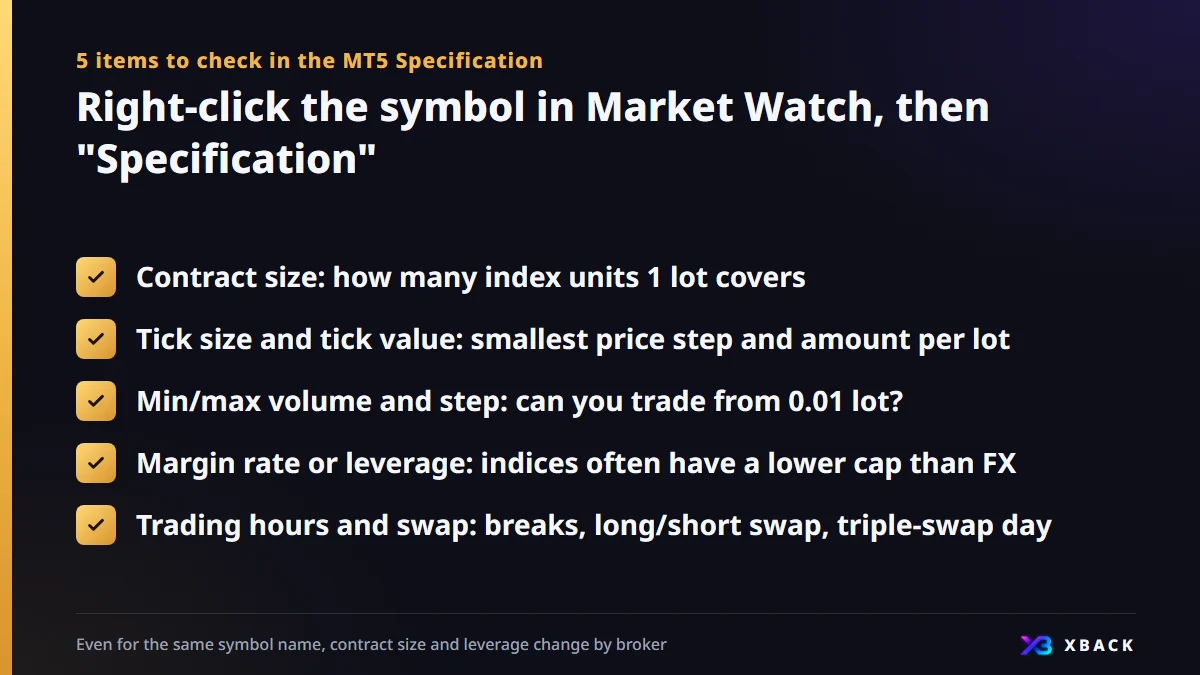
In MT5, each symbol's contract terms are in its Specification window. Right-click the symbol in Market Watch and select "Specification".
- Contract size: how many index units 1 lot covers. This is the basis of point value
- Tick size and tick value: the smallest price step and what 1 lot gains or loses per tick
- Min/max volume and volume step: whether you can trade from 0.01 lot and what the step is
- Margin rate or leverage: many brokers cap indices lower than currency pairs
- Trading hours and swap: break times, long and short swap, and the triple-swap day
The wording varies slightly by broker. Also check the "Margin currency" and "Profit currency" fields to see which currency your P/L is in.
Example: point value and P/L for 1 lot
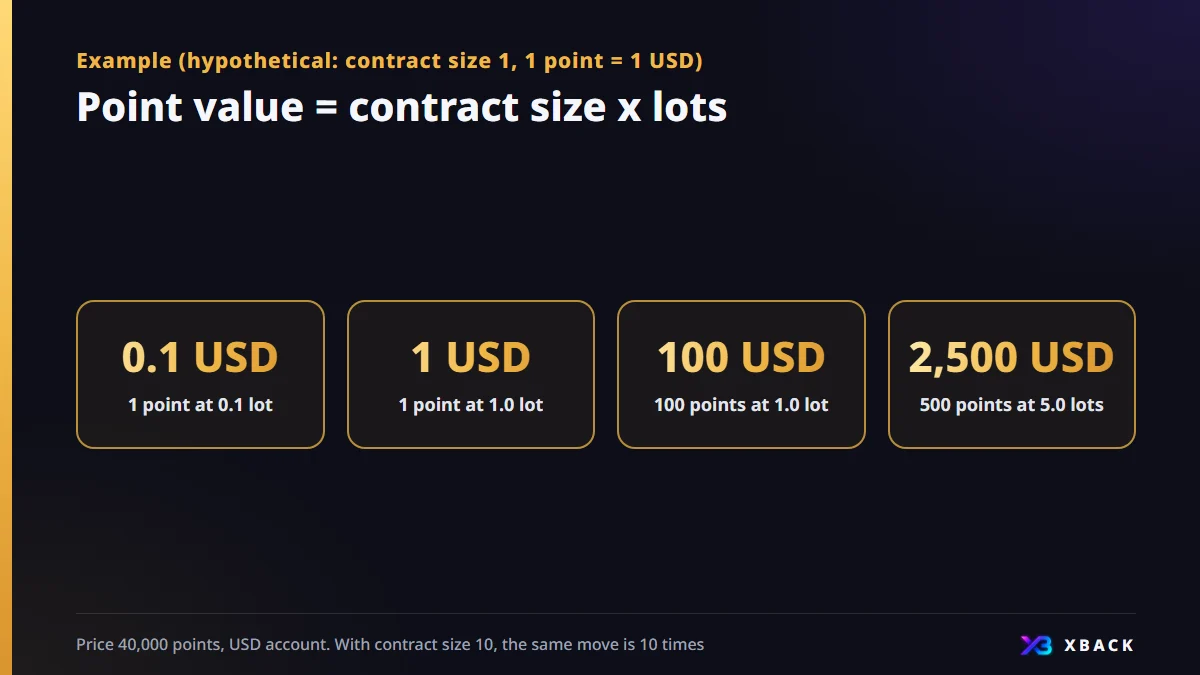
Contract size and tick value describe the same thing in two ways. Multiply them together and you count it twice, so use one or the other.
Take a symbol with contract size 1, tick size 0.1 and tick value 0.1 USD. One point is 0.1 ÷ 0.1 = 1 USD, which matches contract size 1 × 1 lot.
Using that US index CFD at 1 point = 1 USD per 1.0 lot, here is the P/L. Assume a price of 40,000 points and a USD account.
| Lots | Value of 1 point | When price moves 100 points | When price moves 500 points |
|---|---|---|---|
| 0.1 lot | 0.1 USD | 10 USD | 50 USD |
| 1.0 lot | 1 USD | 100 USD | 500 USD |
| 5.0 lots | 5 USD | 500 USD | 2,500 USD |
Check: at 1.0 lot, 100 points is 1 USD × 100 = 100 USD. At 5.0 lots, 500 points is 5 USD × 500 = 2,500 USD.
For a symbol with contract size 10, the same 1.0 lot is worth 10 USD per point. A 100-point move is then 1,000 USD, ten times the P/L.
Indices can move several hundred points in a day. Hold 1.0 lot with a currency-pair mindset and the P/L can be many times what you planned for.
Example: required margin | leverage and margin rate
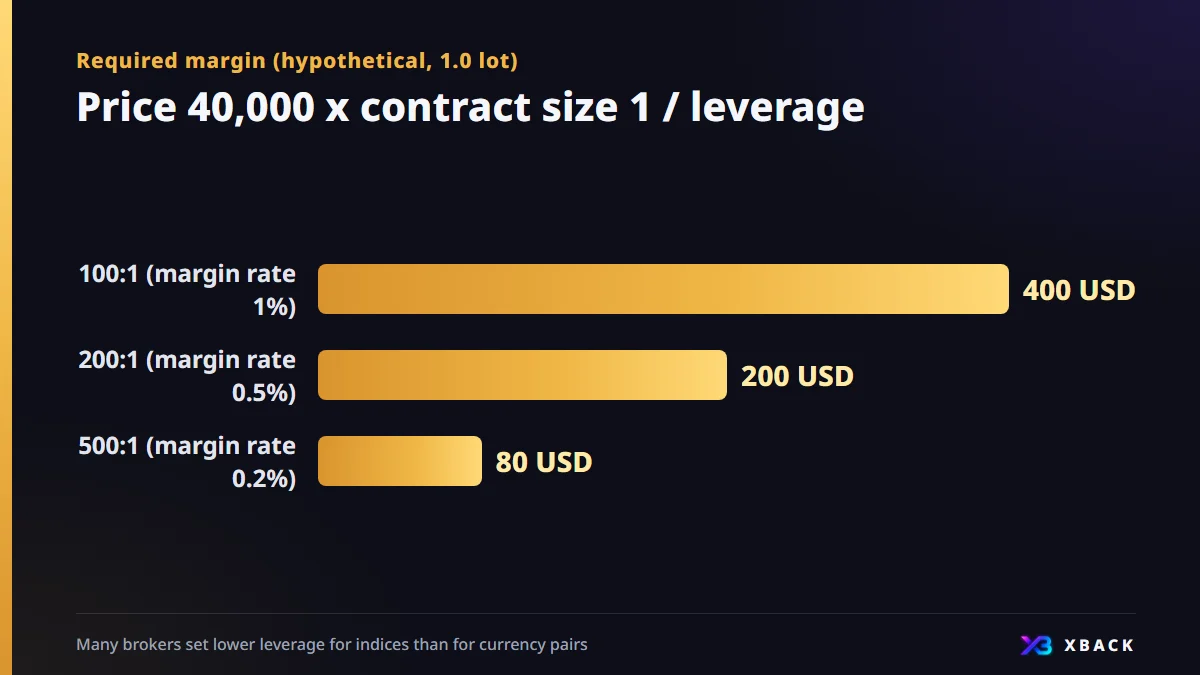
Required margin is price × contract size × lots ÷ leverage. Under the same assumptions, here is the margin for price 40,000, contract size 1 and 1.0 lot.
| Leverage | Margin rate | Required margin (1.0 lot) |
|---|---|---|
| 100:1 | 1% | 400 USD |
| 200:1 | 0.5% | 200 USD |
| 500:1 | 0.2% | 80 USD |
Check: 40,000 ÷ 100 = 400 USD, 40,000 ÷ 200 = 200 USD, 40,000 ÷ 500 = 80 USD. At a 1% margin rate, 40,000 × 1% = 400 USD, the same result.
Index leverage is set separately from your account's maximum leverage. Here are the caps XB has confirmed for each broker.
| Broker | Max leverage on indices | Notes |
|---|---|---|
| HFM | 1:1000 to 1:100 | USA30, USA100 and GER40 at 1:1000; UK100, JPN225 and others at 1:500. Some futures (.F) at 1:200, USDIndex at 1:100 |
| Exness | Follows your account leverage after the change | Announced move from fixed 1:400 to floating (planned for 7 Nov 2026). US indices during HMR: 1:50 to 1:100 |
| DecodeFX | 1:100 | JP225, SPX500, NAS100 and others |
| Monaxa | 1:100 | Standard, Pro and Zero. No equity-based tiers |
At 1:100, the 1.0 lot example needs 400 USD; at HFM's 1:1000 on USA30, it needs 40 USD. Same index, ten times the margin depending on the broker.
Stock index CFD cautions | trading hours, dividend adjustments, gaps
- Trading hours: some symbols pause when the underlying market is closed, and the price can jump when trading resumes
- Dividend adjustments: many brokers credit longs and debit shorts on the ex-dividend dates of constituent stocks
- Swap: as with currency pairs, it applies to positions held overnight. Check how swap days are counted in the Specification
- Gaps: prices often gap after a market close or on data releases, and a stop-loss can fill at a worse price than set
- Volume step: some symbols have a minimum of 0.1 or 1.0 lot, so you may not be able to start small
How dividend adjustments are calculated varies by broker. If you hold a short for a long time, remember you are the one paying.
Stock index CFDs and cashback
Even on accounts opened through XB, index trades can be treated differently from currency pairs. Here are the terms as of 19 Nov 2026.
- Monaxa Zero: 1 USD per round-trip lot on every symbol, indices included
- DecodeFX CENT: no cashback on indices. On STD and PRO, the index amount varies by symbol
- Exness Standard Cent: DE30, JP225 and UK100 may be excluded
- Contract sizes differ, so do not compare per-lot amounts with currency pairs directly
If you mainly trade indices, confirm cashback eligibility before choosing an account. Per-broker amounts are on the cashback rates page.
Enter the price, lots and leverage to estimate required margin. For indices, check the contract size first.
Calculate required marginFAQ
Q.How much does 1 lot of a stock index CFD move?
It depends on the symbol's contract size at your broker. With contract size 1 and 1 point = 1 USD, a 100-point move at 1.0 lot is 100 USD. With contract size 10, the same move is 1,000 USD, so always check the MT5 Specification.
Q.How do I convert a symbol with a tick size of 0.1?
Divide tick value by tick size to get the value of one point. With tick size 0.1 and tick value 0.1 USD, 1 lot is worth 1 USD per point. Do not multiply by contract size again.
Q.What leverage do brokers offer on indices?
It depends on the broker and symbol. HFM offers 1:1000 on USA30 and similar, and 1:500 on JPN225 and others. DecodeFX and Monaxa cap indices at 1:100 (checked November 2026).
Q.Can I get cashback on stock index CFD trades?
It depends on the account. Monaxa Zero pays 1 USD per round-trip lot on every symbol. DecodeFX CENT pays nothing on indices, and on STD and PRO the amount varies by symbol.

This article is for information purposes only and is not investment advice. Conditions may change, so please check each broker's official page for the latest information. Offshore FX and CFD trading carries a risk of losses exceeding your principal.