Margin Call vs Stop Out: Key Differences and 4 Steps to Take
Not sure how a margin call differs from a stop out, or what happens when the warning appears?
In short, a margin call is a warning that your margin level has fallen, while a stop out (also called loss cut) force-closes positions once the level drops below its threshold.
This article covers how the two differ, a calculation of the price distance using hypothetical conditions, and what to do when the warning arrives.
Key takeaways
- A margin call warns that the margin level has fallen, while a stop out force-closes positions once the level drops below its threshold.
- In the hypothetical case (balance 1,000 USD, 1 lot), the gap between the two levels is 6.6 pips, leaving little room.
- Halving the lot more than doubles the distance to each level, which is the best prevention.
In short: a margin call is a warning, a stop out is forced closure
- A margin call warns that your margin level has dropped below a set level, and in many cases it does not close positions by itself
- A stop out (loss cut) means the broker's system force-closes positions once the level falls below its threshold
- Levels differ by broker and account type, so check the numbers for your own account in advance
- Your options at the moment of warning are limited, and the best prevention is a smaller lot that leaves more room
Margin call vs stop out: what actually happens
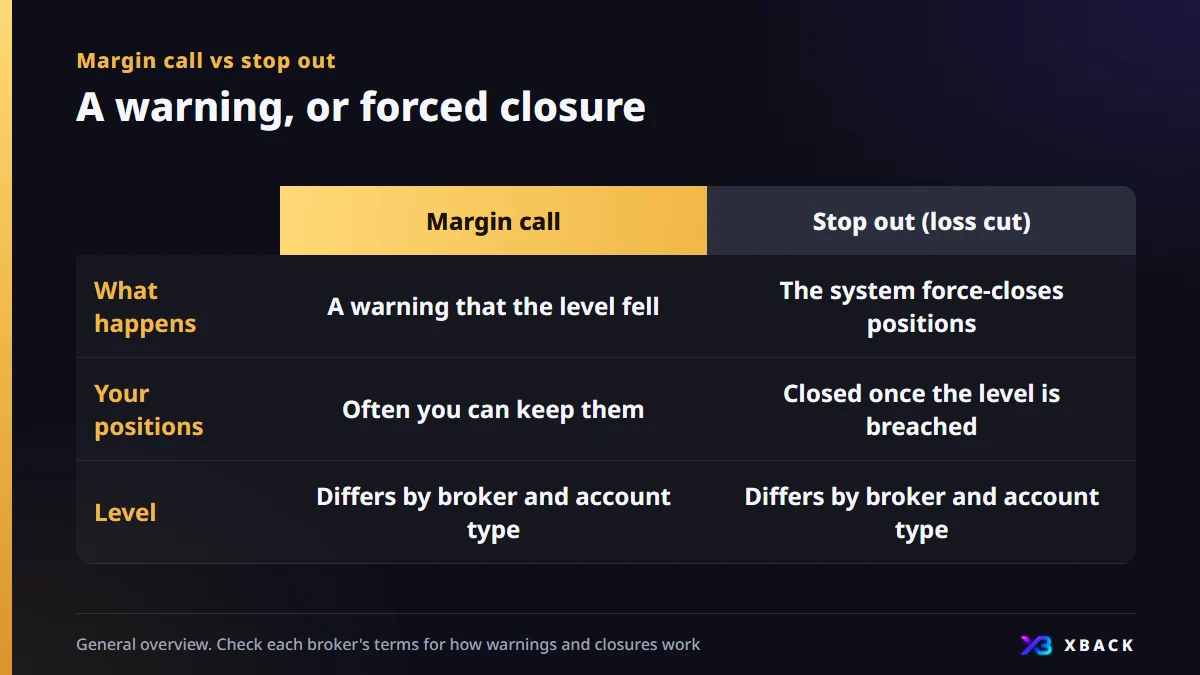
Both come into play when the margin level falls, but what happens is different. The margin call level is generally set higher than the stop out level.
| Margin call | Stop out (loss cut) | |
|---|---|---|
| What happens | A warning that the margin level has fallen | The system force-closes positions |
| Your positions | Often you can keep holding them | Closed once the level is breached |
| What you can do next | Close, deposit, or review orders | Open new trades again (the loss is already realized) |
| Level | Differs by broker and account type | Differs by broker and account type |
In domestic Japanese FX, a margin call can require an additional deposit. Many overseas brokers do not ask for one, but always check the terms.
Distance to each level: a 1-lot example

Here is a calculation with hypothetical conditions: a balance of 1,000 USD, a 1-lot (100,000 units) buy of EURUSD at 1.1000, leverage of 500x, and 1 pip = 10 USD.
Required margin is 100,000 × 1.1000 ÷ 500 = 220 USD. Margin level is equity ÷ required margin × 100, so right after entry it is 1,000 ÷ 220 = 454.5%.
| Margin call (hypothetical 50%) | Stop out (hypothetical 20%) | |
|---|---|---|
| Equity at the level | 220 × 50% = 110 USD | 220 × 20% = 44 USD |
| Floating loss then | −890 USD | −956 USD |
| Move against entry | 89 pips | 95.6 pips |
Between the margin call and the stop out there are only 95.6 − 89 = 6.6 pips (66 USD). Assume you will have very little time to act after seeing the warning.
What changes when you halve the lot
Now compare with a lot of 0.5 on the same 1,000 USD balance. Required margin falls to 110 USD, and a 1-pip move is worth 5 USD.
| 1 lot | 0.5 lot | |
|---|---|---|
| Required margin | 220 USD | 110 USD |
| Margin level right after entry | 454.5% | 909.1% |
| Value of a 1-pip move | 10 USD | 5 USD |
| To margin call (equity) | 89 pips (110 USD) | 189 pips (55 USD) |
| To stop out (equity) | 95.6 pips (44 USD) | 195.6 pips (22 USD) |
Halving the lot more than doubles the distance to each level. The gap between the two levels is still 6.6 pips at 0.5 lot, so what grows is the distance to the levels.
4 things to do when a margin call arrives
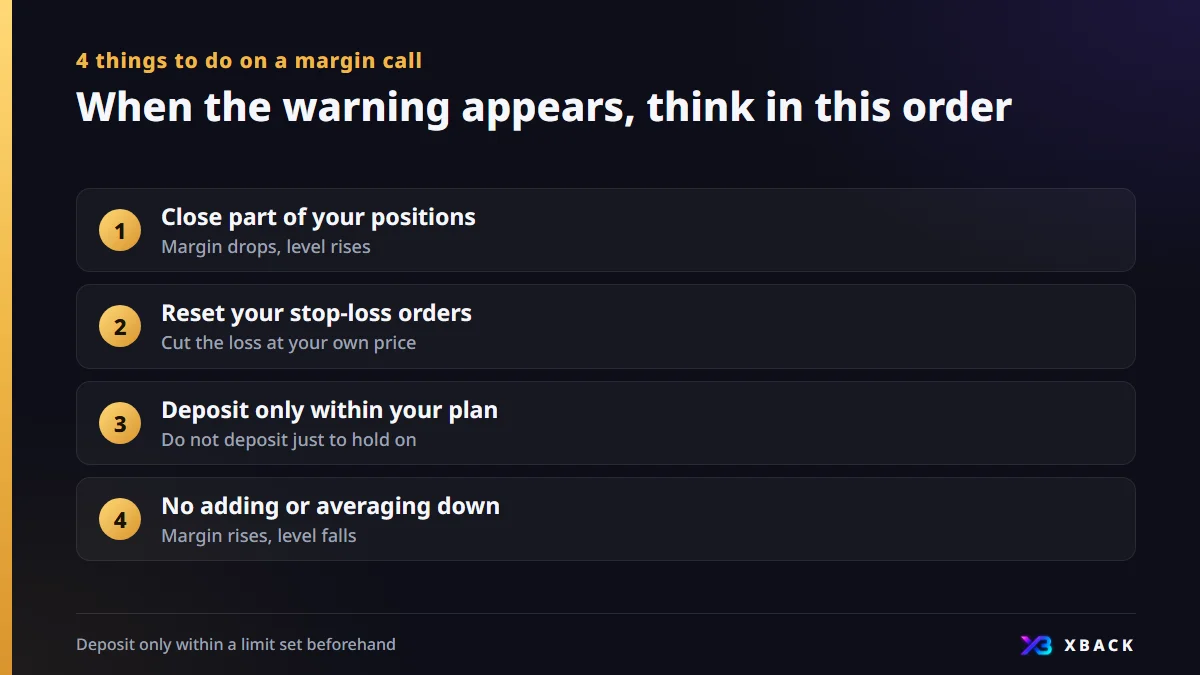
- 1
Close part of your positions
Required margin drops and the margin level rises. If you cannot decide on closing everything, a partial close can stop the decline.
- 2
Reset your stop-loss orders
Instead of leaving it to the stop out, cut the loss at a price you chose. Work out the stop position backward from the loss you can accept.
- 3
Deposit more only within your plan
A deposit raises the margin level, but depositing just to hold on tends to widen losses. Stay within a limit you set beforehand.
- 4
Do not add new positions or average down
Adding positions increases required margin and lowers the margin level further. Avoid adding to a position during a warning.
Whichever you choose, the premise is that you know your levels. If you check them beforehand, you can act without hesitation when the warning appears.
A stop out can still leave a loss larger than your balance
A stop out starts closing positions once the level is breached, but it does not always fill at that exact price. After a gap or a sharp move, positions can close at a worse price than the level.
- Around weekend gaps or economic releases, price can jump and pass the level in one move
- If execution is delayed, the loss at closure becomes larger than the calculated level
- If the loss exceeds your balance, the account balance can turn negative
- Zero-cut is the mechanism by which a broker clears a negative balance, and whether it exists and on what terms depends on the broker's terms
How to check the margin call and stop out levels
You can look up the levels before opening an account. Broker-specific numbers can change, so this article does not list them and only points to where to check.
- The specification table by account type on the broker's official site (the margin call and stop out rows)
- The clause on forced closure in the trading terms you agree to when opening an account
- The margin level shown in the account information of your trading platform, if it is displayed
- For anything unclear, ask the broker's support and keep the reply on record
Enter balance, lot, leverage and level to see the distance to stop out in USD and pips.
Calculate the distance to stop outFAQ
Q.What is the difference between a margin call and a stop out?
A margin call is a warning that the margin level has fallen below a set level, and in many cases it does not close positions by itself. A stop out (loss cut) means the broker's system force-closes positions once the level falls below its threshold. Levels differ by broker and account type.
Q.Will my positions always be closed when a margin call arrives?
In many cases the warning alone does not close positions. However, if the margin level keeps falling below the stop out level, they are force-closed. In the hypothetical calculation, the gap between the two levels was 6.6 pips (66 USD).
Q.What should I do when a margin call arrives?
Four things: close part of your positions, reset your stop-loss orders, deposit more only within your plan, and do not add new positions or average down. Your options at the time of warning are limited, so keeping the lot small beforehand is the best prevention.
Q.Do overseas forex margin calls require an additional deposit?
Many brokers do not ask for an additional deposit, but it differs by broker. Check the specifications by account type and the trading terms in advance for how margin calls are handled.
Q.Is my loss kept within my balance after a stop out?
Not always. After a gap or sharp move, positions can fill at a worse price than the level and the balance can turn negative. Whether zero-cut exists and on what terms depends on the broker's terms, so check before opening an account.

This article is for information purposes only and is not investment advice. Conditions may change, so please check each broker's official page for the latest information. Offshore FX and CFD trading carries a risk of losses exceeding your principal.