Equity vs Free Margin: The 5 MT5 Numbers in One Example
Equity and free margin sound alike, and it is easy to lose track of how they differ.
In short, equity is your account's real worth including floating profit and loss, and free margin is what remains after subtracting required margin, the room you have for new orders.
This article uses one example, a BUY on EURUSD with a 1,000 USD balance, to show how the five numbers relate and how they move as floating losses grow.
Key takeaways
- Equity is your balance plus floating profit and loss, and subtracting required margin from it gives free margin.
- In the example, a 1,000 USD balance with 0.5 lots bought and a 30-pip adverse move gives equity of 850 USD, free margin of 740 USD and margin level of 772.7%.
- In the MT5 Trade tab, free margin appears as Free Margin and margin level as Margin Level, and XB mapped them in a table.
In short: equity vs free margin is a matter of before or after subtracting margin
- Equity = balance + floating profit/loss. It falls with floating losses and rises with floating profits
- Free margin = equity - required margin. This is the amount available for new orders
- Margin level = equity / required margin x 100. This ratio is what stop-out is judged on
- The stop-out level differs by broker: 20% on the main XS, HFM and Monaxa accounts, and 0% at Exness
How the 5 terms relate: lining up the numbers in one example
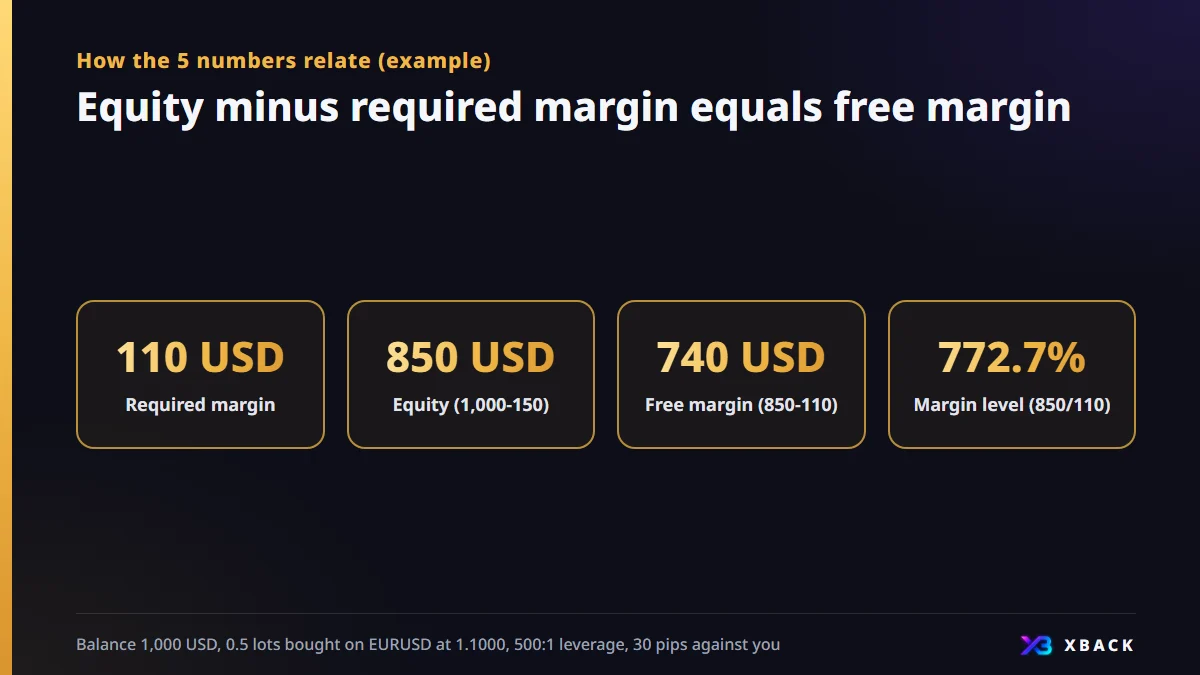
As an example, say you buy 0.5 lots (50,000 units) of EURUSD at 1.1000 in an account with a 1,000 USD balance and 500:1 leverage. Required margin is 50,000 x 1.1000 / 500 = 110 USD.
Then the rate moves 30 pips against you. At 0.5 lots, 1 pip = 5 USD, so the floating loss is -150 USD. With that, the five numbers line up as in the table below.
| Term | Meaning | Formula | Example value |
|---|---|---|---|
| Balance | Amount after settled profit and loss | Deposits +/- settled profit and loss | 1,000 USD |
| Required margin | Amount held to keep the position open | 50,000 x 1.1000 / 500 | 110 USD |
| Equity | Real value of the account including floating profit and loss | 1,000 + (-150) | 850 USD |
| Free margin | Room available for new orders | 850 - 110 | 740 USD |
| Margin level | Equity as a percentage of required margin | 850 / 110 x 100 | 772.7% |
The key point is that the balance does not move with floating profit and loss, while equity does. Required margin depends on position size, so it stays at 110 USD even when the market moves against you.
How each number moves as floating losses grow
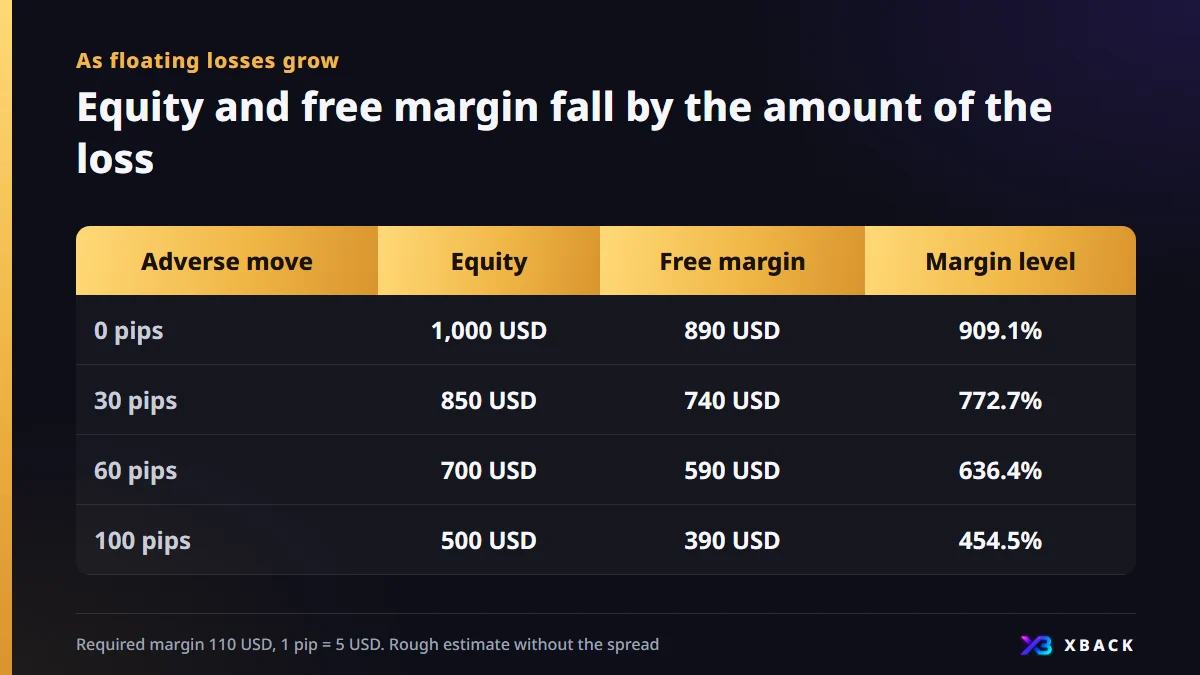
Here is how the numbers change with the same position as the adverse move widens. Equity and free margin fall by exactly the amount of the floating loss, and margin level falls as a ratio.
| Adverse move | Floating P/L | Equity | Free margin | Margin level |
|---|---|---|---|---|
| 0 pips | 0 USD | 1,000 USD | 890 USD | 909.1% |
| 30 pips | -150 USD | 850 USD | 740 USD | 772.7% |
| 60 pips | -300 USD | 700 USD | 590 USD | 636.4% |
| 100 pips | -500 USD | 500 USD | 390 USD | 454.5% |
After a 100-pip move against you, the floating loss is -500 USD, half your balance. Free margin is still 390 USD, so new orders still go through. Having room to trade and having a small loss are two different things.
What happens when free margin runs short
If free margin falls below the margin a new position needs, the order is rejected. If you add positions, required margin rises and margin level falls.
- Free margin is too low: a new order is rejected for insufficient margin
- Adding a position: required margin rises, so margin level falls even with the same floating loss
- Floating losses grow: equity falls and margin level approaches the stop-out level. What happens if the balance goes negative is covered in zero cut
- Stop-out level: it differs by broker and account type. The main brokers' levels are in the table below
| Broker | Stop-out level (margin level) | Equity at stop-out in this example |
|---|---|---|
| XS | 20% (Cent: 10%) | 22 USD (floating loss -978 USD) |
| HFM | 20% (KATANA: 0%) | 22 USD (floating loss -978 USD) |
| Exness | 0% | 0 USD (floating loss -1,000 USD) |
| Monaxa | 20% | 22 USD (floating loss -978 USD) |
At a broker with a 20% stop-out, this position is closed after roughly a 196-pip move against you. A 978 USD loss divided by 5 USD per pip is 195.6 pips.
Free margin tells you whether an order will go through; margin level tells you how close you are to forced closure. For broker-by-broker calculations, see how to calculate margin level.
- 1
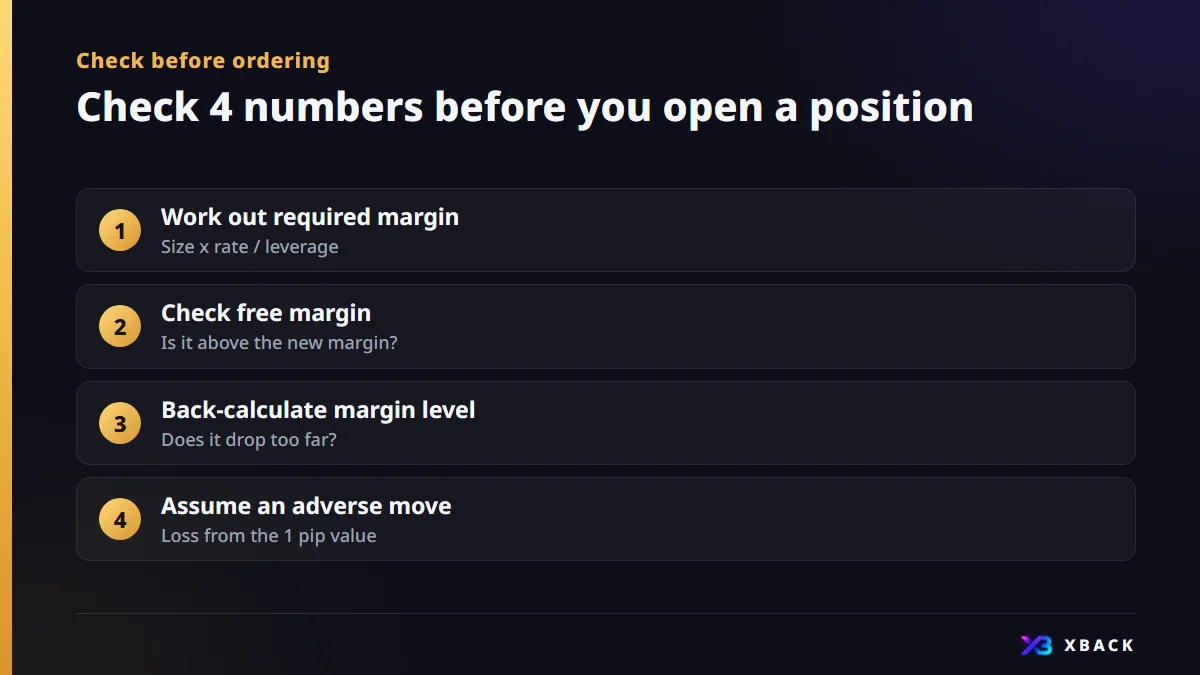
Work out required margin
Use size x rate / leverage to see how much the position holds.
- 2
Check free margin
Confirm that free margin is comfortably larger than the margin the new order needs.
- 3
Back-calculate margin level
Use equity after the order / total required margin to make sure margin level does not drop too far.
- 4
Assume an adverse move
Calculate equity after a floating loss from the value of 1 pip in advance.
How to read an account with a bonus (credit)
On accounts where a bonus is granted as credit, the credit is included in equity. The official MT5 help also describes equity as Balance + Credit - Commission +/- Floating profit/loss - Blocked.
- Credit is included in equity, so it pushes up free margin and margin level
- On many accounts the credit itself cannot be withdrawn. Check the treatment in each broker's terms
- With the same balance, an account with credit has more room than one without for the same adverse move
- If a condition for the bonus to expire is met, equity can drop suddenly
Where MT5 shows them: the account state in the Trade tab
In MT5, the account state appears below the list of positions and pending orders in the Trade tab of the Toolbox window. The table maps this article's terms to the names shown in the official MT5 help.
| Term in this article | Shown in MT5 (name in the official help) | Description in the official help |
|---|---|---|
| Balance | Balance | (See the definition in the table above) |
| Equity | Equity | Balance + Credit - Commission +/- Floating profit/loss - Blocked |
| Required margin | Margin | (See the definition in the table above) |
| Free margin | Free Margin | The free amount of money that can be used to open positions (Equity - Margin) |
| Margin level | Margin Level | Equity / Margin x 100 (%) |
The account state line is highlighted in red when the account is in a dangerous state. Use Free Margin to judge room for orders and Margin Level to judge how close you are to stop-out.
Enter your balance, lot size, leverage and level to see the price range to stop-out in USD. You can also work out required margin with the margin calculator.
Check your room with the stop-out calculatorFAQ
Q.What is the difference between equity and free margin?
Equity is your balance plus floating profit and loss, and free margin is that amount minus required margin. For example, with equity of 850 USD and required margin of 110 USD, free margin is 740 USD.
Q.Where does MT5 show free margin?
On the account state line in the Trade tab of the Toolbox. In the official MT5 help, free margin appears as Free Margin and margin level as Margin Level.
Q.What happens if free margin goes negative?
New orders are no longer accepted. Equity has fallen below required margin, so margin level is under 100%. That is not stop-out yet: the main XS, HFM and Monaxa accounts close positions at 20%, and Exness at 0%.
Q.Is stop-out judged by free margin or margin level?
In general, margin level is used. Free margin is a guide to the room you have for new orders, not the stop-out level itself.
Q.Is a bonus (credit) included in equity?
When it is granted as credit, yes, it is included in equity. However, on many accounts the credit itself cannot be withdrawn, and expiry conditions apply. Treatment differs by broker, so check the terms.
Sources
- MetaQuotes official help (MetaTrader 5): Executing trades (account state items) (checked 2026-11-10)

This article is for information purposes only and is not investment advice. Conditions may change, so please check each broker's official page for the latest information. Offshore FX and CFD trading carries a risk of losses exceeding your principal.