Is Exness Safe? Compensation Fund, Segregation and Balance Protection
If Exness went under, would you get your money back? Many traders are not sure what protection actually exists.
The short answer: there is no government-backed compensation fund. Protection rests on fund segregation and negative balance protection. We checked the official help pages on November 17, 2026.
Below we explain what the Financial Commission's €20,000 cap is actually for, and when balance protection does not kick in, with worked examples.
Key takeaways
- Exness help says client funds are held in omnibus accounts separate from company funds.
- There is no government-backed compensation fund, and we could not find any mention of trust protection or insurance.
- Negative balance protection returns the balance to 0 after a stop out, but does not cover deposits into accounts where only equity is negative.
Summary: Exness has no government-backed compensation fund, and protection rests mainly on segregation
- Client funds are held in omnibus accounts, separate from the company's own money
- The official help states plainly: "there is no government-backed compensation fund or similar scheme available"
- The Financial Commission fund pays out on that body's rulings. It is capped at €20,000 per client and does not cover a broker's insolvency
- Negative balance protection resets a balance to 0 after a stop out. Deposits into an account where only equity is negative are not covered
Exness protections: what we could confirm officially
| Protection | Official wording | What we found |
|---|---|---|
| Segregation | Held in omnibus accounts separate from company funds | Stated |
| Government-backed compensation fund | "There is no government-backed compensation fund or similar scheme available" | None |
| Third-party body membership | Member of the Financial Commission | Stated |
| Trust account arrangement | Not mentioned in the help | Not found |
| Insurance | No mention of coverage in the help | Not found |
| Negative balance protection | Balance reset to 0 if negative after a stop out | Stated |
The public pages do not cover four things: a trust account arrangement, insurance, which entity serves residents of Japan, and which entity the Financial Commission fund covers. Those are the only open points in this article.
What does Exness's fund segregation actually protect?
Segregation means client money is kept apart from the broker's own money. It is not the same as placing funds with an independent trustee, and the Exness help does not describe any trust arrangement.
What the help does describe: funds are held with regulated, reputable financial institutions and spread across several of them where possible.
- Omnibus account: client funds sit in an account separate from the company's own funds
- Where funds are held: regulated, reputable financial institutions
- Spreading: split across several institutions where possible. Regulation may require funds to be held with a local institution
If a broker fails, the help says the applicable laws and the regulator's procedures apply. It does not say how much clients would get back or in what order.
For a broader look at segregated funds and trust arrangements, see Trust Preservation vs. Segregated Funds.
Does Exness have a compensation fund (exness compensation fund)? Existence and limit
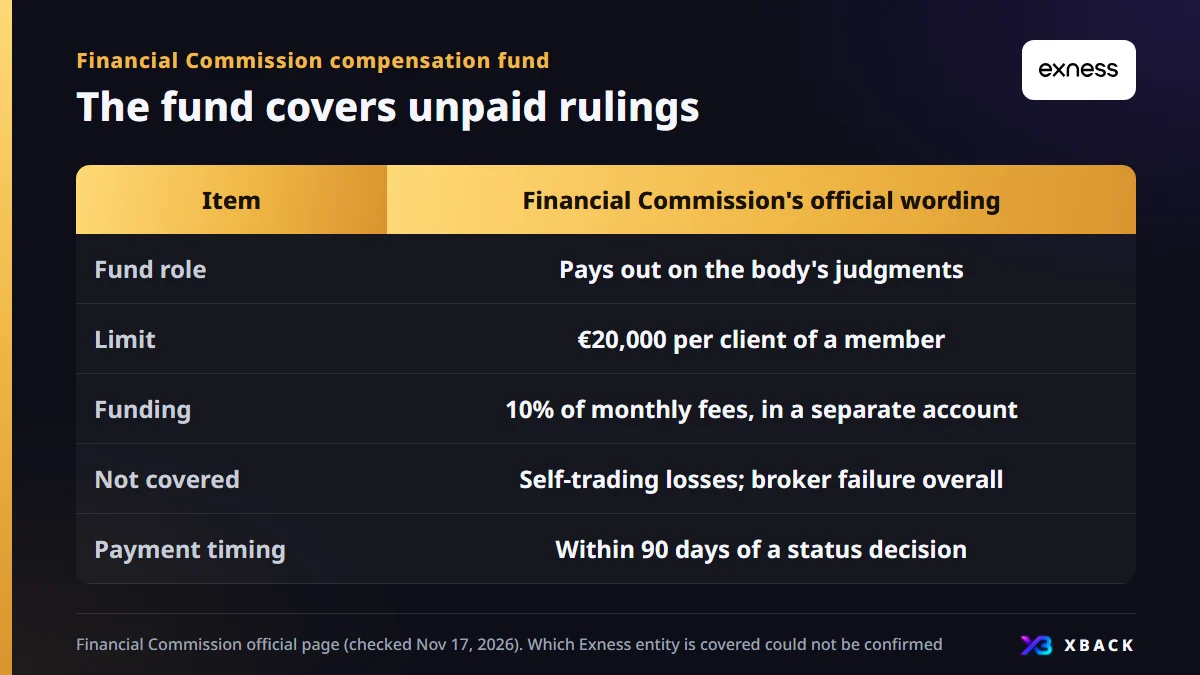
The Exness help states that no government-backed compensation fund or similar scheme is available.
It does, however, list Exness as a member of the Financial Commission, which it describes as an independent international organization.
| Item | Financial Commission's official wording |
|---|---|
| Role of the fund | Used for payments based on the body's judgment |
| Limit | €20,000 per client of a member (in euros) |
| Funding | 10% of monthly membership fees set aside in a separate bank account |
| Not covered | Losses from self-trading, and clients as a whole if a broker fails |
| Payment timing | Within 90 days of a decision on a change in the member's status |
In other words, the fund is a backstop for when the Commission rules in a client's favour and the broker does not pay. Trading losses and the insolvency of the broker itself are not covered.
So €20,000 is not a guarantee on your Exness balance. We also could not confirm which Exness entity it applies to, so do not use it to decide how much to keep in your account.
Exness negative balance protection: conditions and exclusions
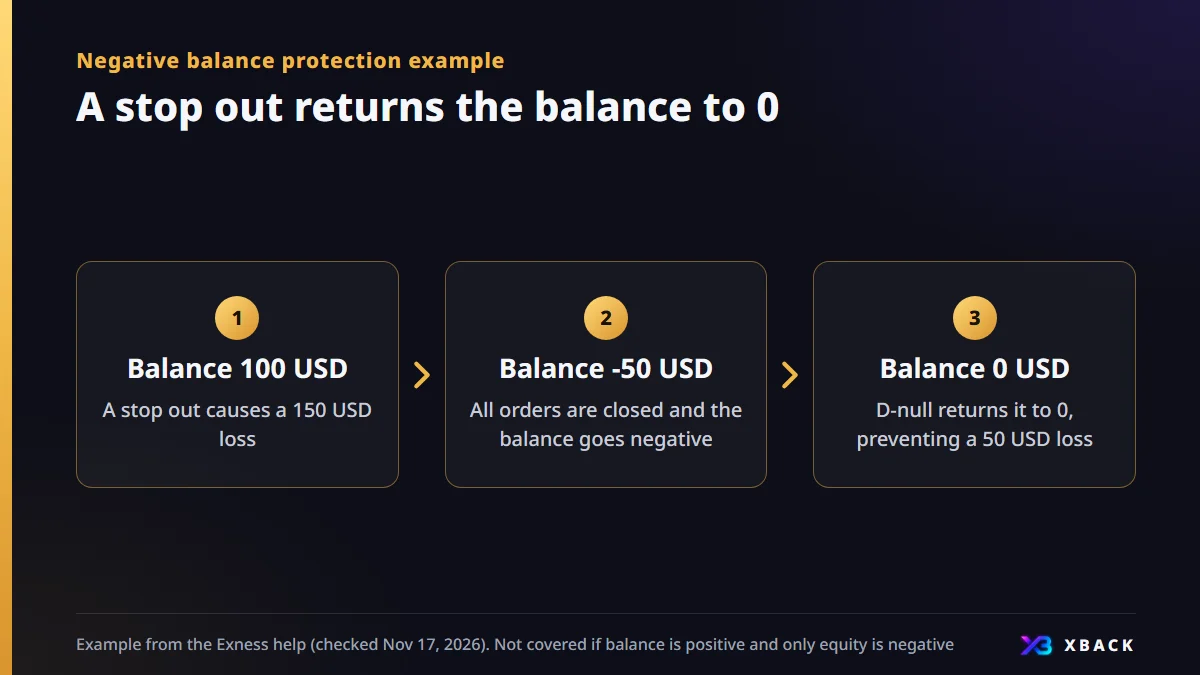
According to the official help, if a stop out leaves your balance negative, it is reset to 0. For how this works across brokers, see What Is Zero Cut?.
- Example: an account with a 100 USD balance takes a 150 USD loss on stop out, leaving -50 USD. Negative balance protection resets it to 0 USD, so you do not owe the 50 USD
- Exness calls this reset "D-null"
- D-null applies when every order on the account has been closed by stop out and the balance is negative
- The account stays active after D-null
There is one important exclusion. If your balance is positive but your equity is negative and you deposit, that negative amount is not covered. The shortfall comes out of your deposit.
The help's example: an account with a 1,000 USD balance and -50 USD equity. Deposit 100 USD and a 50 USD loss is locked in.
If you deposit into an account with a negative balance by mistake, open a ticket in the Support Hub.
Exness sets the stop out at a 0% margin level on all five account types. The help says registrations through the Kenyan and Jordan entities use 20% (checked November 12, 2026). Floating losses can run deep before a stop out, so size your lots to your balance.
Which Exness entity applies, and what residents of Japan should check
What protection you get depends on the entity that holds your account and the regulator behind it. The footer of the Japanese site shows entities including Exness (SC) Ltd (Seychelles FSA, SD025).
| Entity | Regulator | Official wording |
|---|---|---|
| Exness (SC) Ltd | Seychelles FSA | Securities Dealer (registration number 8423606-1, license SD025) |
| Other group entities | Regulators in each country | No list on the public pages; shown on the regulation page after login |
That footer is not a statement of which entity contracts with residents of Japan. The first step in judging how safe Exness is for you is pinning down the entity that holds your account.
- Save the account opening screens and the entity shown in your Personal Area
- Read the client agreement of your entity for how funds are held and what happens on insolvency
- The help itself says it does not change or replace the agreement. The agreement takes precedence
- Ask Exness support whether the Financial Commission fund extends to your entity
Practical steps to avoid withdrawal trouble at Exness
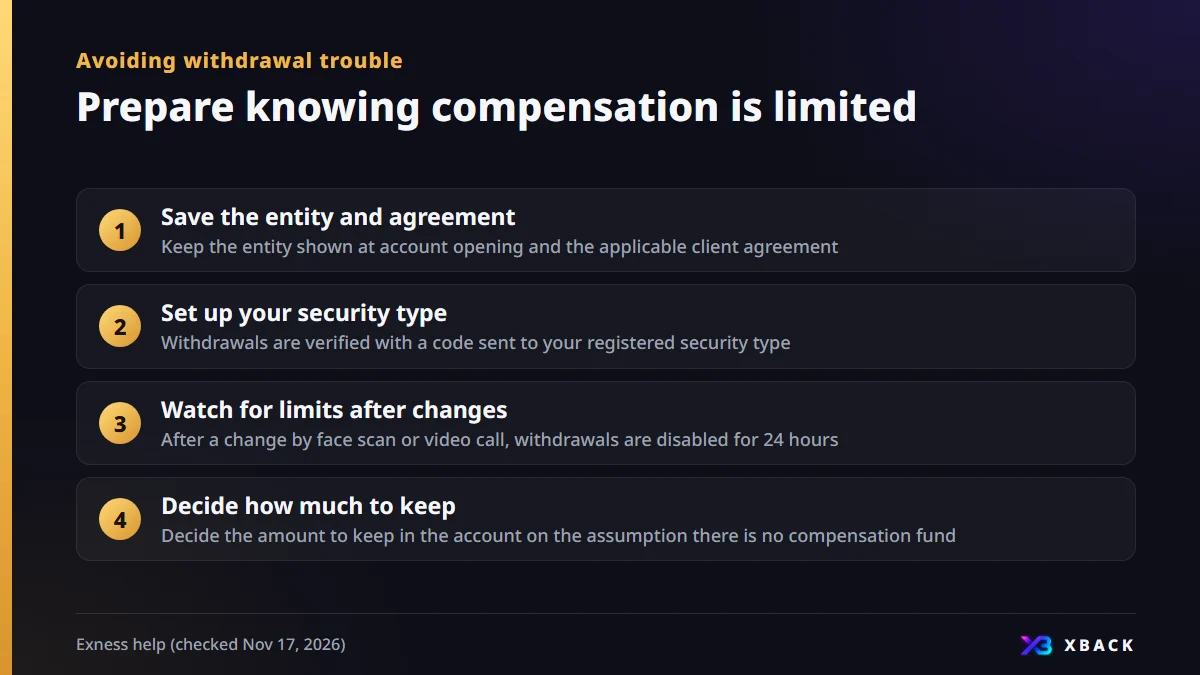
With limited compensation available, how much you keep in the account and how you handle withdrawals are your real safeguards. Here is what the official pages say.
- 1
Save the entity and agreement
Keep the entity shown at account opening and the applicable client agreement
- 2
Set up your security type
Withdrawals are verified with a code sent to your registered security type
- 3
Watch for limits after changes
After a change by face scan or video call, withdrawals are disabled for 24 hours
- 4
Decide how much to keep
Decide the amount to keep in the account on the assumption there is no compensation fund
The rules on when a security type change blocks withdrawals are in the official help article "Security types". For withdrawal steps and timing, see Exness Withdrawal Rules and Timing.
FAQ
Q.Is Exness safe?
What the public pages confirm is the Seychelles FSA license held by Exness (SC) Ltd (SD025), segregation of client funds, and negative balance protection that resets the balance to 0 after a stop out. There is no government-backed compensation fund. None of this guarantees safety, so check your entity's client agreement.
Q.Does Exness have a compensation fund?
The official help states there is no government-backed compensation fund or similar scheme. The Financial Commission fund pays out on that body's rulings and is capped at €20,000 per client. It does not cover broker insolvency, so it is not an Exness compensation amount.
Q.Is my balance protected up to €20,000?
No. €20,000 is the cap on payments under Financial Commission rulings, not a guarantee on your account balance. The public pages also do not say which Exness entity it applies to.
Q.If Exness fails, will I get my money back?
The official pages do not say. The help only states that the applicable laws and the regulator's procedures apply, without saying how much would be returned or in what order. Check your client agreement.
Q.Which entity holds accounts of residents of Japan at Exness?
The public pages do not say. The Japanese site footer shows Exness (SC) Ltd (Seychelles FSA, SD025), but that is not a statement of the contracting entity. Check the screens at account opening.
Sources
- Exness Help: Is my money secure in an Exness trading account? (Japanese) (checked 2026-11-17)
- Exness Help: Is my money secure in an Exness trading account? (English) (checked 2026-11-17)
- Exness Help: Negative Balance Protection (Japanese) (checked 2026-11-17)
- Exness Help: Negative Balance Protection (English) (checked 2026-11-17)
- Exness Help: Security types (English) (checked 2026-11-17)
- Exness official website (footer of the Japanese page) (checked 2026-11-17)
- Financial Commission: Compensation Fund (checked 2026-11-17)
- Exness Regulation (checked 2026-10-22)
- Exness Help: Margin call and stop out (Japanese) (checked 2026-11-12)

This article is for information purposes only and is not investment advice. Conditions may change, so please check each broker's official page for the latest information. Offshore FX and CFD trading carries a risk of losses exceeding your principal.