Offshore FX Stop-Out Levels Compared: Margin Call by Account at 6 Brokers
You want a broker that is less likely to stop you out, but the levels differ by account and are hard to compare. Sound familiar?
We compared 6 brokers (XS, HFM, Axi, Exness, DecodeFX and Monaxa) using their official statements. The stop-out level is lowest at 0% for Exness and HFM's KATANA, and 20% for most accounts.
This article gives a list by account type and a USD example of how the level affects the price move you can absorb.
Key takeaways
- In XB's check, the stop-out is 0% at Exness (excluding the KE and Jordan entities) and HFM's KATANA, the lowest of the 6 brokers.
- XS Standard, HFM (other than KATANA), Axi (MT4 and MT5) and Monaxa are 20%, and DecodeFX lists both 30% and 50%.
- In the example of 400 USD required margin and 1,000 USD balance, you can absorb 92 pips at 20% and 100 pips at 0%.
Short answer: which offshore FX brokers have the lowest stop-out level?
- The lowest stop-out level is 0% at Exness and HFM's KATANA. Exness KE and Jordan entities are 20%, though. Next is 10% for XS's Cent
- XS Standard, Pro, Elite, Extra and Classic, HFM accounts other than KATANA, Axi (MT4 and MT5) and Monaxa are 20%
- DecodeFX lists both 30% and 50% in different official places. Axi's Axi Trading Platform is 50%
- The margin call level is 60% at Exness (30% for pro-type accounts), 50% at HFM and Monaxa, and 40% at XS. DecodeFX's PDS and Axi's notice are 100%
- A lower level delays forced closing, but the position is closed after the floating loss has grown deeper. Zero cut treatment also differs by broker
Margin call and stop-out levels at 6 offshore FX brokers, by account type
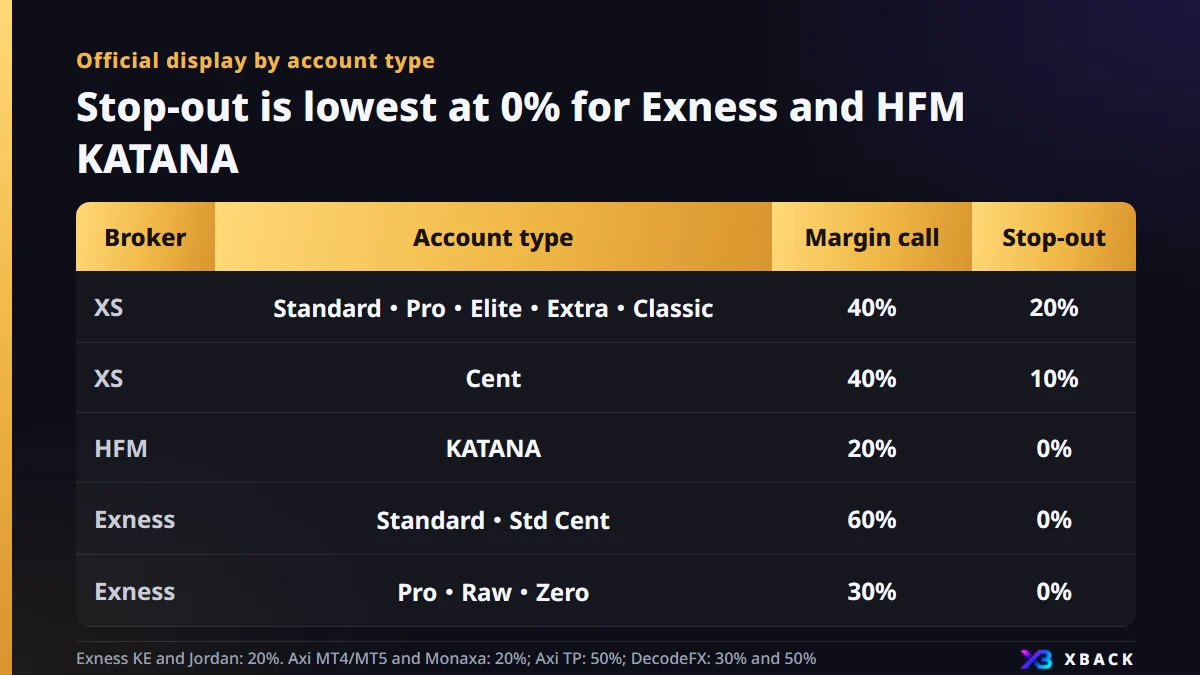
The levels below come from each broker's official account pages, help pages and terms, listed by account type. The zero cut column is explained in detail in the next section.
| Broker | Account type | Margin call | Stop-out | Zero cut |
|---|---|---|---|---|
| XS | Standard, Pro, Elite・Extra・Classic | 40% | 20% | Negative balance protection policy stated (entity not specified) |
| XS | Cent | 40% | 10% | Same as above |
| HFM | Premium, Cent, Zero, Pro, Top-Up Bonus | 50% | 20% | Negative balances reset to zero automatically (conditions in the terms) |
| HFM | KATANA | 20% | 0% | Same as above |
| Axi | Standard, Premium, Elite (MT4, MT5) | Notice below 100% | 20% | Not covered for SVG clients |
| Axi | Axi Trading Platform | Notice below 100% | 50% | Same as above |
| Exness | Standard Cent, Standard | 60% | 0% | Reset to 0 if the stop-out leaves a negative balance |
| Exness | Pro, Raw Spread, Zero | 30% | 0% | Same as above |
| DecodeFX | STD, PRO, CENT (per-account figures not found) | 100% (PDS) | 30% (product page) / 50% (Japanese account page FAQ, English FAQ, PDS) | Officially listed differently |
| Monaxa | Standard, Pro, Zero, Cent | 50% | 20% | The page says “no loss beyond the deposit”; the terms say it is discretionary |
Exceptions not in the table are written in the official materials.
- Exness: for accounts registered with Exness (KE) Limited or the Jordan entity, the stop-out is 20%. For stocks, it can rise to 100% outside trading hours
- Monaxa: for bonus accounts, the stop-out may be raised to 30% or more during the offer period (official bonus FAQ)
- DecodeFX: the terms (T&C 10.4) say the company can change margin rates and stop-out levels according to market movements and other factors
- Axi: the official help has no dedicated margin call %. A notice is sent below 100%, and users are told to manage this themselves rather than rely on the notice
For some brokers, the entity that applies to residents of Japan cannot be confirmed on public pages. Check the entity you contract with on the sign-up screen and in the terms.
How does zero cut treatment differ across the 6 brokers?
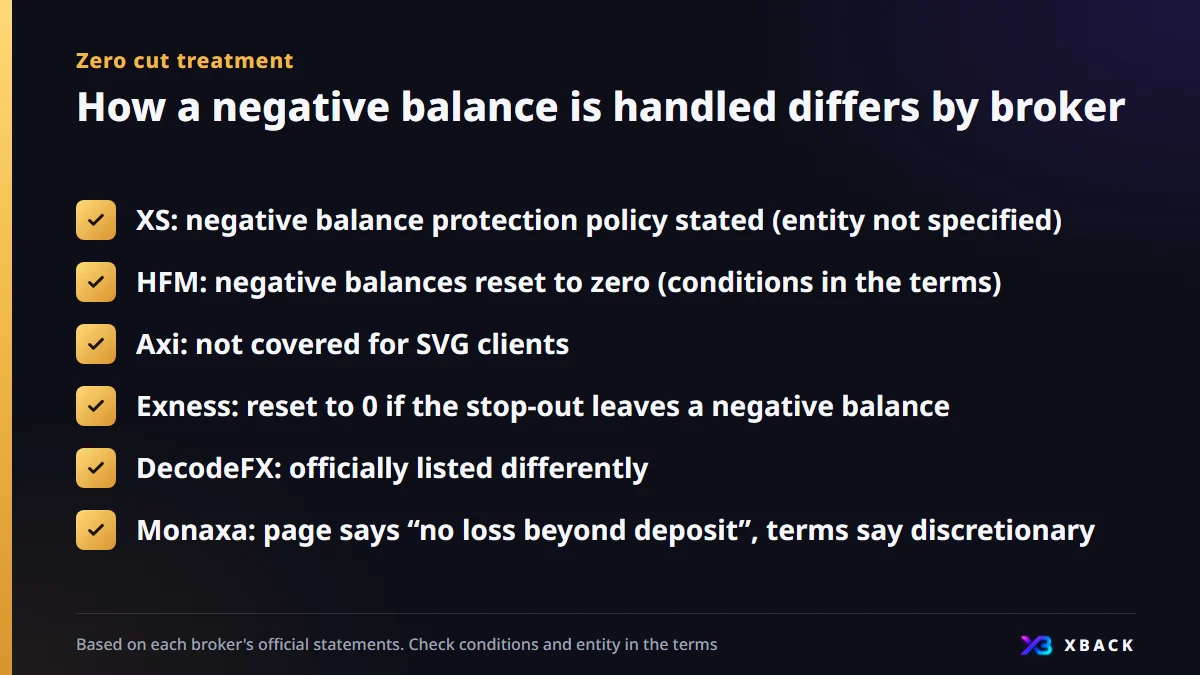
A low stop-out level tells you nothing about what happens if the balance goes negative. Here is what each of the 6 brokers officially says.
- XS: the official help says a negative balance protection policy applies. It does not say which entity's policy
- HFM: it states that a negative account balance is automatically reset to zero. The applicable entity and conditions need to be checked in the terms
- Axi: the official help states that clients trading under the SVG license are not covered by negative balance protection
- Exness: if the stop-out leaves a negative balance, it is returned to 0. If you deposit into an account with a positive balance but negative equity, that negative amount is not covered
- DecodeFX: the Japanese account page says “provided, on request each time”, and the English account page says “Yes”. The English FAQ says “not automatic on MT4 accounts, judged individually”
- Monaxa: the account page says “you will not lose more than your deposit”. Trading terms 22.9 say the company grants it at its discretion and it is not a legal right
Where protection does not apply, as with Axi, any loss beyond your deposit is yours to cover. See What Is Zero Cut in Offshore FX? for how it works.
How do stop-out level differences affect the price move you can absorb?
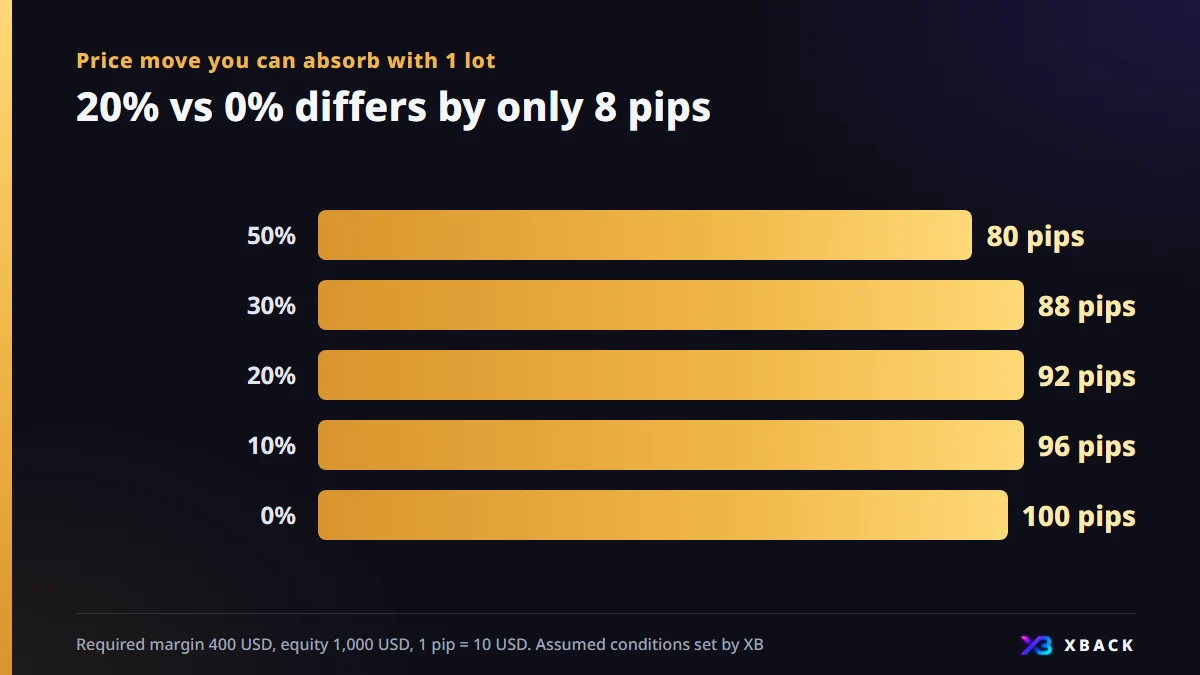
A stop-out happens when the margin level (equity ÷ required margin × 100) falls below the level. With the level as S%, the floating loss you can absorb before forced closing is given by the formula below.
Allowable loss = equity − (required margin × S%). The conditions below are assumptions set by XB, not an official example.
- Buy EURUSD; 1 pip is 10 USD per lot (20 USD for 2 lots)
- Required margin is 400 USD per lot. Balance and equity are 1,000 USD, with no other positions
- Equity falls only through floating loss; commissions, swaps and slippage are ignored
First, holding 1 lot (required margin 400 USD, margin level 250%).
| Stop-out level | Equity at forced closing | Floating loss you can absorb | Price move against you |
|---|---|---|---|
| 50% (Axi Trading Platform, DecodeFX FAQ) | 200 USD | 800 USD | 80 pips |
| 30% (DecodeFX product page) | 120 USD | 880 USD | 88 pips |
| 20% (XS Standard, Extra, Classic, HFM, Axi MT4/MT5, Monaxa) | 80 USD | 920 USD | 92 pips |
| 10% (XS Cent) | 40 USD | 960 USD | 96 pips |
| 0% (Exness, HFM KATANA) | 0 USD | 1,000 USD | 100 pips |
The gap between 20% and 0% is 80 USD, or 8 pips. With the same 1 lot, the difference in level was less than 10% of the price move.
Next, holding 2 lots with the same 1,000 USD (required margin 800 USD, margin level 125%). The required margin is below equity, so this position can actually be opened.
| Stop-out level | Equity at forced closing | Floating loss you can absorb | Price move against you |
|---|---|---|---|
| 50% | 400 USD | 600 USD | 30 pips |
| 30% | 240 USD | 760 USD | 38 pips |
| 20% | 160 USD | 840 USD | 42 pips |
| 10% | 80 USD | 920 USD | 46 pips |
| 0% | 0 USD | 1,000 USD | 50 pips |
Double the lots and the room you have even at 0% is cut in half, from 100 pips to 50 pips. The gap between 20% and 0% is still 8 pips at 2 lots.
Because the total room shrinks to 42 and 50 pips, though, those 8 pips make up a bigger share of it.
The 2 lots in this example open at a margin level of 125%. That sits above HFM and Monaxa at 50% and XS at 40%, and also above the 100% used for Axi's notice and in the DecodeFX PDS.
- Even if the level falls from 20% to 0%, the price move gained is only a few pips. The number of lots matters more
- Even at a broker with a low level, adding lots makes the price move you can absorb shrink quickly
- 0% means forced closing never arrives until the very end, and the loss can grow to the full equity
Actual required margin changes with the instrument, price and leverage. The guide below shows how to run the numbers for your own position.
It covers how to work out required margin, equity and margin level, and a calculation example of the price move before stop-out.
See the margin level calculationWhat should you watch for when comparing stop-out levels?
- The stop-out is the broker's level, not a mechanism that protects your losses. In a 0% account, nothing is forcibly closed until the balance runs out
- The margin call is a warning level, not forced closing itself. See Margin Call vs Stop-Out for the difference
- Around economic releases or weekend gaps, positions may not close at the level's price. Whether the balance then goes negative depends on the zero cut treatment
- The level can change by account type, registered entity, bonus accounts and instrument. Check the value for your own account on the account screen or in the terms
- The higher the leverage, the smaller the required margin. Even with the same level, you do not get room in price move unless you keep lots down
For the wider picture, read How to Choose an Offshore FX Broker. For position sizing, Lot Size by Capital is a useful guide.
Each broker's account types and where to check the official trading conditions are on the broker pages.
See supported brokersFAQ
Q.Which offshore FX brokers have a low stop-out level?
In XB's check in November 2026, Exness and HFM's KATANA have the lowest level at 0%. Next is XS's Cent at 10%, and Exness is 20% for the KE and Jordan entities. Note that the lower the level, the deeper the floating loss tends to get.
Q.What is the difference between a margin call and a stop-out?
A margin call is the level for a warning or notice when the margin level falls, and a stop-out is the level at which forced closing begins. At offshore FX brokers, the stop-out is often set lower, such as a 50% margin call and a 20% stop-out.
Q.Does the stop-out level change by account type?
It depends on the broker. XS is 10% for Cent and 20% for the others. HFM is 0% only for KATANA. Exness has a margin call of 60% for standard-type accounts and 30% for pro-type. Monaxa is shown as 20% for all 4 accounts.
Q.Does a 0% stop-out level make zero cut more likely?
Even at 0%, the balance does not always go negative. Whether the balance is restored when it goes negative depends on the zero cut treatment. Exness says it returns a negative balance to 0 after a stop-out, but the conditions differ by broker and entity.
Q.With the same margin, can I hold on longer at a broker with a lower stop-out level?
The lower the level, the larger the floating loss you can absorb. In the example of 400 USD required margin and 1,000 USD equity, it is 92 pips at 20% and 100 pips at 0%. The gap is 8 pips, and the effect of lots is larger.
Q.How do the margin call levels of offshore FX brokers differ?
XS is 40%, HFM and Monaxa are 50%, and Exness is 60% for standard-type and 30% for pro-type. Axi sends a notice below 100%, and the DecodeFX PDS says 100%. Levels may change (values confirmed in November 2026).
Sources
- XS Official Page “Standard Account” (Japanese; margin call 40% / stop-out 20%) (checked 2026-11-19)
- XS Official Page “Cent Account” (Japanese; 40% / 10%) (checked 2026-11-19)
- XS Official Page “Pro Account” (Japanese; 40% / 20%) (checked 2026-11-19)
- XS Official Page “Elite Account” (Japanese; 40% / 20%) (checked 2026-11-19)
- XS Official Page “Extra Account” (English; margin call 40% / stop-out 20%) (checked 2026-11-24)
- XS Official Page “Classic Account” (English; margin call 40% / stop-out 20%) (checked 2026-11-24)
- XS Official Page “Extra Account” (English; margin call 40% / stop-out 20%) (checked 2026-11-24)
- XS Official Page “Classic Account” (English; margin call 40% / stop-out 20%) (checked 2026-11-24)
- XS Help Center “Client Protection” (negative balance protection policy; value confirmed in the existing xs-safety article) (checked 2026-10-22)
- HFM Official Page “Trading Account Types” (Japanese) (checked 2026-11-19)
- HFM Official Page “KATANA Account” (Japanese) (checked 2026-11-19)
- HFM Security of Funds (treatment of negative balances) (checked 2026-11-19)
- Axi Help “Stop Out” (20% for MT4 and MT5, 50% for Axi Trading Platform) (checked 2026-11-19)
- Axi Help “What Is a Margin Call” (notice below 100%) (checked 2026-11-19)
- Axi Help “Negative Balance and Negative Balance Protection” (SVG clients not covered; value confirmed in the existing axi-safety article) (checked 2026-10-22)
- Exness Help Center “Margin Call and Stop Out” (checked 2026-11-19)
- Exness Help Center “Stop Out” (checked 2026-11-19)
- Exness Help Center “Negative Balance Protection” (Japanese) (checked 2026-11-19)
- DecodeFX Official Page “Trading Accounts” (Japanese; zero cut display and the 50% stop-out FAQ) (checked 2026-11-17)
- DecodeFX Official Page “FAQ (Funds)” (English; 50% stop-out and negative balance protection) (checked 2026-11-17)
- Decode Global Limited Product Disclosure Statement (dated June 21, 2021; 5.7 and 5.8) (checked 2026-11-17)
- Decode Global Limited Terms and Conditions (dated June 21, 2021; 10.4) (checked 2026-11-17)
- Monaxa Official “Account Types” (Japanese; 50% / 20% and the zero cut notice) (checked 2026-11-19)
- Monaxa Official Support and FAQ (Japanese; margin call 50% / stop-out 20%; reset of negative balances) (checked 2026-11-19)
- Monaxa Official Bonus FAQ (Japanese; stop-out for bonus accounts) (checked 2026-11-18)
- Monaxa Terms of Business (English; 22.9) (checked 2026-11-18)

This article is for information purposes only and is not investment advice. Conditions may change, so please check each broker's official page for the latest information. Offshore FX and CFD trading carries a risk of losses exceeding your principal.