Monaxa Account Types Compared: Which of the 4 Accounts to Choose?
Monaxa offers several accounts. Not sure which one to open?
In short: Standard if you want no commission, Pro if spreads matter most. On minimum figures, Zero has the lowest total cost per lot, and Cent is there for small-stakes practice.
Using Monaxa's account types page (checked November 19, 2026), we compare the four accounts, then set the cost per lot against XB's cashback.
Key takeaways
- Monaxa has 4 accounts: Standard, Pro, Zero and Cent. Only Zero charges a commission.
- The minimum first deposit is $15 for Standard and Cent, $50 for Pro and $200 for Zero.
- The official pages suggest Standard first, Cent for small amounts, Pro for low spreads and Zero for EAs.
Short answer: Monaxa has 4 account types. Choose by cost structure and deposit amount
- There are 4 account types: Standard, Pro, Zero and Cent, all tradable on MT4 or MT5
- Minimum first deposit: $15 for Standard and Cent, $50 for Pro, $200 for Zero
- Only Zero charges a commission ($3.50 per side). On the others, the spread is your cost
- Only Cent has a 1,000 contract size and a cent-denominated base currency. It covers FX and metals
- Monaxa calls Standard its most popular account and suggests Cent for practice, Pro for tight spreads, and Zero for scalping and EAs
What are the differences between Monaxa account types? Comparing the 4 accounts
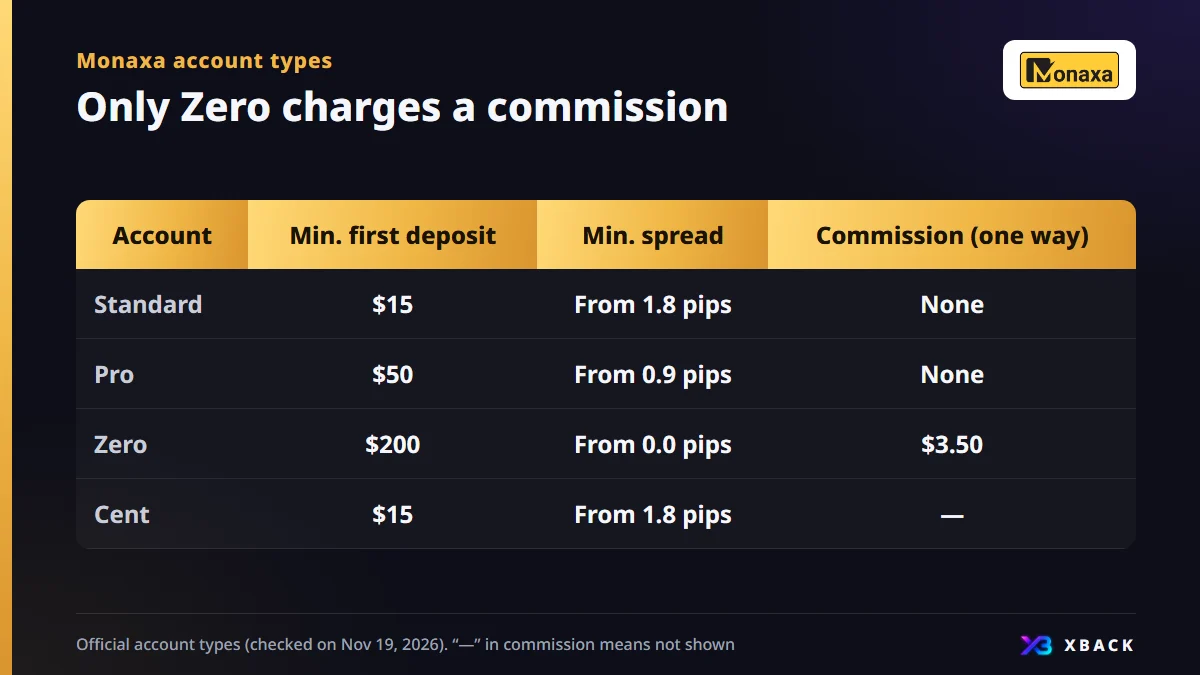
These are the items on Monaxa's account types page that actually differ between accounts.
| Account | Minimum deposit (first) | Minimum spread | Commission (per side) | Max leverage | Contract size |
|---|---|---|---|---|---|
| Standard | $15 | From 1.8 pips | None | 1:2000* | 100,000 |
| Pro | $50 | From 0.9 pips | None | 1:2000* | 100,000 |
| Zero | $200 | From 0.0 pips | $3.50 | 1:2000* | 100,000 |
| Cent | $15 | From 1.8 pips | — | 1:1000 | 1,000 |
| Account | Base currency | Instruments | Max open positions |
|---|---|---|---|
| Standard, Pro, Zero | USD, EUR, GBP, JPY | FX, indices, metals, energies, stock CFDs, crypto, ETFs | 200 |
| Cent | USC, ZARC (cents) | FX, metals | 100 |
What do all 4 Monaxa accounts have in common?
- Platforms: MT4 and MT5 on all four
- Minimum lot size: 0.01 on all four
- Margin call / stop out: shown as “50% / 20%” on all four
- Negative balance protection: the account types page says you cannot lose more than you deposit (the Terms of Business make it discretionary)
- You can hold Standard, Pro, Zero and Cent under one profile at the same time, and move funds between them from $1 (official FAQ)
Monaxa describes the execution and client protection as the same across accounts. What changes is the cost structure, deposit, contract size and instrument range.
Which Monaxa account is best? Choosing by trading style
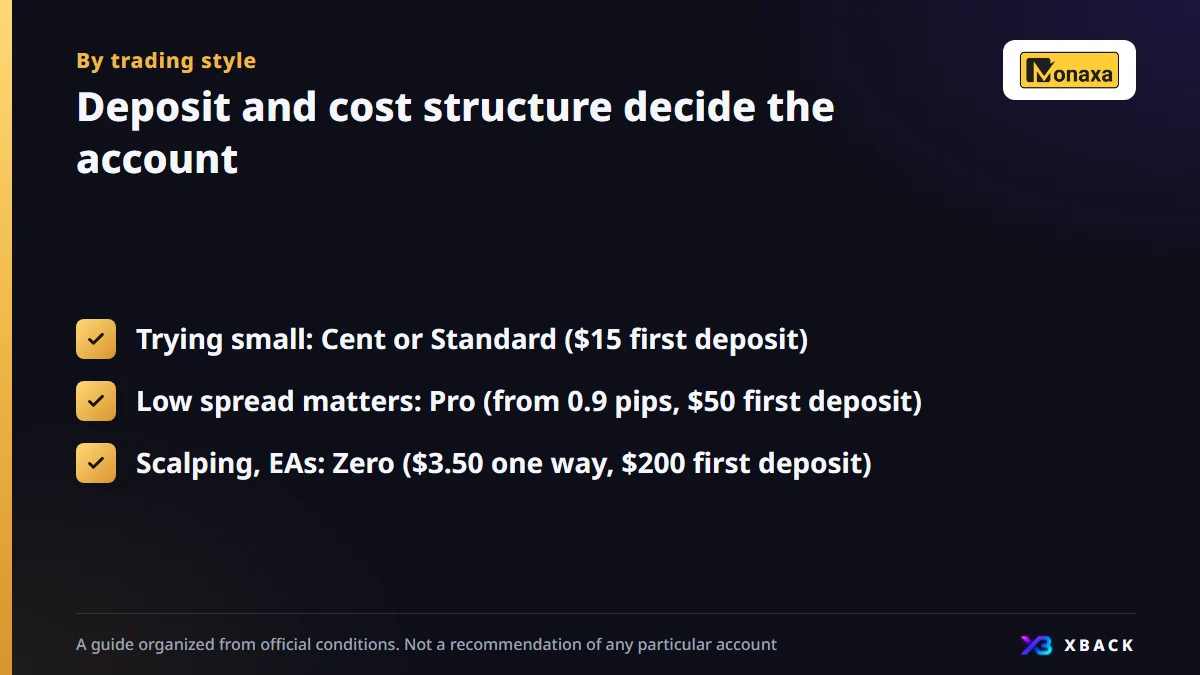
| Trading style | Candidate accounts | What the official conditions tell us |
|---|---|---|
| Trying it with a small deposit | Cent, Standard | Minimum first deposit is $15. Monaxa suggests Cent for practice |
| Starting with no commission | Standard | No commission, all instruments. The FAQ calls it the most popular |
| Tighter spreads for discretionary trading | Pro | No commission, from 0.9 pips. First deposit $50 |
| Scalping and EAs | Zero | From 0.0 pips plus $3.50 per side. First deposit $200. The terms set conditions on short-term trades and EAs |
Starting small: Cent or Standard?
Both need a $15 first deposit. The difference is that Cent is a cent-denominated account with a 1,000 contract size, and it only covers FX and metals.
Monaxa recommends Cent for small-stakes practice. If you also want indices or crypto, Standard's wider range is the better fit.
Cent also caps leverage at 1:1000, versus 1:2000* on the other three. Its lot is a different size, so don't size positions the way you would on the other accounts.
Discretionary trading: Standard or Pro?
Neither charges a commission, so the spread is your cost. Standard starts at 1.8 pips and Pro at 0.9 pips.
In return, Pro needs a $50 first deposit, and Monaxa points spread-focused traders to it. These are minimum spreads; live values vary by instrument and time of day.
Is the Zero account the one for scalping and EAs?
Zero charges a $3.50 per-side commission instead of a spread markup. Monaxa markets it as the account for scalping and EAs.
Clause 9.11 of the Terms of Business does set conditions on short-term trading and EAs, though. Check these two points before choosing Zero.
- If trades closed within 120 seconds exceed 10% of your total, they may be voided or adjusted
- EA use may require approval. Hyper EAs and latency-arbitrage EAs are not allowed
Monaxa's support FAQ simply says EAs “can be used”, which reads differently from the terms. We cover the key terms in Monaxa reviews and terms.
Does XB cashback change by Monaxa account type?
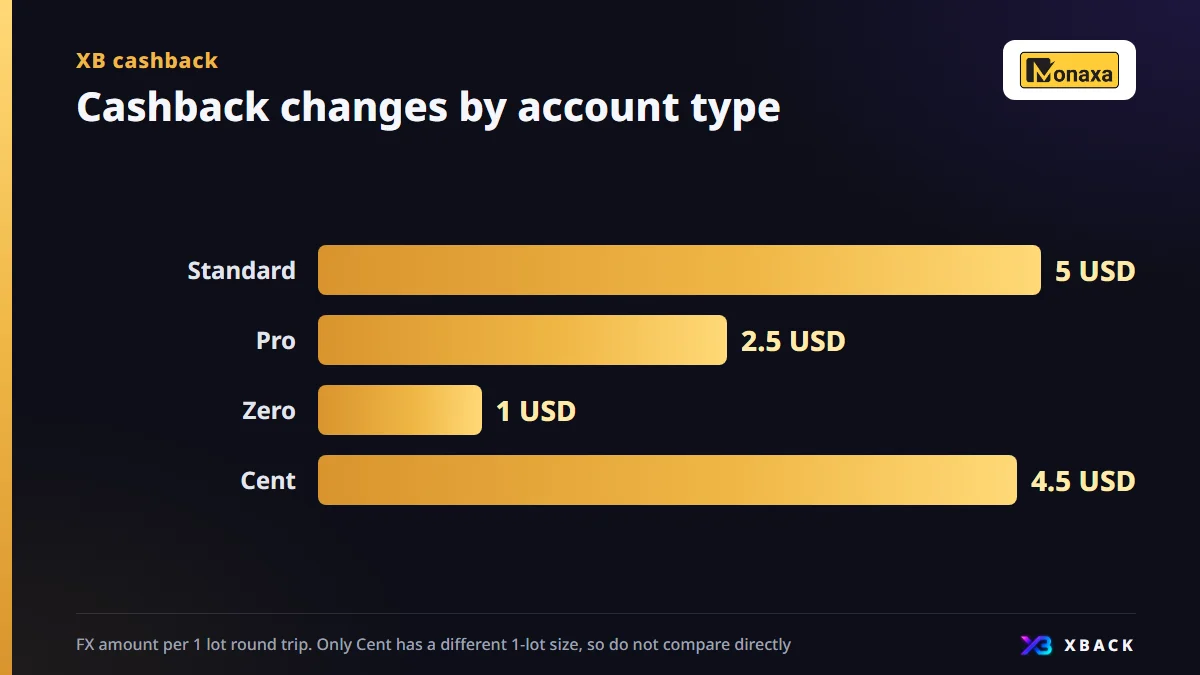
Yes. XB's Monaxa cashback went live on November 18, 2026, and the amount depends on account type and instrument class. For FX it is:
| Account | FX cashback (per lot, round turn) |
|---|---|
| Standard | 5 USD |
| Pro | 2.5 USD |
| Zero | 1 USD |
| Cent | 4.5 USD |
Standard, Pro and Zero all use 1 lot = 100,000 units. Here is the minimum cost of 1 lot next to the cashback.
| Account | Minimum cost per lot (round turn) | FX cashback | Net |
|---|---|---|---|
| Standard | 18 USD (1.8 pips) | 5 USD | 13 USD |
| Pro | 9 USD (0.9 pips) | 2.5 USD | 6.5 USD |
| Zero | 7 USD (0.0 pips + $3.50 × 2) | 1 USD | 6 USD |
Standard pays the most cashback, but Pro and Zero come out lower on a net basis. The cost maths is in Monaxa spreads and commission, and amounts for metals and more are in Monaxa cashback.
What should you watch for when choosing a Monaxa account type?
- The spreads on the account types page are minimums. There is no per-instrument table
- Max leverage of 1:2000 carries a “conditions apply” note. Monaxa's leverage page says it varies by account type, instrument, equity and trade size
- Monaxa's pages disagree on whether you can switch account type later (see below)
The account types page says you can switch at any time to suit your strategy. Monaxa's help centre, however, says an existing account's type cannot be changed and tells you to add a new account of the type you want.
If you can't decide, one approach is to start with Standard and add Pro or Zero to the same profile later. See how to open a Monaxa account for the steps.
Conditions and cashback for each account type are on the Monaxa broker page.
See eligibility and cashback by Monaxa account typeFAQ
Q.Which Monaxa account is recommended?
Monaxa's FAQ names Standard (no commission, $15 minimum) as its most popular account. It suggests Cent for practice, Pro for tight spreads, and Zero for scalping and EAs.
Q.Can I scalp on a Monaxa Zero account?
Monaxa markets Zero for scalping and EAs. However, Terms of Business clause 9.11 says trades may be voided or adjusted if those closed within 120 seconds exceed 10% of your total.
Q.Can I hold more than one Monaxa account type at once?
Monaxa's FAQ says you can hold all four under one profile and move funds between them from $1.
Q.Can I change my Monaxa account type later?
Monaxa's pages disagree. The account types page says you can switch at any time, while the help centre says an existing account's type cannot be changed. Adding a new account of the type you want is the safe route.
Sources
- Monaxa official page: Account Types (Japanese) (checked 2026-11-19)
- Monaxa official help & FAQ (checked 2026-11-18)
- Monaxa Terms of Business (PDF) (checked 2026-11-18)
- Monaxa Partner Agreement (PDF) (checked 2026-11-18)

This article is for information purposes only and is not investment advice. Conditions may change, so please check each broker's official page for the latest information. Offshore FX and CFD trading carries a risk of losses exceeding your principal.